Is The Cordless Drill Becoming Obsolete?
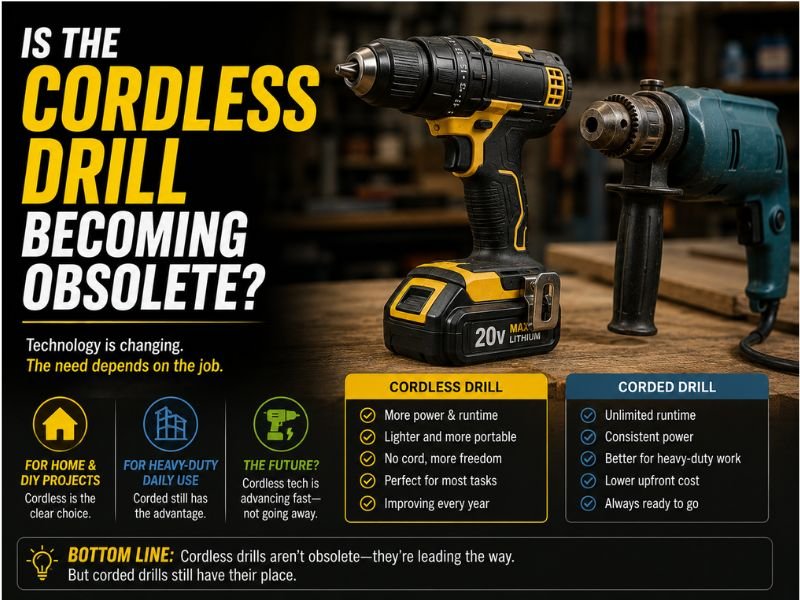
No. The cordless drill is not becoming obsolete; it is becoming more specialized as impact drivers and other cordless tools take over some jobs that drills once handled by default.
The distinction matters. Twenty years ago, a cordless drill was commonly expected to drill holes, install screws, remove fasteners, bore through framing, and handle almost any rotating accessory that fit its chuck. Today, a contractor or serious DIYer may reach for an impact driver for screws, a rotary hammer for concrete, a right-angle drill for rough-ins, and a specialty installation driver for confined spaces.
That does not leave the drill without a purpose. It leaves it doing the jobs it is particularly good at: controlled drilling, accurate hole making, accepting a broad range of bit shanks, driving fasteners with clutch control, and handling applications where smooth rotational power is preferable to impact action.
Current tool development also gives little indication that manufacturers view the drill as a disappearing category. Makita introduced a new 40V max XGT 3-speed driver-drill in July 2026, while DEWALT, Milwaukee, and Bosch continue to maintain current professional cordless drill/driver lines.
So why does the cordless drill sometimes feel less important than it used to? The answer has more to do with specialization than obsolescence.
Why People Think the Cordless Drill Is Becoming Obsolete
The biggest reason is the rise of the cordless impact driver.
For years, many users drove screws with the same drill they used to make holes. A drill/driver’s clutch made that possible, and for light work it still works well.
But impact drivers have become increasingly capable fastening tools. Modern models combine compact bodies, 1/4-inch quick-change hex holders, high fastening torque, multiple drive modes, and rapid impact mechanisms that are particularly useful when driving long or resistant fasteners. Bosch’s current 18V GDR18V-215, for example, is specifically designed around fastening and uses a 1/4-inch quick-change hex drive with multiple speed and automatic driving modes.
Once someone owns both tools, a natural division develops:
Drill the hole with the drill. Drive the screw with the impact driver.
That workflow is so established that manufacturers continue to sell drill/driver and impact-driver combination kits. DEWALT currently pairs a 1/2-inch hammer drill with an impact driver in new professional kits, while Milwaukee offers drill/driver and impact-driver kits on its M18 platform.
The drill has therefore lost some fastening work, but losing one role is not the same as becoming obsolete.
The Impact Driver Changed the Cordless Drill’s Job
An impact driver and drill overlap, but their designs emphasize different tasks.
A conventional drill/driver provides smooth rotary output through an adjustable chuck. That chuck can accept many round-shank and hex-shank accessories.
An impact driver typically uses a fixed 1/4-inch hex holder and adds repeated rotational impacts when fastening resistance increases. Bosch’s current professional impact-driver design, for example, combines a 1/4-inch quick-change holder with rotational impact output specifically for driving applications.
That makes the impact driver especially attractive for:
- Deck screws
- Structural screws
- Long wood screws
- Repetitive fastening
- Cabinet installation
- Framing hardware
- Fasteners in dense lumber
For those jobs, the cordless drill is no longer automatically the first tool many professionals reach for.
But an impact driver is not simply a better drill.
Its 1/4-inch hex interface limits the accessories it accepts directly, and its impact mechanism is unnecessary—and sometimes undesirable—for controlled hole drilling.
This is why the two tools continue to coexist.
Why the Cordless Drill Is Still Hard to Replace
The drill’s greatest advantage is not maximum fastening torque.
It is versatility combined with control.
A standard drill/driver gives the user an adjustable chuck, variable speed, mechanical gearing, and usually a torque-limiting clutch for fastening. Current professional cordless drills continue to use this basic architecture while adding more powerful motors and electronics. DEWALT’s current DCD801, Milwaukee’s M18 FUEL drill/driver, Bosch’s current 18V drill lineup, and Makita’s new GFD03 all demonstrate continued development of the format.
Those features give a drill several advantages that an impact driver cannot fully duplicate.
A Drill Accepts More Types of Bits
One of the cordless drill’s most important advantages is easy to overlook: the adjustable chuck.
Professional 18V and 20V-class drills commonly use a 1/2-inch chuck. Bosch, for example, describes its current 18V professional drill/drivers as using 1/2-inch chucks for demanding drilling and driving applications.
That chuck can accept numerous accessory types, including many:
- Twist drill bits
- Brad-point bits
- Masonry bits where applicable
- Forstner bits within tool capacity
- Hole saw arbors
- Countersinks
- Step bits
- Spade bits
- Nut drivers
- Driver bits
- Wire brushes where appropriate
- Other round- or hex-shank accessories
An impact driver generally requires a compatible 1/4-inch hex-shank accessory unless an adapter is used.
That difference alone keeps the drill highly relevant.
Drills Are Better for Precision Hole Making
Impact force is useful when a stubborn screw does not want to turn.
It is not automatically useful when you want a clean, accurately placed hole.
A drill provides continuous rotation that can be controlled through its trigger and gearbox. That makes it more natural for operations such as:
- Starting a small hole accurately
- Drilling sheet metal
- Making pilot holes
- Countersinking
- Drilling furniture parts
- Using brad-point bits
- Boring holes where edge quality matters
The latest drill designs continue to emphasize speed control rather than abandoning it. Makita’s 2026 GFD03 uses a three-speed transmission with separate low-, medium-, and high-speed ranges plus an electronic clutch and variable-speed trigger.
Those are not features of a tool category approaching extinction. They are refinements aimed at making drilling more controllable.
The Clutch Still Makes the Drill Valuable for Small Fasteners
Impact drivers are excellent at fastening, but maximum force is not always desirable.
Small screws used in:
- Furniture
- Cabinet hardware
- Electrical devices
- Hinges
- Fixtures
- Interior trim
- Light assemblies
may benefit from controlled torque rather than repeated impact action.
A drill/driver’s clutch allows the user to set a torque threshold. Once resistance reaches that level, the clutch limits additional drive force.
The exact implementation varies by model. Makita’s newly released GFD03 takes the concept further with an electronic digital clutch providing different torque-setting ranges in each of its three transmission speeds.
For repetitive screws that need to stop at a consistent depth, that kind of control remains a strong reason to use a drill/driver.
Cordless Drills Have Become More Powerful, Not Less Relevant
Another argument against obsolescence is simple: manufacturers are still investing engineering effort in high-performance drill platforms.
Makita released the GFD03 in the United States on July 7, 2026, describing it as its most powerful driver-drill at launch. It uses a 40V max XGT platform, a brushless motor, three mechanical speed ranges, a digital clutch, and a 1/2-inch chuck.
DEWALT continues to sell professional brushless drill/drivers across its 20V MAX platform and currently lists dedicated drill/driver categories alongside hammer drills and other drilling tools.
Milwaukee currently offers M18 FUEL drill/drivers, including versions with ONE-KEY connectivity, while Bosch maintains multiple 18V drill/driver models ranging from compact tools to higher-torque connected units.
The technology is changing, but the basic drill/driver is still being actively developed.
Where Cordless Drills Are Losing Ground
The cordless drill is not obsolete, but several tool categories have taken over applications that used to fall to it.
Repetitive Heavy Fastening
Impact drivers are often the better choice for long screws and repetitive fastening.
Their compact front ends and rotational-impact mechanisms suit high-resistance screw driving, and modern models include increasingly sophisticated fastening modes. Bosch’s current GDR18V-215, for example, includes dedicated automatic modes for wood screws and self-drilling metal screws.
A drill can still drive these fasteners, but there is often little reason to make it do so if an impact driver is available.
Heavy Concrete Drilling
A hammer drill/driver can drill many smaller holes in suitable masonry, but a dedicated rotary hammer is usually the more specialized category for sustained or demanding concrete drilling.
The cordless drill did not disappear here. Instead, the cordless market expanded to include more specialized drilling tools.
Large Plumbing and Electrical Rough-In Holes
Standard drills can use large boring accessories within their rated capacities, but professionals making repeated large holes through studs and joists may choose dedicated stud-and-joist or right-angle drills.
DEWALT currently sells cordless compact stud-and-joist drills specifically for this category of heavy rough-in work.
Again, specialization has removed a task from the ordinary drill without eliminating the drill itself.
Tight-Space Installation Work
Compact installation drivers, right-angle tools, interchangeable-head drills, and specialty fastening tools can work in areas a traditional drill cannot reach comfortably.
Bosch, for example, currently offers an 18V FlexiClick drill/driver system with multiple attachments intended to expand access and application flexibility.
Specialty tools are therefore reducing how often one drill is forced to do everything.
Is the Hammer Drill Replacing the Regular Drill?
In some tool lines, the hammer drill/driver has become a popular all-purpose option because it adds a masonry mode while retaining ordinary drilling and driving functions.
That can make a standard drill/driver seem redundant for someone who owns a good hammer drill.
But hammer capability does not mean the basic drilling function has disappeared. A hammer drill/driver is still fundamentally performing ordinary drill/driver work whenever hammer mode is switched off.
DEWALT and Milwaukee both currently offer dedicated professional hammer drill/drivers alongside standard drill/drivers.
So the hammer drill is better viewed as an expanded version of the drill concept rather than evidence that drilling tools are becoming obsolete.
Is the Impact Driver Replacing the Drill for DIY Users?
Not completely.
For someone buying only one cordless power tool, a drill/driver remains extremely practical because it can both drill holes and drive ordinary screws.
An impact driver is outstanding for fastening, but its standard 1/4-inch hex interface makes it less flexible as a general drilling platform.
A homeowner may need one tool for:
- Hanging shelves
- Drilling wall anchors
- Assembling furniture
- Making pilot holes
- Installing hardware
- Drilling wood
- Drilling metal
- Driving occasional screws
A drill/driver can perform all of those basic tasks with appropriate accessories.
An impact driver becomes more compelling when the user’s projects involve large quantities of screws or heavier fastening.
For this reason, a drill is still a logical first cordless tool for many households, while the impact driver is often the next addition.
Why Professionals Often Carry Both
The drill-versus-impact-driver debate sometimes assumes that one tool has to win.
Professional tool kits demonstrate why that framing is misleading.
DEWALT’s current new professional combo kits deliberately include both a hammer drill and an impact driver, and Milwaukee continues to package compact drill/drivers with impact drivers in the same kit.
That allows a worker to keep:
- A drill bit in the drill
- A driver bit in the impact driver
A common workflow becomes:
- Drill the pilot hole.
- Set down the drill.
- Pick up the impact driver.
- Install the fastener.
No chuck changes are required.
The tools increase each other’s usefulness rather than making one redundant.
The Corded Drill Is More Threatened Than the Cordless Drill
If any traditional drill category has seen its role challenged dramatically, it is arguably the general-purpose corded drill.
Modern battery systems now power drills, impact drivers, rotary hammers, saws, grinders, and other demanding jobsite tools. Makita explicitly describes its XGT system as designed for high-demand cordless applications, while DEWALT and other manufacturers maintain broad battery platforms covering numerous professional tool categories.
Corded drills still make sense in particular continuous-use applications, workshops, or situations where battery management is undesirable.
But the cordless drill itself has benefited from the battery transition rather than being harmed by it.
Brushless Motors Changed What a Cordless Drill Can Do
Older cordless drills were constrained by battery capacity, motor efficiency, size, and weight.
Current professional drills commonly use brushless motors.
DEWALT’s current DCD801 is brushless. Milwaukee’s current M18 FUEL drill/driver uses its brushless motor and electronics platform. Makita’s newly released GFD03 also uses a brushless motor, and Bosch lists numerous brushless models in its current professional drill lineup.
Brushless technology has allowed manufacturers to combine high output with increasingly compact packaging and electronic motor control.
That development has helped cordless drills remain viable even as specialty tools become more common.
Smart Electronics May Define the Next Generation of Drills
The future cordless drill is likely to look familiar externally while becoming increasingly electronic internally.
That transition is already happening.
Makita’s 2026 GFD03 uses a digital clutch that changes its available torque settings depending on gearbox selection.
Milwaukee currently offers a drill/driver with ONE-KEY capability, adding connected tool functions to the conventional drill format.
Bosch currently sells connected-ready drill/drivers that can communicate with supported mobile-tool systems, and some higher-output drill platforms incorporate additional electronic control functions.
DEWALT’s latest high-performance hammer drill packages include anti-rotation technology designed to sense excessive tool rotation and shut the tool down.
This suggests that future competition is not simply about increasing voltage or maximum torque. It is also about improving control.
Could a Single Future Tool Replace Both Drill and Impact Driver?
Manufacturers are certainly trying to broaden tool capabilities.
There are already multi-function products that combine traditionally separate mechanisms. Bosch, for example, currently offers a two-in-one impact driver/wrench with both a 1/4-inch hex interface and a 1/2-inch square drive.
But combining functions involves compromises.
The traditional drill chuck remains valuable because it accepts varied drill-bit shanks. The impact mechanism remains valuable because it is optimized for resistant fastening. A tool designed to do both perfectly would need to preserve the advantages of both interfaces and both power-delivery methods without becoming excessively large, heavy, expensive, or complex.
That is possible in specialized designs, but the continued popularity of drill-plus-impact-driver kits indicates that two optimized tools remain practical today.
When a Cordless Drill Is Still the Best Tool
Choose a cordless drill when you need:
- Precise pilot holes
- Standard round-shank drill bits
- Controlled metal drilling
- Clean woodworking holes
- Adjustable clutch settings
- Countersinking
- Small or delicate screw driving
- Hole saws within the drill’s rated capacity
- Broad accessory compatibility
- Smooth rotational power instead of impacts
Choose an impact driver when the job centers primarily on repetitive or high-resistance screw driving.
Choose a rotary hammer for sustained heavy masonry drilling.
Choose a right-angle or stud-and-joist drill when large holes and limited access make a conventional drill awkward.
The modern jobsite increasingly rewards using the correct specialized tool rather than asking one drill to perform every possible task.
Should You Still Buy a Cordless Drill?
For most DIYers and many professionals, yes.
If you already own an impact driver and primarily install screws, you may use your drill less frequently than you once would have.
But consider how many common operations still begin with making a hole.
A drill remains useful for:
- Furniture projects
- Carpentry
- Electrical work
- Metalworking
- Cabinet installation
- General repairs
- Maintenance
- Construction
- Remodeling
If budget allows, the most flexible setup is often a drill/driver plus an impact driver sharing the same battery platform.
That is exactly the pairing that major manufacturers continue to sell.
Frequently Asked Questions
Is the Cordless Drill Becoming Obsolete?
No. Cordless drills are losing some fastening work to impact drivers and some specialized drilling work to rotary hammers and right-angle drills, but they remain widely developed and sold. Makita even launched a new high-performance 40V max driver-drill in July 2026.
Are Impact Drivers Replacing Cordless Drills?
Impact drivers have replaced drills for many heavy and repetitive fastening applications, but they have not replaced drills for general hole making. Their 1/4-inch hex interface and impact-focused design serve a different primary purpose.
Do I Need a Drill if I Have an Impact Driver?
Usually, yes, if you regularly drill holes. A drill’s adjustable chuck accepts a much broader range of ordinary drilling accessories, while a typical impact driver uses a 1/4-inch hex holder.
Is a Drill or Impact Driver Better for a Homeowner?
If buying only one, a drill/driver is generally more versatile because it can drill holes and drive normal screws. An impact driver is an excellent second tool if you frequently drive long or difficult fasteners.
Are Cordless Drills Still Used by Professionals?
Yes. Major professional tool manufacturers continue to develop cordless drill/drivers and sell them both individually and in combination with impact drivers.
Why Do Tool Kits Include Both a Drill and Impact Driver?
Because the tools complement each other. The drill can remain fitted with a drilling accessory while the impact driver handles fasteners. Current DEWALT and Milwaukee kits continue to use this pairing.
Will Hammer Drills Replace Regular Drills?
A hammer drill/driver can perform ordinary drilling and driving with hammer mode disengaged, so it may replace a standard drill for some individual users. However, manufacturers continue to offer both categories because not everyone needs the added masonry capability.
What Is Replacing Cordless Drills?
No single tool is replacing them. Impact drivers have taken over much screw driving, rotary hammers handle demanding concrete work, and right-angle drills handle specialized large-hole applications. The result is a more specialized tool ecosystem rather than the disappearance of drilling tools.
Are New Cordless Drills Still Being Developed?
Yes. Makita released the GFD03 40V max XGT 3-speed driver-drill on July 7, 2026, with a brushless motor, three-speed transmission, digital clutch, and 1/2-inch chuck. Other major brands also maintain current professional drill lines.
Conclusion
The cordless drill is not becoming obsolete. Its role is becoming clearer.
Impact drivers have taken over much of the demanding screw driving that drills once performed. Rotary hammers are better suited to serious masonry work, right-angle drills handle specialized rough-ins, and other cordless tools continue to divide the jobsite into increasingly specific applications.
Yet the cordless drill retains several advantages that remain difficult to replace: an adjustable chuck, broad bit compatibility, smooth rotary power, accurate hole drilling, mechanical speed selection, and controlled screw driving through a clutch.
Manufacturers are also still investing in the category. Current professional drills use brushless motors, advanced electronics, anti-rotation systems, connected features, and increasingly sophisticated clutch and transmission designs. Makita’s release of a new 3-speed professional driver-drill in July 2026 is particularly clear evidence that cordless drill development is continuing rather than winding down.
The real change is that the cordless drill is no longer expected to be the only cordless tool you own. For many users, it now works beside an impact driver instead of competing with one.
The drill makes the hole. The impact driver installs the fastener. Specialty tools handle the extremes.
That is evolution—not obsolescence.