Will a Leaf Blower Work on Wet Leaves? What to Know
Yes, a leaf blower can move wet leaves, but they are much harder to clear than dry leaves because moisture makes them heavier, stickier, and more likely to cling to grass, pavement, and each other.
A leaf blower works best when the leaves are only damp or loosely scattered. Once leaves become waterlogged, pressed into wet grass, or packed into a dense mat, even a powerful blower may struggle. In those situations, technique matters just as much as blower power, and combining a rake with the blower can be more efficient.
The surface also makes a big difference. Wet leaves on a driveway are generally easier to move than the same leaves embedded in turf, gravel, or mulch.
Will a Leaf Blower Work on Wet Leaves?
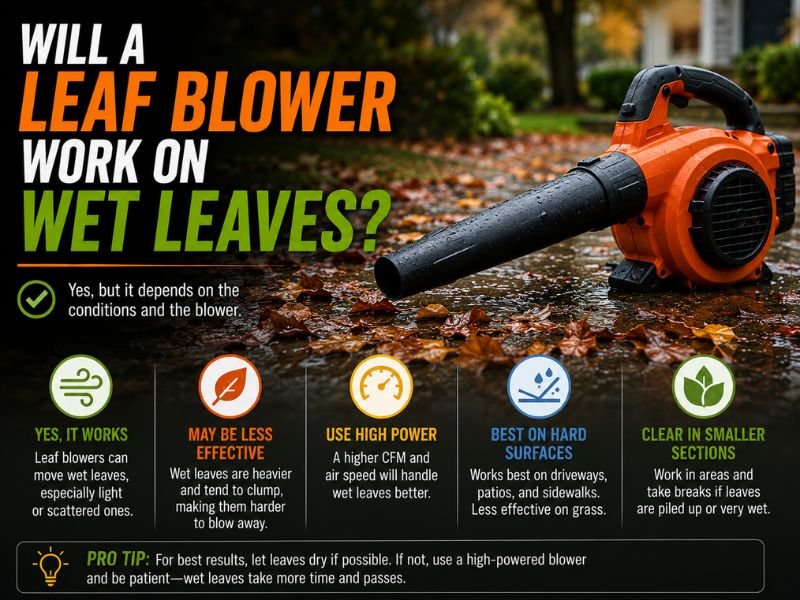
Yes, in many situations.
A leaf blower can usually handle:
- Slightly damp leaves
- Loose wet leaves
- Small wet piles
- Wet leaves on pavement
- Damp leaves on decks and patios
It becomes less effective with:
- Soaking-wet leaves
- Thick matted piles
- Leaves pressed into grass
- Waterlogged debris
- Leaves mixed with mud
The wetter and more compacted the material becomes, the more difficult it is for moving air to lift and push it.
Why Are Wet Leaves Harder to Blow?
Dry leaves are light and usually sit loosely on the surface.
Wet leaves behave differently.
Water adds weight and makes the leaves more likely to:
- Stick to the ground
- Stick to each other
- Form dense mats
- Slide instead of lift
- Collect in heavy piles
A blower that easily sends dry leaves across a yard may need several passes to move the same leaves after rain.
The problem is not necessarily that the blower has lost power. The material itself has become harder to move.
Can a Leaf Blower Move Soaking-Wet Leaves?
Sometimes, but efficiency drops significantly.
If leaves are saturated, they can become heavy enough that airflow moves only the top layer.
You may notice that the blower:
- Pushes leaves only a short distance
- Breaks apart the pile slowly
- Moves individual leaves but not the whole mass
- Leaves the bottom layer stuck to the ground
If practical, let the leaves drain or dry somewhat before cleanup.
If you need to remove them immediately, break the pile into smaller sections and work gradually.
A rake can also help separate heavily matted leaves before you use the blower.
Does CFM Matter for Wet Leaves?
Yes.
CFM refers to the volume of air the blower moves.
Higher airflow can help push a larger quantity of heavy debris.
For wet leaves, good air volume can be useful when:
- Moving broad patches
- Pushing larger piles
- Clearing a wide section of pavement
- Gathering loose wet leaves
However, there is no universal CFM number that guarantees good wet-leaf performance.
Leaf moisture, surface type, nozzle design, and airflow speed all affect the result.
Does MPH Matter for Wet Leaves?
Yes.
MPH describes how fast the air is moving.
Higher air velocity can help:
- Break leaves loose from pavement
- Separate stuck leaves
- Get heavy material moving
- Free debris from corners
A simple way to think about it is:
MPH helps loosen the leaves, while CFM helps move a larger amount of material.
Both can matter.
That is why judging a blower by only one specification can be misleading.
Is a More Powerful Leaf Blower Better for Wet Leaves?
Generally, stronger airflow helps.
A more capable blower may:
- Break up wet piles faster
- Move heavier leaves farther
- Reduce the number of passes needed
But power alone cannot solve every problem.
A thick layer of leaves that has been sitting in rain for days may be compacted so tightly that it behaves more like a wet mat than loose yard debris.
In that situation, even a strong blower may work better after the material has been loosened manually.
Can a Leaf Blower Move Wet Leaves From Grass?
Yes, but lawns are one of the harder surfaces.
Wet leaves can settle between grass blades and press tightly against the turf.
This becomes worse when:
- Grass is long
- Leaves have been walked on
- Rain has soaked the lawn
- Several layers of leaves are present
A good technique is to keep the nozzle angled rather than pointing directly down.
Use the airflow to get underneath the edge of the leaves and push them forward.
Work in overlapping passes toward one collection point.
If the leaves are deeply embedded in wet grass, a rake may be faster for loosening them.
Can a Leaf Blower Remove Wet Leaves From a Driveway?
Usually, yes.
A driveway is one of the easier surfaces because it is:
- Firm
- Smooth
- Open
- Difficult for leaves to sink into
Even wet leaves can often be pushed across pavement with enough airflow.
The job becomes harder when:
- Leaves are sitting in puddles
- They have been driven over
- Mud is mixed into the pile
- The leaves are completely waterlogged
Try to move smaller sections rather than pushing one large wet pile across the entire driveway.
Can You Blow Wet Leaves Off a Deck?
Yes, especially when the leaves are damp rather than fully soaked.
Decks generally give the blower a firm surface to work against.
Wet leaves may still:
- Stick to boards
- Collect in corners
- Settle between gaps
- Form patches around furniture
Work toward an open edge and use controlled passes.
If some leaves are stuck firmly to the surface, waiting for them to dry slightly can make cleanup easier.
Will a Leaf Blower Work on Wet Leaves in Gravel?
Yes, but it requires control.
The problem is that enough airflow to move heavy wet leaves may also move:
- Small stones
- Dust
- Loose gravel
Keep the nozzle farther from the surface and use a shallow angle.
Start with moderate power rather than maximum speed.
Increase airflow only as needed.
The goal is to lift and push the leaves without blasting the gravel out of place.
Can a Leaf Blower Remove Wet Leaves From Mulch?
It can remove some of them, but mulch is challenging.
Wet leaves may stick to bark or wood chips, while strong airflow can disturb the landscaping material.
For best results:
- Use lower power
- Keep the nozzle elevated
- Blow across the surface
- Avoid directing airflow straight downward
Leaves sitting loosely on top are much easier to remove than leaves pressed into wet mulch.
For stubborn areas, hand cleanup or light raking may be more practical.
Why Does My Leaf Blower Struggle With Wet Leaves?
Several factors can make the job difficult.
Possible causes include:
- Leaves are too wet
- Pile is too large
- Leaves are tightly matted
- Nozzle is too far away
- Blowing angle is poor
- Airflow is insufficient
- Leaves are embedded in turf
- Cordless battery is low
- Surface is holding the leaves in place
If the blower handles dry leaves normally but struggles only after rain, the tool may be working exactly as expected.
Wet leaves simply require more force to move.
How to Blow Wet Leaves More Effectively
A few technique changes can make a major difference.
Work in Smaller Sections
Do not try to move an entire heavy pile at once.
Break the area into manageable sections.
Loosen Matted Leaves First
If the leaves are packed together, separate them with airflow or a rake.
Keep the Nozzle Relatively Close
A closer nozzle can provide more concentrated airflow.
Do not scrape the nozzle against the ground.
Use a Shallow Angle
Direct air underneath and across the leaves.
Pointing straight down can press material against the surface.
Build Several Smaller Piles
Wet leaves become heavy quickly.
Several manageable piles are easier to move and collect than one huge pile.
Work From One Direction
Choose a collection area and push the leaves toward it systematically.
Random blowing often creates more work.
Leaf Blower vs. Rake for Wet Leaves
Both tools can be useful.
| Situation | Better Tool |
| Slightly damp loose leaves | Leaf blower |
| Wet leaves on pavement | Leaf blower |
| Light wet leaves on lawn | Leaf blower |
| Thick matted leaves | Rake |
| Waterlogged piles | Rake + blower |
| Leaves in gravel | Controlled leaf blower |
| Leaves embedded in wet grass | Rake may work better |
For difficult conditions, one of the most effective strategies is:
Loosen with a rake, then gather with the blower.
That lets each tool do the job it handles best.
Cordless vs. Gas vs. Corded Blowers for Wet Leaves
All three can move wet leaves, but each has different practical considerations.
Cordless Leaf Blower
Advantages:
- Easy mobility
- Quick startup
- No cord
- Variable-speed control on many models
Limitations:
- Battery runtime
- Reduced performance if battery is nearly discharged
Gas Leaf Blower
Gas blowers can be useful for:
- Large yards
- Heavy debris
- Longer cleanup sessions
Considerations include:
- Fuel
- Maintenance
- Exhaust
- Weight and noise
Corded Leaf Blower
Corded models provide continuous electrical power.
The main issue is managing the cord, especially around wet ground.
Always follow the manufacturer’s guidance for operating electrical equipment in damp or wet conditions.
Can You Vacuum Wet Leaves With a Leaf Blower Vacuum?
Possibly, but wet leaves can be difficult for vacuum systems.
They are more likely to:
- Clog the tube
- Pack inside the intake
- Reduce mulching efficiency
- Make the collection bag very heavy
A blower-vac that works perfectly on dry leaves may struggle with soaked material.
Check whether your specific model is designed to handle damp debris before using vacuum mode.
Avoid intentionally vacuuming standing water or materials the tool is not designed to collect.
Should You Wait for Wet Leaves to Dry?
If you have the option, often yes.
Drier leaves are:
- Lighter
- Easier to lift
- Less sticky
- Easier to pile
- Faster to collect
Waiting even until the surface moisture has reduced can make a noticeable difference.
However, waiting is not always practical.
If leaves need to be removed immediately, use smaller piles, controlled airflow, and a rake for the most stubborn sections.
Can Wet Leaves Damage a Leaf Blower?
Blowing damp leaves from a distance is different from allowing water to enter the tool.
The main concern is moisture exposure.
Follow the operating instructions for your specific blower, especially with electrical equipment.
Be cautious about:
- Water entering openings
- Wet extension-cord connections
- Damaged plugs
- Standing water
- Vacuuming waterlogged debris
Do not assume every blower is designed for the same level of moisture exposure.
Common Mistakes
Avoid these common errors:
- Expecting soaking-wet leaves to move like dry ones
- Trying to push one giant wet pile
- Holding the nozzle too far away
- Blowing straight down
- Using maximum power around gravel or mulch
- Ignoring a low cordless battery
- Vacuuming waterlogged debris without checking the tool instructions
- Assuming MPH alone determines performance
- Using electrical equipment contrary to wet-condition guidance
Frequently Asked Questions
Will a Leaf Blower Work on Wet Leaves?
Yes. It can move wet leaves, but the job is harder because moisture makes them heavier and stickier.
Can a Leaf Blower Move Soaking-Wet Leaves?
Sometimes, but waterlogged leaves may require several passes or manual loosening first.
Is CFM or MPH More Important for Wet Leaves?
Both matter. MPH helps loosen stuck leaves, while CFM helps move larger quantities.
Can a Leaf Blower Remove Wet Leaves From Grass?
Yes, but heavily matted leaves may require a rake before blowing.
Can a Leaf Blower Remove Wet Leaves From a Driveway?
Usually yes. Firm pavement makes wet leaves easier to move than grass or mulch.
Can You Blow Wet Leaves Off a Deck?
Yes, especially if they are loose. Leaves stuck firmly to the surface may require more effort.
Will a Leaf Blower Work on Wet Leaves in Gravel?
Yes, but use controlled airflow so you do not scatter the gravel.
Why Does My Leaf Blower Struggle With Wet Leaves?
The leaves may be waterlogged, matted, embedded, or too heavy for the current airflow and technique.
Is a Backpack Blower Better for Wet Leaves?
It can be helpful for large properties or heavy accumulation, but blower performance still depends on actual airflow and leaf condition.
Can You Vacuum Wet Leaves With a Leaf Blower?
Some blower-vacs may handle damp leaves, but wet material is more likely to clog the intake and collection system. Check the specific tool instructions.
Should I Rake Wet Leaves Before Blowing Them?
For thick or matted leaves, yes. Loosening them first can make blowing much easier.
Is It Better to Wait Until Leaves Dry?
Usually, if practical. Drier leaves are lighter, less sticky, and easier to move.
Conclusion
If you’re asking “will a leaf blower work on wet leaves,” the answer is yes, but wet leaves require more airflow and better technique than dry leaves because moisture makes them heavier and causes them to stick together and to the ground.
Slightly damp, loose leaves are usually manageable with a capable blower. The job becomes much harder when leaves are fully soaked, compressed into the lawn, sitting in puddles, or forming a dense mat.
Hard surfaces such as driveways and decks are generally the easiest places to blow wet leaves. Grass, gravel, and mulch require more careful technique because the leaves can become embedded or because strong airflow may disturb the surface itself.
Both CFM and MPH matter. Air speed helps loosen stubborn leaves, while air volume helps push larger amounts. Good nozzle positioning and smaller piles can make just as much difference as raw blower power.
When the leaves become too matted for efficient blowing, use a rake to break them apart first and let the blower handle the gathering.
A leaf blower can handle wet leaves, especially when they are only damp or loosely scattered, but heavily soaked or matted leaves are often faster to loosen with a rake before using the blower to move and collect them.