Will a Leaf Blower Melt Ice? What You Need to Know
A standard leaf blower will not melt ice effectively because it moves air rather than producing enough controlled heat to thaw frozen water. It may, however, help remove loose snow, frost, or small ice fragments once they are already detached.
This distinction matters because air speed and air temperature are not the same thing. A powerful leaf blower can move lightweight material very quickly, but solid ice bonded to concrete, pavement, steps, or a windshield usually needs heat, mechanical removal, or an appropriate de-icing method.
A leaf blower can still be useful in winter, but mostly as a cleanup tool rather than an ice-melting tool.
Will a Leaf Blower Melt Ice?
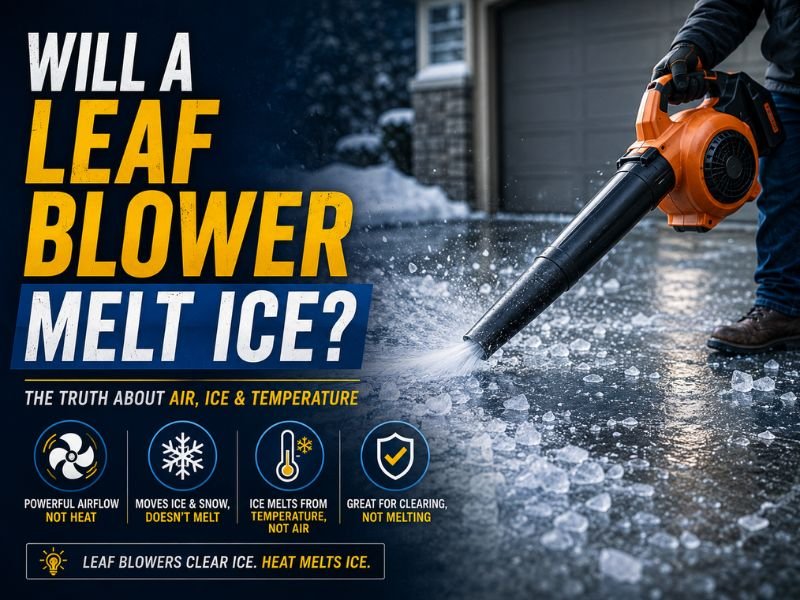
Generally, no.
A standard leaf blower is designed to move air at high speed. It does not function like a heater.
It may help with:
- Loose powdery snow
- Light frost
- Detached ice chips
- Snow sitting on top of ice
- Loose frozen debris
It is usually ineffective against:
- Thick driveway ice
- Ice firmly bonded to concrete
- Hard-packed frozen snow
- Windshield ice
- Large frozen patches on steps
If the ice is physically attached to a surface, airflow alone usually will not remove it.
Why Doesn’t a Leaf Blower Melt Ice?
Melting ice requires thermal energy.
The ice must absorb enough heat for its temperature to rise and for the solid water to begin changing into liquid water.
A leaf blower mainly provides:
- Air velocity
- Airflow volume
- Mechanical force
Those are useful for moving material, but they do not automatically provide significant heat.
This is why a blower can send dry snow across a driveway while doing almost nothing to a clear layer of ice directly underneath it.
High air speed does not mean high air temperature.
Can Warm Air From a Leaf Blower Melt Ice?
Some leaf blowers may discharge air that feels somewhat warmer than the surrounding air.
That warmth can come from:
- Motor heat
- Engine heat
- Air passing near warm internal components
- Relatively warm outdoor conditions
However, that does not make a normal leaf blower an effective ice-melting device.
On very thin frost or ice that is already close to thawing, slightly warmer moving air may appear to help. In many cases, though, sunlight or rising outdoor temperature is doing much of the actual thawing.
Thick bonded ice usually will not disappear simply because a blower is pointed at it.
Will a Gas Leaf Blower Melt Ice Better?
Not in a practical sense.
A gas-powered leaf blower produces engine heat, and its exhaust can become hot. However, the machine is not designed to use exhaust as a controlled heating system.
Its primary output at the blower tube is still high-volume moving air.
Trying to use engine exhaust directly to melt ice is not a good de-icing method and can create unnecessary risks around:
- Plastic
- Vehicle surfaces
- Flammable materials
- People
- Enclosed spaces
A gas blower may be powerful for snow removal, but that should not be confused with ice melting.
Can an Electric Leaf Blower Melt Ice?
Electric leaf blowers are also ineffective for melting substantial ice.
Corded and cordless models may create some internal heat during use, but the airflow is not intended to function as heated air.
They can still be useful for:
- Blowing away loose snow
- Clearing powder from steps
- Removing detached ice fragments
- Cleaning treated surfaces after ice loosens
For ice that is bonded to the surface, use a more appropriate method.
Can a Leaf Blower Remove Frost?
Sometimes.
Very light frost is easier to remove than solid ice because it may consist of loose or lightly bonded crystals.
A leaf blower may help when the frost is:
- Thin
- Dry
- Loosely attached
- Already beginning to thaw
It may struggle when the frost is:
- Thick
- Frozen firmly to the surface
- Mixed with moisture
- Covered by refrozen water
On a sunny morning, frost may loosen naturally as the surface warms. At that point, airflow can help clear the remaining crystals.
Can a Leaf Blower Remove Snow?
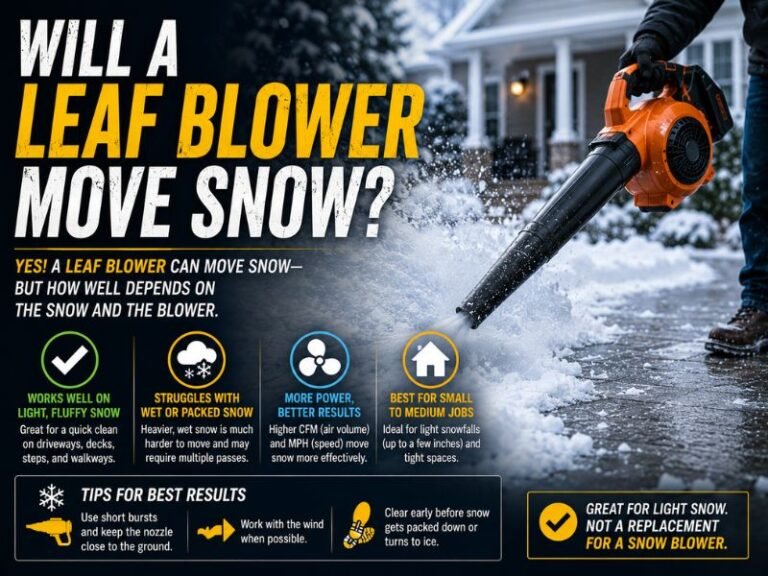
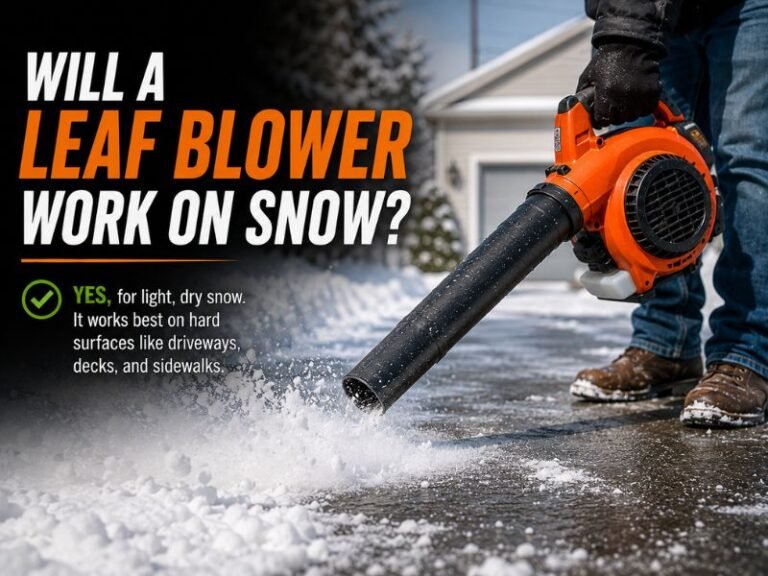
Yes, and this is where a leaf blower is much more useful in winter.
It performs best on snow that is:
- Dry
- Light
- Powdery
- Shallow
- Freshly fallen
A leaf blower can be especially convenient for:
- Steps
- Decks
- Walkways
- Small driveways
- Vehicles
- Patios
Performance drops considerably when snow becomes:
- Wet
- Heavy
- Compacted
- Partially melted
- Refrozen
Once snow turns into hard ice, the advantage of the blower largely disappears.
Can a Leaf Blower Remove Ice From a Driveway?
Not if the ice is firmly bonded to the driveway.
A blower may still help after the ice has already been loosened.
For example, once ice has been:
- Broken with a scraper
- Loosened by an appropriate de-icer
- Softened by sunlight
- Partially melted by warmer weather
the blower may help move detached fragments off the surface.
This can be useful because loose chips can otherwise remain scattered across the driveway.
The blower is therefore more useful during cleanup than during the actual ice-breaking process.
Can a Leaf Blower Remove Ice From Steps?
The same limitation applies to steps.
A blower can remove:
- Loose powder
- Snow
- Detached ice pieces
- Surface debris
It generally cannot remove a sheet of ice bonded tightly to the step.
A practical sequence is:
- Remove loose snow.
- Address bonded ice with an appropriate method.
- Loosen or break remaining ice carefully.
- Use the blower to clear detached material.
- Check the surface again for slippery spots.
Do not assume a step is safe simply because the visible snow has been blown away. A nearly transparent ice layer can remain underneath.
Can a Leaf Blower Remove Ice From a Car?
A leaf blower can be useful around a vehicle, but mostly for loose snow rather than ice.
It may help clear:
- Powdery snow from the roof
- Loose snow from windows
- Snow around mirrors
- Light accumulation on the hood
It will usually not melt or remove firmly bonded windshield ice.
For windshield ice, better options include:
- Vehicle defroster
- Ice scraper
- Suitable windshield de-icing product
Avoid using extremely hot water on frozen automotive glass. Rapid temperature changes can increase the chance of damaging the glass.
Does Fast-Moving Air Make Ice Melt Faster?
Not necessarily.
Moving air affects heat transfer, evaporation, and sublimation, but the result depends on environmental conditions.
If the surrounding air is well above freezing, airflow may help transfer heat to the ice.
If the air is very cold, moving more cold air across the surface may do little to promote melting and can sometimes help keep the surface cold.
The major factors are usually:
- Air temperature
- Surface temperature
- Sunlight
- Ice thickness
- Wind
- Surface material
That is why airflow alone is not a reliable ice-melting method.
Could a Heated Blower Melt Ice?
A purpose-built heated-air tool is different from a normal leaf blower.
Heated air can melt ice when enough energy is transferred to it, but this does not automatically make concentrated heating the best solution for a driveway or large outdoor surface.
Potential problems include:
- Slow progress
- Damage to heat-sensitive surfaces
- Meltwater refreezing nearby
- Uneven heating
- Electrical concerns around water
For large areas, proper scraping or de-icing is generally more practical than trying to heat every frozen patch with hot air.
Leaf Blower vs. De-Icer for Ice
These tools solve different problems.
Leaf Blower
Best for:
- Powdery snow
- Loose material
- Detached ice pieces
- Surface cleanup
De-Icer
Better suited for:
- Bonded ice
- Slippery frozen surfaces
- Weakening the bond between ice and pavement
The appropriate de-icing product depends on the surface, temperature, and surrounding environment.
A leaf blower can still be useful afterward to clear loosened material.
Leaf Blower vs. Ice Scraper
An ice scraper attacks the problem mechanically.
Leaf Blower
Advantages:
- Fast on loose material
- No direct scraping contact
- Useful over broad areas
Limitations:
- Cannot break bonded ice effectively
Ice Scraper
Advantages:
- Breaks or lifts ice
- Useful for localized hard patches
- Works even when airflow does nothing
Limitations:
- Requires physical effort
- Must be used carefully on delicate surfaces
For solid ice, the scraper generally addresses the actual problem while the blower handles cleanup.
Leaf Blower vs. Snow Blower
A leaf blower and snow blower should not be treated as interchangeable machines.
Leaf Blower
Best for:
- Light powdery snow
- Small areas
- Steps
- Decks
- Vehicles
- Walkways
Snow Blower
Better for:
- Deeper accumulation
- Larger areas
- More substantial snow loads, depending on machine type
Neither is primarily designed to melt ice.
A snow blower may remove packed snow more effectively than a leaf blower, but a hard layer of bonded ice can still remain.
Can a Leaf Blower Make an Icy Surface More Dangerous?
Yes, in some situations.
A blower can remove the visible snow layer and expose smooth ice underneath.
That may make the area look clean while remaining extremely slippery.
Other potential problems include:
- Blowing ice chips toward people
- Sending gravel into nearby vehicles
- Scattering salt or debris
- Losing footing while using the blower on ice
Always inspect the surface after clearing it.
Removing snow does not necessarily mean the traction problem has been solved.
Is It Safe to Use a Leaf Blower on Ice?
It can be used for loose material around icy areas, but extra caution is needed.
Use stable footwear and maintain good footing.
Also:
- Wear eye protection
- Keep people away from the discharge path
- Do not direct loose ice or gravel toward vehicles
- Avoid unstable footing
- Follow the blower’s weather and electrical-use instructions
- Do not deliberately use engine exhaust as an ice heater
For corded electric blowers, pay particular attention to electrical safety around wet or melting surfaces.
What Is the Best Way to Deal With Ice?
The right method depends on where the ice is located.
Driveways and Walkways
Possible approaches include:
- Mechanical scraping
- Appropriate de-icing products
- Waiting for sunlight or warmer temperatures where practical
Windshields
Use:
- Vehicle defroster
- Proper ice scraper
- Suitable windshield de-icer
Loose Ice Pieces
Once ice is detached, a leaf blower may help clear those fragments efficiently.
The goal is to use the blower where airflow is useful rather than expecting it to perform a heating function.
Common Mistakes
Avoid these common errors:
- Assuming high blower MPH means high heat
- Trying to melt thick driveway ice with airflow
- Using hot engine exhaust as a de-icing method
- Blowing away snow without checking for ice underneath
- Directing ice chips toward people
- Blowing gravel toward vehicles or windows
- Expecting a blower to replace an ice scraper
- Treating loose snow and bonded ice as the same problem
- Using inappropriate heating methods on automotive glass
Frequently Asked Questions
Will a Leaf Blower Melt Ice?
Generally, no. A normal leaf blower moves air but does not provide enough controlled heat to melt substantial bonded ice.
Can a Leaf Blower Remove Frost?
It may remove thin, loose frost, particularly when the surface is already warming.
Can a Leaf Blower Blow Away Ice?
It can blow away small ice pieces that have already broken free, but it usually cannot remove ice that is bonded to the surface.
Will a Gas Leaf Blower Melt Ice?
No meaningful advantage should be expected. A gas blower produces engine heat, but it is not designed as an ice-melting device.
Can a Leaf Blower Remove Snow From a Driveway?
Yes, if the snow is light, dry, and relatively shallow. Wet or packed snow is much harder to move.
Can a Leaf Blower Remove Ice From a Windshield?
Not effectively if the ice is firmly bonded. A defroster and ice scraper are better options.
Does Fast-Moving Air Melt Ice Faster?
Not necessarily. Air temperature and surface temperature matter much more than air speed alone.
Can a Leaf Blower Remove Ice From Steps?
It can remove loose ice fragments but usually cannot break or melt a bonded ice layer.
Is It Safe to Use a Leaf Blower on an Icy Driveway?
It can be used carefully for loose snow or debris, but slippery footing and flying ice or gravel are important hazards.
Can a Leaf Blower Remove Frozen Snow?
Loose frozen particles may move, but compacted or refrozen snow can be too hard and heavy for effective blowing.
What Is Better for Ice: a Leaf Blower or Ice Scraper?
An ice scraper is generally better for bonded ice. A leaf blower is better for clearing loose material afterward.
What Is the Best Way to Remove Ice After Snowfall?
Remove loose snow first, then use an appropriate scraping or de-icing method for bonded ice. A leaf blower can help clear the loosened fragments afterward.
Conclusion
If you’re asking “will a leaf blower melt ice,” the answer is generally no. A standard leaf blower creates strong airflow, but it does not provide enough controlled heat to efficiently melt ice that is bonded to a driveway, sidewalk, step, or vehicle.
Where a leaf blower can be useful is before or after the actual de-icing process. It can remove light powdery snow before it becomes packed, clear frost that is already loose, and blow away small ice pieces after they have been broken or loosened.
Do not confuse air speed with heat. A blower with impressive airflow may move snow extremely well while having almost no effect on a solid sheet of ice.
For bonded ice, use a method designed to weaken, melt, or mechanically remove it. Then use the leaf blower as a cleanup tool if loose fragments remain.
Be especially careful on driveways and steps because blowing away snow can reveal slick ice underneath. Maintain stable footing and avoid directing ice, salt, gravel, or other debris toward people or property.
Use a leaf blower to move loose snow and detached ice fragments, not to melt solid ice. For actual de-icing, scraping, defrosting, or an appropriate de-icing method will be far more effective.