Will a Leaf Blower Work on Snow? What to Know
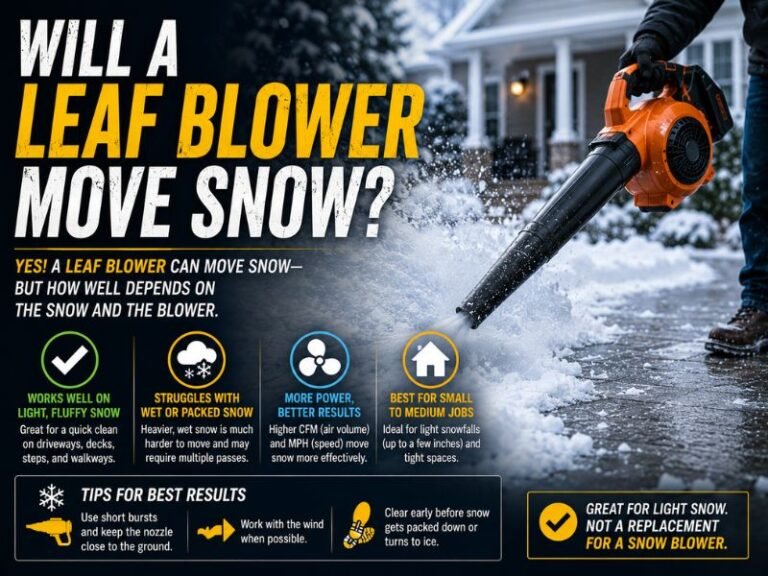
Yes, a leaf blower can work on snow when the snow is fresh, dry, powdery, and relatively shallow. It becomes much less effective on wet, heavy, packed, or frozen snow.
A leaf blower does not melt snow. It uses high-speed airflow to lift and push loose material across a surface. That makes it useful for light snowfall on driveways, sidewalks, decks, steps, and vehicles, especially when the snow has just fallen and has not yet been compressed.
The biggest factor is snow condition. Dry powder can move surprisingly easily, while wet or compacted snow may barely respond to the same blower.
Will a Leaf Blower Work on Snow?
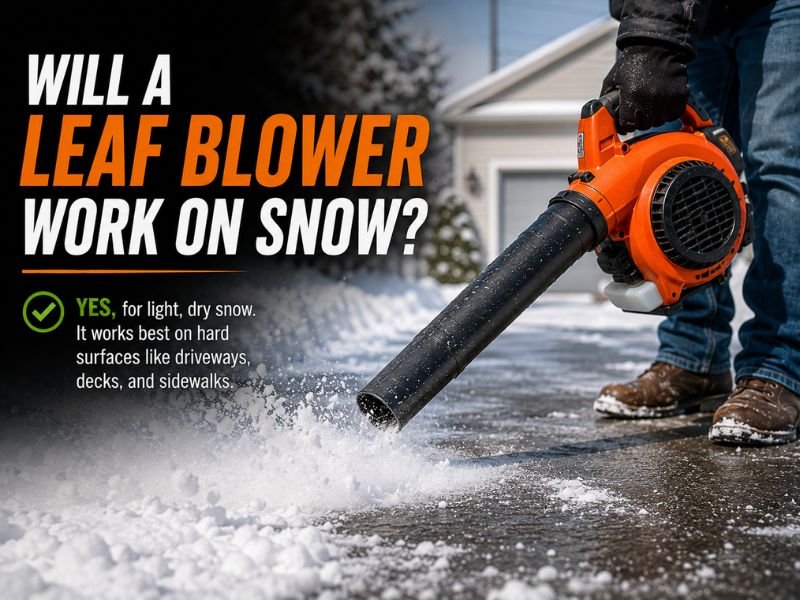
Yes, in the right conditions.
A leaf blower generally works well on:
- Fresh powder
- Light snowfall
- Shallow accumulation
- Loose snow on smooth surfaces
- Steps and decks
- Snow on vehicles
It works poorly on:
- Wet snow
- Heavy accumulation
- Packed snow
- Snow driven over by vehicles
- Frozen crust
- Ice bonded to a surface
The earlier you clear the snow, the better the results usually are.
Why Does a Leaf Blower Work on Light Snow?
Fresh powder is lightweight and loose.
A leaf blower creates a strong stream of moving air that can lift those snow particles and push them away.
This works particularly well when the snow has not yet been:
- Walked on
- Driven over
- Partially melted
- Refrozen
- Mixed with slush
The blower is simply moving the snow mechanically.
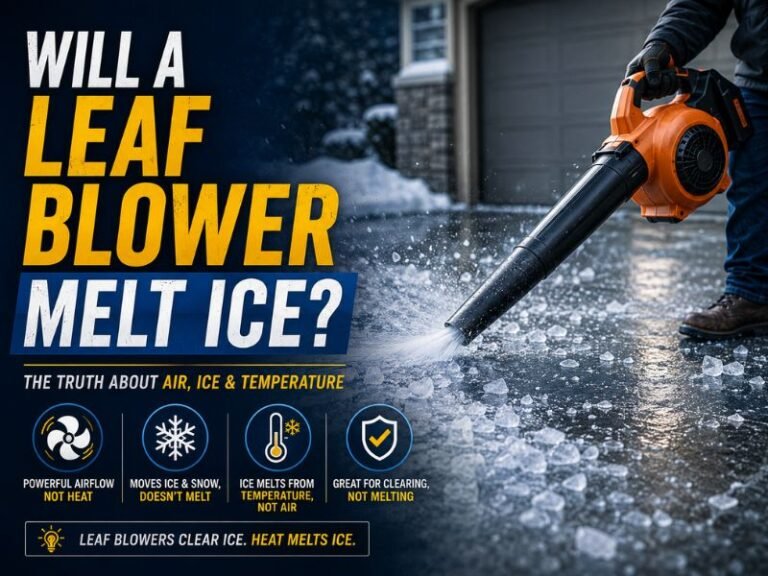
Airflow moves snow; it does not melt it.
That distinction becomes important when dealing with frozen or bonded material.
What Type of Snow Works Best With a Leaf Blower?
Dry Powder
Dry powder is the ideal snow for a leaf blower.
It is:
- Light
- Loose
- Easy to lift
- Less likely to stick to pavement
A relatively thin layer of powder may disappear from a walkway or deck very quickly.
Freshly Fallen Snow
Fresh snow is also easier because nothing has compressed it yet.
Once people walk across it or tires roll over it, the snow may become packed against the surface.
Shallow Accumulation
Leaf blowers are best suited to relatively light accumulations.
There is no universal maximum snow depth because performance depends on:
- Snow density
- Moisture
- Blower airflow
- Surface condition
- Wind
A few inches of very light powder may sometimes move more easily than a much thinner layer of wet snow.
Will a Leaf Blower Work on Wet Snow?
It may move some wet snow, but performance drops considerably.
Wet snow is:
- Heavier
- Stickier
- More cohesive
- Harder to lift with airflow
Instead of blowing freely, it may slide, clump, or remain stuck to the surface.
A thin layer of slightly wet snow might still be manageable with a strong blower.
Waterlogged snow, however, is usually better handled with a shovel or snow blower.
If the blower only moves the upper layer while leaving wet snow underneath, that is usually a limitation of the snow condition rather than a sign that the tool is faulty.
Will a Leaf Blower Work on Deep Snow?
Not very effectively.
As snow depth increases, the blower has to move a much larger amount of material.
Common problems include:
- Upper powder moves while lower snow remains
- Snow piles up in front of the airflow
- Several passes are required
- Clearing becomes slow
A leaf blower is much better for frequent light cleanup than for removing a large accumulation after a major snowfall.
Once the snow becomes deep, a snow blower or shovel is usually more practical.
Can a Leaf Blower Clear Snow From a Driveway?
Yes, especially if the snow is fresh and light.
A driveway is a good surface because loose snow can travel easily across pavement.
The blower performs best when:
- Snowfall is recent
- Accumulation is shallow
- Snow is dry
- Cars have not driven over it
Once vehicle tires compress snow into tracks, airflow becomes much less effective.
For light snowfall, clearing the driveway early can save effort later.
Can You Use a Leaf Blower on a Sidewalk?
Yes.
Sidewalks and walkways are among the better places to use a leaf blower for snow.
They are usually:
- Narrow
- Firm
- Easy to clear toward one edge
Start at one end and work toward an open area.
One important precaution is to inspect the walkway afterward.
Blowing away the visible snow can expose a thin layer of ice underneath, making the surface look safer than it actually is.
Can a Leaf Blower Clear Snow From Steps?
Yes, especially dry powder.
A leaf blower can be convenient for steps because it can reach:
- Corners
- Individual treads
- Edges
- Areas where a shovel feels awkward
Wet snow may stick to the steps and resist airflow.
Ice will also remain after the loose snow is gone.
Stable footing is especially important because operating a blower while standing on icy steps can increase slip risk.
Will a Leaf Blower Work on Snow on a Deck?
Often, yes.
A thin layer of fresh powder on a deck can usually be blown away quickly.
This can be useful around:
- Railings
- Furniture
- Corners
- Narrow spaces
Wet or partially melted snow is harder to move.
Any ice bonded to the deck will remain.
Also follow the manufacturer’s instructions regarding operation in snowy or damp conditions, since not every blower is designed for the same level of moisture exposure.
Can You Use a Leaf Blower to Clear Snow Off a Car?
Yes, loose powder can often be removed from a vehicle with a leaf blower.
It may help clear:
- Hood
- Roof
- Windows
- Trunk
- Pickup bed
This works best before snow starts melting or freezing to the vehicle.
Be careful around gravel and debris. Strong airflow may pick up small particles and blow them toward paint or glass.
Also avoid letting the blower tube contact the vehicle surface.
For bonded windshield ice, use the vehicle defroster and an appropriate ice scraper.
Will a Cordless Leaf Blower Work on Snow?
Yes, provided the snow is light enough and the model is suitable for the conditions.
Cordless models are convenient because they offer:
- No extension cord
- Easy movement
- Quick setup
- Good access around vehicles and steps
The main limitations are battery runtime and cold-weather performance.
Cold temperatures can temporarily reduce lithium-ion battery performance.
You may notice:
- Shorter runtime
- Reduced power
- More frequent battery changes
Battery storage and charging-temperature recommendations vary by manufacturer, so follow the guidance for your exact battery system.
Will a Gas Leaf Blower Work on Snow?
Yes.
A gas blower can move light powder when it provides sufficient airflow.
It may be useful for:
- Larger areas
- Longer clearing sessions
- Properties where battery runtime is limiting
However, gas power does not automatically mean it will handle heavy or wet snow well.
Snow condition still matters.
Gas models also involve:
- Fuel
- Engine maintenance
- Exhaust
- Weight
- Noise
For dry powder, they can be effective. For heavy slush, a dedicated snow-removal tool is still better.
Will a Corded Leaf Blower Work on Snow?
Potentially.
A corded blower can move light snow and provides continuous electrical power.
The challenge is using electrical equipment around snow and moisture.
You need to consider:
- Extension-cord condition
- Outdoor-rated connections
- Moisture exposure
- Manufacturer operating instructions
Do not assume that because a blower can physically move snow, it is automatically approved for every snowy or wet condition.
Is CFM or MPH More Important for Snow?
Both matter.
MPH
MPH describes air velocity.
Higher air speed helps:
- Break loose powder
- Start snow moving
- Clear small stubborn areas
CFM
CFM describes the volume of air the blower moves.
Higher airflow volume helps:
- Push larger amounts of snow
- Clear broader areas
- Keep material moving
A blower with good balance between air speed and volume may perform better than one marketed around only a single impressive number.
Snow condition can still matter more than either specification.
Can a Leaf Blower Remove Packed Snow?
Usually not very well.
Packed snow develops after:
- Foot traffic
- Vehicle traffic
- Partial melting
- Compression
- Freeze-thaw cycles
Once the snow is pressed firmly against the surface, airflow has difficulty getting underneath it.
A shovel, scraper, or other mechanical method is usually more effective.
The blower may still help remove loose powder surrounding the packed areas.
Can a Leaf Blower Remove Frozen Snow or Ice?
Loose frozen particles may move.
Material frozen firmly to the surface generally will not.
It helps to distinguish between:
- Loose frozen granules
- Frozen crust
- Solid bonded ice
A blower may move the first type.
It will struggle with the second and will not meaningfully remove solid bonded ice.
After frozen material has been loosened by another method, the blower can be useful for clearing the fragments.
Leaf Blower vs. Snow Blower
These tools are designed for different snow conditions.
| Condition | Better Tool |
| Fresh powder | Leaf blower |
| Light shallow snow | Leaf blower |
| Steps and small decks | Leaf blower can work well |
| Wet snow | Snow blower or shovel |
| Deep accumulation | Snow blower |
| Large driveway after heavy snowfall | Snow blower |
| Packed snow | Mechanical removal |
| Ice | Scraping or de-icing method |
A leaf blower is fast and convenient for light cleanup.
A snow blower is designed to move larger volumes and heavier snow.
Leaf Blower vs. Shovel
A shovel still has an important advantage: it does not depend on airflow.
Leaf Blower
Best for:
- Dry powder
- Shallow snow
- Quick cleanup
- Small surfaces
Shovel
Better for:
- Wet snow
- Heavy accumulation
- Deep snow
- Snow that sticks to pavement
The tools can also complement each other.
You might blow away loose powder first and use the shovel only where heavier material remains.
How to Use a Leaf Blower on Snow
Clear Snow Early
Fresh snow is much easier to move than snow that has been sitting for hours.
Inspect the Surface
Look for:
- Gravel
- Ice
- Loose objects
- Debris
Strong airflow can send small objects toward people or property.
Decide Where the Snow Will Go
Choose a clear discharge direction before starting.
Work With the Wind
When possible, use the natural wind direction rather than fighting against it.
Use Controlled Passes
Move manageable amounts at a time.
Trying to push one large pile may make the job harder.
Angle the Nozzle
A shallow angle helps push the snow across the surface.
Pointing straight down can waste airflow.
Check for Ice Afterward
Loose snow can hide slippery ice.
Inspect the cleared area before assuming it is safe.
Why Isn’t My Leaf Blower Moving the Snow?
Possible reasons include:
- Snow is too wet
- Accumulation is too deep
- Snow is packed
- Surface is frozen
- Blower airflow is insufficient
- Nozzle angle is poor
- Battery charge is low
- Snow has turned to slush
If the same blower easily moves fresh powder but struggles with older snow, the tool may be functioning normally.
The snow has simply become harder to move.
Can Cold Weather Affect Leaf Blower Performance?
Yes, particularly with cordless models.
Cold conditions can temporarily reduce battery performance.
That may result in:
- Shorter runtime
- Reduced output
- Slower recovery between batteries
Temperature recommendations vary, especially for charging.
Do not assume a battery that feels weak in extreme cold is permanently damaged.
Follow the manufacturer’s battery instructions.
Can Using a Leaf Blower in Snow Damage It?
Potentially, especially if moisture enters parts of the tool that are not designed for exposure.
Possible concerns include:
- Snow entering ventilation openings
- Wet electrical connections
- Moisture reaching internal components
- Hidden gravel or debris striking the blower
Check the exact model’s instructions regarding wet or snowy use.
This is especially important with corded electric blowers.
Safety Tips for Using a Leaf Blower on Snow
Winter use creates several hazards that may not be present during normal yard cleanup.
Keep these points in mind:
- Wear eye protection
- Use footwear with good traction
- Maintain stable footing
- Watch for hidden ice
- Keep people away from the discharge path
- Avoid blowing gravel toward vehicles or windows
- Follow electrical-use instructions
- Avoid unsafe wet connections
- Stop if the surface becomes too slippery
Common Mistakes
Avoid these errors:
- Waiting until powder becomes wet or packed
- Expecting a leaf blower to handle deep snow
- Treating ice like loose snow
- Blowing gravel toward property
- Ignoring hidden ice
- Working directly against strong wind
- Judging snow performance only by MPH
- Assuming every blower is approved for wet conditions
Frequently Asked Questions
Will a Leaf Blower Work on Snow?
Yes, especially when the snow is fresh, dry, loose, and shallow.
How Much Snow Can a Leaf Blower Handle?
There is no universal depth. Snow density, moisture, blower airflow, surface type, and wind all affect performance.
Will a Leaf Blower Work on Wet Snow?
It may move a thin layer, but wet snow is much heavier and more difficult than dry powder.
Can a Leaf Blower Clear a Driveway?
Yes, if the snow is light and has not been compacted by vehicles.
Can You Use a Leaf Blower on Snow-Covered Steps?
Yes. Light powder can often be removed quickly, but watch for ice underneath.
Can a Leaf Blower Remove Snow From a Car?
Yes, loose powder can be blown away, but bonded ice will need another method.
Will a Cordless Leaf Blower Work in Snow?
Yes, although cold weather may temporarily reduce battery runtime and performance.
Is CFM or MPH More Important for Blowing Snow?
Both matter. MPH helps start snow moving, while CFM helps push a larger volume.
Can a Leaf Blower Remove Packed Snow?
Usually not effectively. Packed snow generally needs mechanical removal.
Can a Leaf Blower Remove Ice?
It may move loose ice fragments, but it will not remove solid ice bonded to the surface.
Is a Leaf Blower Better Than a Snow Blower for Light Snow?
For very light powder and small areas, a leaf blower can be faster and easier to use. A snow blower is more appropriate for deeper or heavier accumulation.
Can Cold Weather Affect a Cordless Leaf Blower?
Yes. Cold temperatures can temporarily reduce lithium-ion battery performance.
Conclusion
If you’re asking “will leaf blower work on snow,” the answer is yes when the snow is fresh, dry, powdery, and relatively shallow. Wet, heavy, packed, or frozen snow is much harder for airflow to move.
A leaf blower can be a convenient winter tool for clearing light accumulation from driveways, sidewalks, decks, steps, and vehicles. The best results come from clearing snow soon after it falls, before traffic and temperature changes make it heavier or more compact.
Both CFM and MPH affect performance, but neither specification can overcome every snow condition. Wet or deep accumulation is generally better handled with a shovel or snow blower, while packed snow and ice require another removal method.
Cold temperatures can also affect cordless battery performance, and snowy conditions introduce moisture and footing concerns. Follow the operating guidance for your specific blower and pay close attention to ice, gravel, and electrical safety.
A leaf blower can be a fast solution for fresh powder and light snow, but once the snow becomes wet, deep, packed, or frozen, dedicated snow-removal equipment is the better choice.