Will a Hedge Trimmer Cut Tall Grass? What to Know
Yes, a hedge trimmer can cut some tall grass and weeds, especially when the growth is upright, dry, and relatively thin, but it is not designed to replace a lawn mower, string trimmer, or brush cutter.
A hedge trimmer can be useful when grass has grown so tall that a mower struggles to handle it. Its reciprocating blades can slice through upright grass and light weeds, allowing you to reduce the height before using a more suitable lawn tool. However, thick, wet, tangled, or matted grass can clog the blades and make the job slow.
The best approach is to treat a hedge trimmer as an occasional overgrowth tool rather than your primary grass-cutting machine.
Will a Hedge Trimmer Cut Tall Grass?
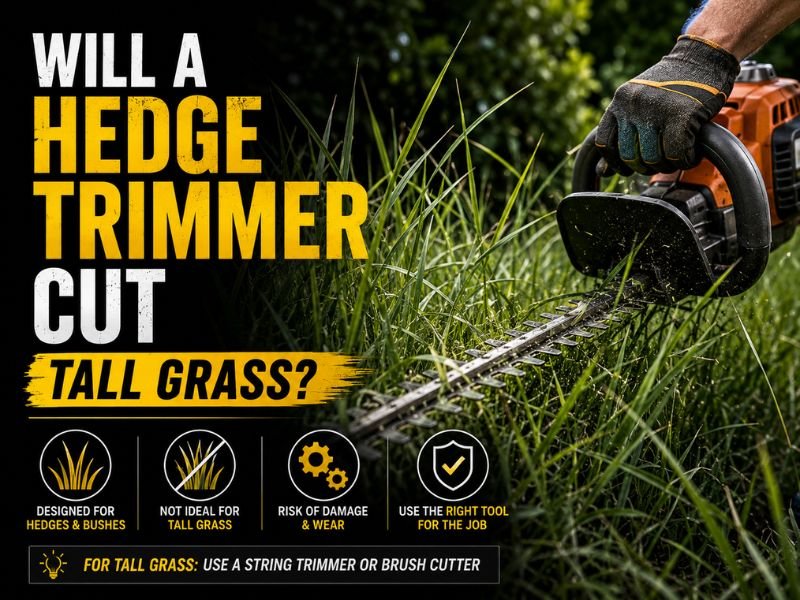
In many situations, yes.
A hedge trimmer works best on tall grass that is:
- Upright
- Relatively dry
- Thin-stemmed
- Easy to access
- Not heavily tangled
It may also handle light weeds and some soft-stemmed vegetation.
Problems are more likely when the grass is:
- Wet
- Matted down
- Extremely dense
- Mixed with vines
- Close to rocks or other debris
- Growing over uneven ground
A hedge trimmer can reduce tall vegetation quickly in a small area, but it usually cannot produce the even, low finish of a mower.
Why Can a Hedge Trimmer Cut Grass at All?
A hedge trimmer uses two rows of teeth that move back and forth against each other.
When vegetation enters the gaps between the teeth, the blades shear it.
This mechanism is designed mainly for:
- Hedge growth
- Small branches
- Shrubs
- Soft stems
Tall grass can also enter those blade gaps, which is why the tool can cut it.
The problem is that grass behaves differently from hedge branches. Grass is flexible and can:
- Bend away from the blade
- Fold over
- Wrap around cutting parts
- Pack between blade teeth
That makes performance less predictable than when trimming a hedge.
When Does a Hedge Trimmer Work Well on Tall Grass?
A hedge trimmer is most useful when you are dealing with a limited area of severe overgrowth.
Examples include:
- A neglected corner of the yard
- Tall grass along a fence
- Vegetation around an unused structure
- Overgrowth near a garden boundary
- Tall weeds that need to be knocked down
- Grass too tall for your mower to enter comfortably
A long hedge-trimmer blade can sweep across a relatively wide section of standing vegetation.
That makes it particularly useful for reducing the upper portion of extremely tall grass before finishing the area with another tool.
Can You Use a Hedge Trimmer on an Overgrown Lawn?
Yes, but it is better for the initial knockdown than the final cut.
Suppose a lawn has been neglected for several weeks or months and the grass is now exceptionally tall.
Driving a mower directly into that growth can cause:
- Clogging
- Uneven cutting
- Heavy load on the mower
- Large piles of clippings
A hedge trimmer can help reduce the vegetation first.
You might cut the tallest section down to a more manageable height, remove or spread the clippings, and then use a mower for the final cut.
This approach is especially useful on small patches.
For an entire large lawn, using a hedge trimmer would usually be tiring and inefficient.
Can a Hedge Trimmer Cut Tall Weeds?
Many light weeds can be cut with a hedge trimmer.
The tool tends to work well on weeds that are:
- Upright
- Soft
- Thin-stemmed
- Not heavily woody
A hedge trimmer may have more difficulty with mature weeds that develop thick, hard stalks.
The exact limit depends on the tool’s cutting capacity.
Do not assume that because the blade can physically fit around a stem, it is appropriate to force the trimmer through it.
If the vegetation is thick and woody, a brush cutter or another appropriate cutting tool may be better.
Can a Hedge Trimmer Cut Thick Grass?
Individual thick grass blades usually are not the main problem.
Dense clumps are.
When too much grass enters the blade at once, the vegetation may:
- Fold over
- Pack together
- Stop feeding into the teeth
- Jam the blade
Instead of pushing through dense material aggressively, take smaller passes.
Cutting the vegetation in stages can reduce blade binding and put less load on the tool.
If the entire area is dense, tangled, and difficult to penetrate, a brush cutter or heavy-duty string trimmer is generally more suitable.
Can a Hedge Trimmer Cut Ornamental Grass?
Yes, a hedge trimmer can be useful for cutting back many ornamental grass clumps.
Large ornamental grasses can be difficult to cut one handful at a time with hand pruners.
A hedge trimmer allows you to cut across the entire clump more quickly.
Depending on the plant and season, a practical approach may be to:
- Gather or loosely tie the clump together.
- Select the appropriate cutting height.
- Cut across the stems gradually.
- Remove the cut material.
Be aware of hidden objects around ornamental plants, including:
- Stakes
- Supports
- Irrigation tubing
- Landscape edging
Also check the care requirements for the specific ornamental grass, because not every variety should be cut back at the same time.
When Should You Not Use a Hedge Trimmer on Grass?
There are several situations where another tool is a better choice.
Wet Grass
Wet vegetation tends to stick together and can pack around the blades.
It can also make the ground slippery.
Allowing the grass to dry can improve both cutting and footing.
Very Short Grass
A hedge trimmer is awkward for producing a low, even lawn cut.
A mower is much better suited to that job.
Dense Matted Grass
Flattened grass may simply bend beneath the blade instead of entering the teeth.
Large Open Lawns
Even if the hedge trimmer technically works, cutting a large lawn this way would be inefficient.
Areas With Hidden Debris
Do not sweep a hedge trimmer blindly through vegetation that may hide solid objects.
What Hidden Objects Are Dangerous in Tall Grass?
This is one of the biggest concerns when using any powered cutting tool in severe overgrowth.
Tall grass can conceal:
- Stones
- Metal wire
- Fence pieces
- Garden stakes
- Irrigation components
- Tools
- Bottles
- Branches
- Landscape edging
A hedge trimmer blade striking a hard hidden object can damage the blade or cause sudden tool movement.
Inspect the area before cutting whenever possible.
As you remove the upper layers of vegetation, continue checking the newly exposed ground.
Can You Use a Hedge Trimmer Like a String Trimmer?
Not very effectively.
The two tools cut vegetation differently.
Hedge Trimmer
A hedge trimmer uses reciprocating metal teeth.
It works well for:
- Hedges
- Shrubs
- Upright stems
- Broad sweeping cuts through tall vegetation
String Trimmer
A string trimmer uses rapidly rotating line.
It is much better suited for:
- Grass edges
- Around trees
- Around fences
- Uneven ground
- Normal tall grass
- Ground-level finishing
If the main job is grass rather than shrubs, the string trimmer is usually the more natural tool.
Hedge Trimmer vs. Brush Cutter for Tall Grass
For light overgrowth, a hedge trimmer can work.
For dense vegetation, a brush cutter is generally more appropriate.
Hedge Trimmer Is Better For:
- Thin upright weeds
- Small patches
- Ornamental grass
- Initial cutting of light overgrowth
Brush Cutter Is Better For:
- Dense weeds
- Heavy grass
- Rough vegetation
- Thicker stems
- Larger overgrown areas
The key difference is that the brush cutter is specifically intended for demanding vegetation close to ground level.
Hedge Trimmer vs. Lawn Mower for Tall Grass
A mower remains the correct tool for normal lawn maintenance.
The hedge trimmer can help when grass becomes too tall for normal mowing.
Hedge Trimmer
Useful for:
- Reducing extreme height
- Opening up heavily overgrown patches
- Cutting upright vegetation before mowing
Lawn Mower
Better for:
- Consistent height
- Large lawn areas
- Final finish
- Routine maintenance
The two tools can therefore complement each other when restoring an overgrown lawn.
Cordless vs. Corded Hedge Trimmer for Tall Grass
Both can cut tall grass, but they have different practical considerations.
Cordless Hedge Trimmer
Advantages:
- No extension cord
- Easier movement through overgrowth
- Convenient for scattered patches
Limitations:
- Battery runtime
- Performance depends on battery condition and tool design
Corded Hedge Trimmer
Advantages:
- Continuous electrical power
- No battery charging interruptions
Limitations:
- Extension cord must be managed carefully
- Cord can become hidden in tall vegetation
When working through dense grass, cordless operation can be convenient simply because there is no cable running through the work area.
How to Cut Tall Grass With a Hedge Trimmer
If you decide to use a hedge trimmer, work methodically.
1. Inspect the Area
Before starting, look for anything the blade should not hit.
Remove obvious:
- Rocks
- Wire
- Branches
- Garden tools
- Stakes
- Loose debris
2. Wait for Dry Conditions
Dry grass is generally easier to handle than wet, sticky vegetation.
Dry ground also improves footing.
3. Start Higher Than Your Final Height
If the grass is extremely tall, do not immediately cut at ground level.
Remove the upper portion first.
4. Use Controlled Sweeping Passes
Move the blade gradually through the vegetation.
Avoid forcing large clumps into the teeth.
5. Work Down in Stages
After removing the upper growth, lower the cutting height if necessary.
This reduces the amount of vegetation entering the blade at one time.
6. Clear Heavy Clippings
Large piles can hide objects and interfere with later passes.
7. Finish With a Mower or String Trimmer
Use the hedge trimmer for rough reduction, then switch tools for a cleaner finish.
Why Does My Hedge Trimmer Keep Jamming in Grass?
Jamming usually happens because the vegetation is not feeding cleanly through the blade.
Possible causes include:
- Wet grass
- Dense clumps
- Tangled vegetation
- Vines
- Too much material per pass
- Dull or damaged blades
- Vegetation thicker than the tool can handle
If the blade jams, stop the tool completely before attempting to remove the obstruction.
For a battery-powered model, remove the battery when appropriate according to the manufacturer’s instructions. Disconnect a corded tool from power before clearing or inspecting the blade.
Never attempt to clear vegetation while the blades can move.
Can Tall Grass Damage a Hedge Trimmer?
Normal thin grass is unlikely to harm a properly used hedge trimmer.
Damage is more likely to come from what is hidden within the grass.
Potential problems include:
- Wire caught in the blades
- Rocks striking teeth
- Thick woody stems
- Heavy vines wrapping around the blade
- Forcing a jammed tool
Repeatedly pushing the trimmer into vegetation beyond its capacity can also increase wear.
If the blade repeatedly stalls or jams, use a more appropriate tool rather than forcing it.
Is It Safe to Use a Hedge Trimmer Near the Ground?
Extra caution is necessary.
A hedge trimmer is easier to control when trimming a hedge at waist or chest height than when sweeping close to your feet.
Near ground level, the blade may encounter:
- Rocks
- Soil
- Concrete
- Metal edging
- Irrigation equipment
- Fence wire
There is also less distance between the blade and your legs or feet.
Keep stable footing, control the blade deliberately, and avoid sweeping blindly through vegetation you cannot see through.
What Tool Is Best for Tall Grass?
The right tool depends on the type and amount of vegetation.
| Situation | Better Tool |
| Normal lawn grass | Lawn mower |
| Grass around edges | String trimmer |
| Very tall thin grass | String trimmer or hedge trimmer for initial reduction |
| Dense weeds | Brush cutter |
| Thick rough vegetation | Brush cutter |
| Ornamental grass clumps | Hedge trimmer can work well |
| Hedges and shrubs | Hedge trimmer |
A hedge trimmer makes the most sense when the vegetation is upright and you want to remove a broad section at once.
Common Mistakes When Cutting Grass With a Hedge Trimmer
Avoid these common problems:
- Treating the hedge trimmer like a lawn mower
- Cutting wet vegetation
- Ignoring hidden debris
- Starting immediately at ground level
- Forcing large clumps through the blade
- Continuing when blades repeatedly jam
- Cutting stems beyond the tool’s capacity
- Using damaged or dull blades
- Sweeping close to your feet without control
- Expecting a smooth lawn finish
Frequently Asked Questions
Will a Hedge Trimmer Cut Tall Grass?
Yes. It can cut tall, upright, relatively thin grass, especially when used to reduce severe overgrowth before normal mowing or trimming.
Can You Use a Hedge Trimmer on an Overgrown Lawn?
Yes, particularly for knocking down the tallest vegetation first. A mower or string trimmer is better for the final finish.
Can a Hedge Trimmer Cut Tall Weeds?
Many soft, thin weeds can be cut effectively. Thick or woody weeds may require a brush cutter or another appropriate tool.
Can a Hedge Trimmer Cut Thick Grass?
It can cut some thick grass, but dense clumps can bend, pack together, or jam the blades.
Can You Cut Ornamental Grass With a Hedge Trimmer?
Yes, a hedge trimmer can be useful for cutting back large ornamental grass clumps when the stems are within the tool’s cutting capacity.
Is a Hedge Trimmer Better Than a String Trimmer for Tall Grass?
Usually not for normal grass cutting. A hedge trimmer may be useful for initial reduction of extremely tall upright growth, while a string trimmer is better near the ground.
Can a Hedge Trimmer Replace a Lawn Mower?
No. It cannot provide the consistent cutting height and efficiency of a mower across a normal lawn.
Will Wet Grass Damage a Hedge Trimmer?
Wet grass may not directly damage the tool, but it can clog the blades, increase slipping risk, and make cutting inefficient.
Why Does My Hedge Trimmer Jam in Tall Grass?
Wet vegetation, tangled grass, vines, excessive material, or dull blades can all cause jamming.
Can a Hedge Trimmer Cut Vines?
Some thin vines may be cut, but tangled vines can wrap around the blade and cause jams.
Is It Safe to Use a Hedge Trimmer Near the Ground?
It can be done carefully, but the risk of hitting rocks, metal, edging, and other hidden objects is higher near ground level.
What Is the Best Tool for Very Tall Grass?
A string trimmer or brush cutter is generally better for large areas of tall grass. A hedge trimmer can be useful for initial knockdown in smaller patches.
Conclusion
If you’re asking “will a hedge trimmer cut tall grass,” the answer is yes in many situations, particularly when the grass is tall, upright, relatively dry, and thin enough to enter the blade teeth easily.
A hedge trimmer can be surprisingly useful for reducing severe overgrowth, cutting back ornamental grass, and clearing small patches that are too tall for immediate mowing.
Its limitations become obvious when the vegetation is wet, tangled, matted, extremely dense, or growing close to hidden debris. A hedge trimmer also does not provide the clean, consistent finish expected from a lawn mower.
For an overgrown lawn, a practical approach is to use the hedge trimmer only for the initial reduction when necessary, then follow with a string trimmer or mower. For dense weeds and heavy vegetation, a brush cutter is generally more appropriate.
Inspect the area before cutting, avoid forcing the blade through dense material, and be particularly cautious near the ground where rocks, wire, edging, and irrigation components may be hidden.
A hedge trimmer can cut tall grass, but it works best as a temporary overgrowth solution—not as a replacement for equipment designed specifically for grass cutting.