Why Is My Hedge Trimmer Blade Not Moving?
If your hedge trimmer blade is not moving, the most common causes are debris jammed between the teeth, sticky or poorly lubricated blades, a weak power supply, blade damage, or a problem with the motor, gears, or drive mechanism.
The first thing to determine is whether the motor runs while the blade stays still or whether the hedge trimmer does not start at all. Those two symptoms usually point to different problems. A motor that runs without blade movement suggests a jam or mechanical drive fault, while a completely silent tool may have a battery, cord, switch, safety interlock, or motor problem.
Before inspecting any blade problem, disconnect the hedge trimmer from its power source.
Why Is My Hedge Trimmer Blade Not Moving?

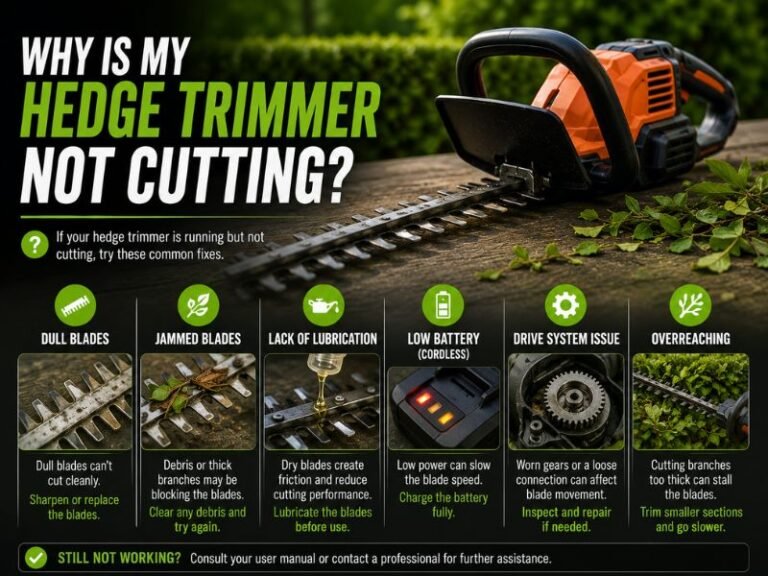
A hedge trimmer blade can stop moving for several reasons.
Common causes include:
- Branches or debris caught between the teeth
- Dried sap or dirt binding the blades
- Lack of lubrication
- Bent or misaligned blades
- Branches that exceed the tool’s capacity
- Weak or discharged battery
- Overheated battery or tool
- Damaged cord or power supply
- Safety switch not fully engaged
- Loose or improperly adjusted blade hardware
- Damaged gearbox
- Broken internal drive mechanism
- Motor failure
Start with the simple external causes before assuming the tool has an expensive internal problem.
Disconnect the Hedge Trimmer Before Inspecting the Blade
This is the most important step.
For a cordless hedge trimmer:
- Release the trigger
- Remove the battery
For a corded model:
- Unplug it from the outlet
For a gas hedge trimmer:
- Shut the engine off
- Wait for all moving parts to stop
- Follow the manufacturer’s service-isolation procedure
Do not put your fingers between the blade teeth while the tool can still start.
Hedge-trimmer blades are sharp even when stationary, so gloves are useful during inspection.
Branches or Debris May Be Jammed in the Blade
A physical obstruction is one of the most common reasons a hedge trimmer blade stops moving.
The blade can trap:
- Twigs
- Thick stems
- Vines
- Leaves
- Grass
- String
- Wire
- Pieces of fencing
A branch may become wedged between the moving and stationary blade sections, locking the mechanism.
With the power disconnected, inspect the entire cutting bar carefully.
Remove loose plant material and look for anything that does not belong there.
Do not force the blade by hand if something is tightly trapped. A badly wedged branch may require careful removal rather than brute force.
Sap and Dirt Can Bind the Blades
Hedge trimmers often collect sticky plant residue during use.
Sap can build up between the sliding blade surfaces, especially after cutting:
- Resinous shrubs
- Thick green hedges
- Wet vegetation
Once the residue dries, it can significantly increase friction.
Possible signs include:
- Blade feels stiff
- Tool worked normally before storage
- Sticky residue is visible
- Blade moves only slightly before stopping
Clean the blade according to the manufacturer’s instructions and remove dried plant residue.
After cleaning, apply the recommended blade lubricant.
The Blades May Need Lubrication
Hedge-trimmer blades slide rapidly against each other.
Without enough lubrication, friction increases.
That can cause:
- Slow blade movement
- Excessive heat
- Higher motor load
- Blade binding
- Reduced cutting performance
If the trimmer has not been lubricated for a long time, this may be part of the problem.
However, lubrication will not fix:
- Bent blades
- Broken gears
- Damaged motors
- Severely jammed branches
Think of lubrication as maintenance, not a cure for every blade problem.
The Blade May Be Bent or Misaligned
A hedge trimmer blade can bend after striking a hard object.
Common causes include hitting:
- Fence wire
- Metal posts
- Rocks
- Thick branches
- Hidden garden hardware
A bent blade may no longer slide freely against the other blade section.
Signs include:
- Blade moves only a short distance
- One section rubs heavily
- Teeth no longer line up
- Tool stopped immediately after striking something
- Visible bend or twist
Do not repeatedly run the motor against a visibly bent blade.
That can increase damage to the motor, gears, or blade assembly.
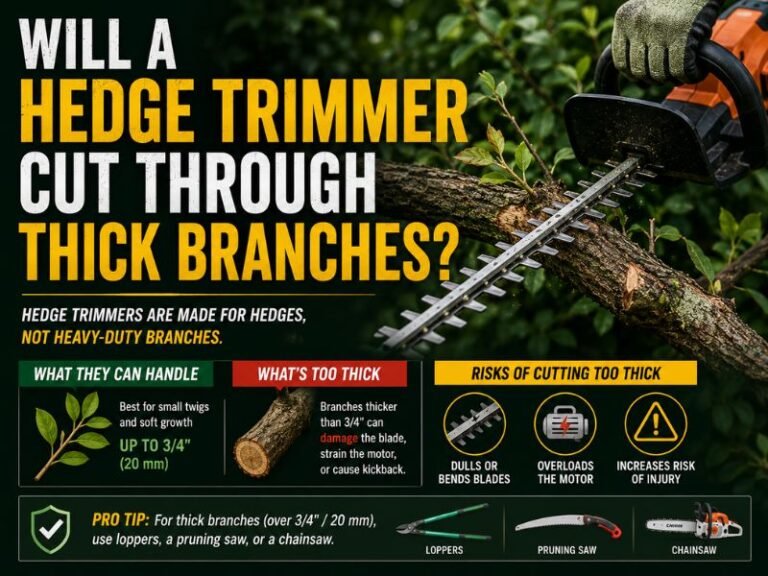
A Branch May Be Too Thick for the Hedge Trimmer
Hedge trimmers are designed primarily for relatively small stems.
If a branch exceeds the tool’s rated cutting capacity, it can wedge between the teeth and stop the blade.
This may cause:
- Immediate stall
- Blade jam
- Tool shutdown
- Motor overload
- Battery protection activation
If the trimmer repeatedly stops on the same branch, switch to a more appropriate tool.
Use:
- Hand pruners for small individual branches
- Loppers for thicker branches
- Pruning saw for larger woody limbs
Do not keep forcing the hedge trimmer through material it was not designed to cut.
A Weak Battery Can Stop the Blade
For cordless hedge trimmers, battery condition matters.
A weak or nearly discharged battery may cause:
- No startup
- Blade movement for only a second
- Intermittent operation
- Tool stopping under load
Check:
- Battery charge level
- Whether the battery is fully seated
- Battery contacts for dirt
- Whether another known-good compatible battery works
A battery may still light an indicator while lacking enough power under load.
If the tool works normally with another compatible battery, the original battery may be the problem.
The Battery or Tool May Be Too Hot
Heavy trimming creates heat.
Repeated blade stalls, dense growth, and hot outdoor conditions can increase that heat quickly.
Some cordless tools may shut down when the battery or electronics become too hot.
If the tool stops after heavy use:
- Remove the battery.
- Check for blade obstruction.
- Allow the tool and battery to cool.
- Reinstall the battery after they return to a normal temperature.
- Try again.
Do not assume every shutdown means the battery is defective.
It may simply be an overload or heat-protection event.
Corded Hedge Trimmers May Have a Power Problem
If you have a corded hedge trimmer and nothing happens, inspect the electrical supply.
Check:
- Wall outlet
- Extension-cord connection
- Plug
- Visible cord damage
- Breaker
- GFCI outlet if applicable
If the cord has:
- Exposed conductors
- Melted insulation
- Burned areas
- Crushed sections
stop using the tool.
A damaged power cord should not be treated as a minor inconvenience.
The Safety Switch May Not Be Fully Engaged
Many hedge trimmers require two controls before the motor starts.
Common controls include:
- Main trigger
- Front-handle safety switch
- Lock-off button
If one control is not fully pressed, the tool may appear dead even though the battery or electrical supply is fine.
Follow the normal startup procedure for your model.
Do not tape down, bypass, or disable a safety switch.
Those controls are designed to prevent accidental blade movement.
Blade Hardware May Be Loose or Too Tight
Depending on the hedge trimmer design, blade hardware can affect movement.
Problems may occur if:
- Fasteners loosen
- Blade assembly shifts
- Adjustment becomes too tight
- Blade surfaces bind against each other
Do not randomly tighten blade bolts.
Some hedge trimmers require specific adjustment or torque values.
If the blade hardware appears loose or unusual, follow the maintenance procedure for the exact model.
The Gearbox or Drive Mechanism May Be Damaged
A hedge trimmer motor does not simply spin the blades directly.
A mechanical drive system converts motor rotation into the back-and-forth movement of the cutting blades.
Depending on the design, this can involve:
- Gears
- Cam mechanism
- Eccentric drive
- Linkage
If one of these internal components fails, the motor may still run while the blade remains stationary.
Possible symptoms include:
- Motor sounds normal
- Blade does not move
- Grinding noise
- Clicking from inside housing
- Blade stopped suddenly during operation
If no external blade jam is present and the motor runs without blade movement, an internal drive fault becomes more likely.
What If the Motor Runs but the Blade Does Not Move?
This symptom is especially useful for diagnosis.
If the motor clearly runs but the blade stays still, possible causes include:
- Blade jam
- Broken gear
- Stripped drive component
- Disconnected linkage
- Damaged gearbox
Stop the tool rather than continuing to run the motor.
A spinning motor with a disconnected or damaged drive mechanism can make internal damage worse.
First inspect the external blade for obstructions.
If nothing is jammed and the blade still does not move, service may be required.
What If the Motor Hums but the Blade Does Not Move?
A humming or struggling sound usually suggests the motor is trying to move the blade against resistance.
Possible causes include:
- Jammed branch
- Heavy sap buildup
- Bent blade
- Tight blade adjustment
- Internal mechanical binding
Do not keep holding the trigger.
If the motor cannot overcome the resistance, continued operation may overheat the tool.
Disconnect power and inspect the blade instead.
What If the Hedge Trimmer Is Completely Silent?
A silent hedge trimmer usually points toward the power or control side rather than a simple blade jam.
Check in this order:
- Battery charge or power outlet
- Battery seating or plug connection
- Safety switch and trigger
- Overheat or overload condition
- Extension cord
- Visible wiring damage
- Internal switch or motor fault
If the power supply is definitely good and the controls are functioning correctly, the tool may require professional service.
Why Is My Hedge Trimmer Blade Moving Slowly?
Sometimes the blade moves, but much more slowly than normal.
Possible causes include:
- Dry blade
- Sap buildup
- Weak battery
- Excessive friction
- Bent blade
- Thick vegetation
- Gear wear
- Internal mechanical damage
First test the tool with no vegetation around the blade.
If it moves slowly even when unloaded, the problem is probably not simply the hedge being too thick.
Clean and lubricate the blade, inspect for damage, and verify the power supply.
Why Does My Hedge Trimmer Keep Stopping?
Repeated stopping usually means the tool is being overloaded or something is preventing free blade movement.
Common causes include:
- Branches too thick
- Dense hedge growth
- Blade binding
- Low battery
- Battery overheating
- Motor overheating
- Mechanical fault
Pay attention to when the tool stops.
If it runs normally with no vegetation but stops while cutting, the workload may be too heavy.
If it stops even when the blade is unloaded, look more closely for a mechanical or electrical problem.
How to Troubleshoot a Hedge Trimmer Blade That Won’t Move
Use a simple sequence.
Step 1: Disconnect the Power
Remove the battery, unplug the cord, or shut down the engine.
Step 2: Inspect for Obstructions
Check the full blade length for:
- Branches
- Vines
- Wire
- Grass
- Debris
Step 3: Inspect Blade Condition
Look for:
- Bent teeth
- Misalignment
- Cracks
- Obvious damage
Step 4: Clean the Blade
Remove sap, dirt, and plant residue.
Step 5: Lubricate the Blade
Use the lubricant recommended for the tool.
Step 6: Check the Power Supply
For cordless models:
- Charge battery
- Reseat battery
- Try a known-good compatible battery if available
For corded models:
- Test outlet
- Inspect cord and plug
Step 7: Verify Safety Controls
Make sure the normal startup controls are being used correctly.
Step 8: Test the Tool Unloaded
After restoring power safely, test the hedge trimmer without vegetation in the blade.
Step 9: Listen to the Tool
The sound can help identify the problem.
- No sound: power or control issue
- Humming: likely binding
- Motor runs normally but blade does not move: drive issue
Step 10: Stop if Internal Repair Is Needed
Do not continue operating a tool with clear mechanical failure.
When Should You Stop Troubleshooting?
Stop using the hedge trimmer if you notice:
- Smoke
- Burning smell
- Sparks
- Melted plastic
- Severely bent blade
- Cracked housing
- Damaged electrical cable
- Grinding noises
- Motor running without blade movement
- Repeated unexplained shutdowns
These symptoms suggest the problem is beyond routine cleaning and lubrication.
Continuing to run the tool may increase damage or create a safety hazard.
How to Prevent the Blade From Jamming Again
Regular maintenance can prevent many blade problems.
Clean the Blade After Use
Remove plant residue before it dries.
Lubricate as Recommended
Proper lubrication reduces friction.
Avoid Oversized Branches
Switch to loppers or a pruning saw when needed.
Inspect Hedges Before Cutting
Look for:
- Wire
- Fence
- Garden stakes
- Hidden metal objects
Do Not Force Dense Growth
Use smaller passes instead.
Keep the Blade Maintained
A dull or damaged blade works harder and jams more easily.
Store the Tool Properly
Keep it clean, dry, and protected from moisture.
Common Mistakes to Avoid
- Clearing a jam without disconnecting power
- Pulling branches from the blade with bare hands
- Holding the trigger while the blade is stuck
- Forcing branches beyond the rated cutting capacity
- Ignoring sap buildup
- Running a bent blade
- Randomly tightening blade hardware
- Bypassing safety switches
- Assuming every shutdown is a battery failure
- Continuing to operate after grinding or burning smells
Frequently Asked Questions
Why Is My Hedge Trimmer Blade Not Moving?
Common causes include debris jams, dried sap, insufficient lubrication, blade damage, battery problems, power-supply faults, or internal gearbox and drive problems.
Why Does My Hedge Trimmer Motor Run but the Blade Doesn’t Move?
A jammed blade, broken gear, stripped drive component, or damaged internal linkage may be preventing motor power from reaching the blade.
Why Does My Hedge Trimmer Hum but Not Move?
The blade may be mechanically bound by debris, dried sap, a bent blade, or an internal jam.
How Do I Unjam a Hedge Trimmer Blade?
Disconnect the tool completely from power, inspect the blade, and carefully remove the obstruction according to the manufacturer’s instructions.
Can Sap Stop Hedge Trimmer Blades From Moving?
Yes. Heavy dried sap can increase friction enough to make the blade stiff or difficult to move.
Does a Hedge Trimmer Blade Need Lubrication?
Yes. Proper lubrication reduces friction and helps the reciprocating blades move freely.
Can a Bent Blade Stop a Hedge Trimmer?
Yes. A bent or misaligned blade may bind against the other blade section and prevent movement.
Why Does My Cordless Hedge Trimmer Keep Stopping?
Possible causes include low battery charge, overheating, blade jams, thick vegetation, or internal tool faults.
Why Does My Hedge Trimmer Stop on Thick Branches?
The branch may exceed the trimmer’s cutting capacity and wedge between the teeth.
Can a Weak Battery Make the Blade Stop Moving?
Yes. A weak battery may allow brief operation but fail when the motor is placed under load.
How Do I Know if My Hedge Trimmer Gearbox Is Bad?
A motor that runs while the blade remains stationary, especially with grinding or clicking noises, can indicate a gearbox or drive-mechanism problem.
When Should I Repair or Replace a Hedge Trimmer?
Consider professional repair or replacement when there is severe blade damage, gearbox failure, motor failure, cracked housing, repeated shutdowns, or electrical damage.
Conclusion
If you’re asking “why is my hedge trimmer blade not moving,” start by checking for a jammed or dirty blade, poor lubrication, blade damage, and power-supply problems before assuming the motor or gearbox has failed.
Many blade problems are caused by simple issues such as branches trapped between the teeth, dried plant sap, or an undercharged battery. Those are worth checking first because they can often be identified without opening the tool.
The sound of the hedge trimmer also provides useful clues. A completely silent tool suggests a power, switch, or motor issue. A humming motor often points to mechanical binding, while a motor that runs normally with a stationary blade may indicate a damaged gearbox or drive mechanism.
Always disconnect the tool before touching the cutting assembly. Never keep holding the trigger when the blade is jammed, and do not force oversized branches through the teeth.
If you notice smoke, burning smells, grinding, melted components, major blade damage, or a motor running without blade movement, stop using the tool and have it serviced.
Start with the simple external causes—debris, sap, lubrication, blade condition, and power. If those check out and the blade still will not move, the problem may be inside the drive system and require repair.