Will a Hedge Trimmer Cut Through Thick Branches?
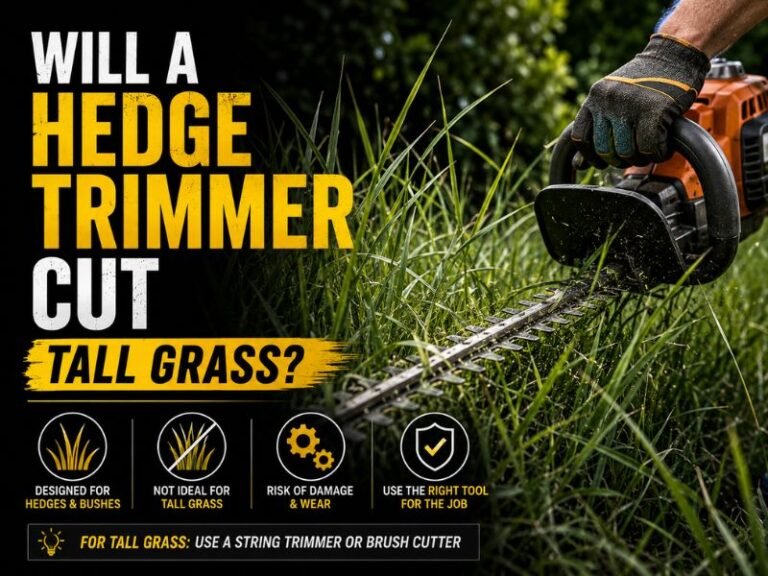
A hedge trimmer can cut some thicker branches, but only when they are within the tool’s rated cutting capacity. Large, hard, or mature woody branches are better handled with loppers, pruning shears, or a pruning saw.
Hedge trimmers are designed to shear many relatively small stems quickly while shaping hedges and shrubs. They are not intended to replace dedicated pruning tools for large branches. A branch may physically fit between the blade teeth and still be too hard or thick for the trimmer to cut efficiently.
The correct limit depends on your exact hedge trimmer, the branch diameter, wood hardness, blade condition, and whether the growth is fresh, mature, or dead.
Will a Hedge Trimmer Cut Through Thick Branches?
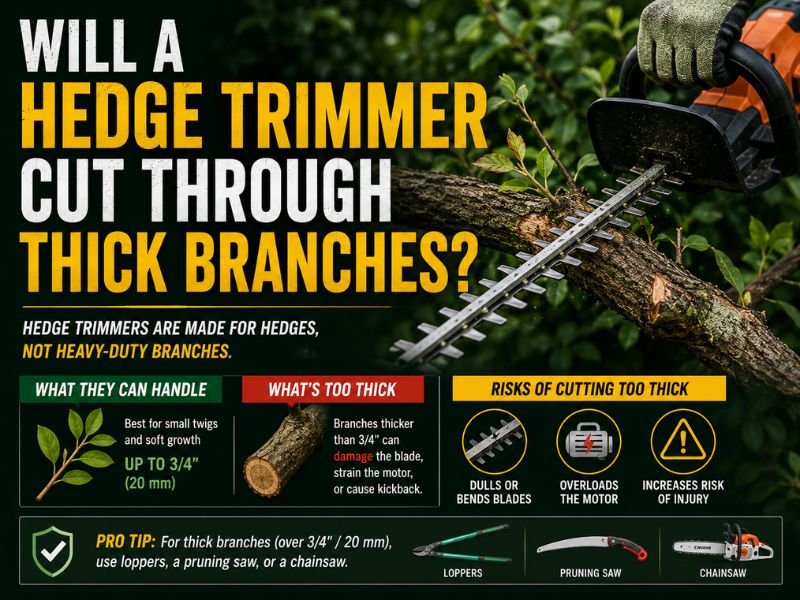
Sometimes.
A hedge trimmer generally performs best on:
- Small hedge stems
- Young branches
- Fresh green growth
- Thin woody shoots
- Multiple small stems at once
It becomes less suitable as branches become:
- Thicker
- Older
- Harder
- Dry
- Dense
- Difficult to fit between the cutting teeth
If a branch is within the manufacturer’s stated cutting capacity, the hedge trimmer may cut it without difficulty.
If it exceeds that capacity, forcing the blades through the wood can jam the tool, damage the cutting teeth, or place unnecessary stress on the motor and gearbox.
How Thick of a Branch Can a Hedge Trimmer Cut?
There is no single branch diameter that applies to every hedge trimmer.
Different models have different cutting capacities.
A compact residential hedge trimmer may be designed primarily for light hedge growth, while a heavier-duty model may handle larger stems.
The best way to determine your limit is to check the specification for your exact model.
Look for terms such as:
- Cutting capacity
- Maximum branch diameter
- Blade gap
- Tooth spacing
Do not assume that every hedge trimmer with a similar blade length can cut the same branch size.
A 24-inch blade, for example, tells you how long the cutting bar is. It does not automatically tell you how thick a branch the machine can handle.
Blade Gap and Cutting Capacity Are Not Always the Same
This is an important distinction.
Blade Gap
Blade gap refers to the physical space between the cutting teeth.
A branch must generally fit into the cutting area before the blades can shear it.
Cutting Capacity
Cutting capacity refers to the size of branch the tool is designed to cut under appropriate conditions.
These two measurements may be related, but they should not automatically be treated as identical.
A branch can fit between the teeth and still be:
- Too hard
- Too dry
- Too dense
- Too difficult for the motor
- Beyond the intended cutting capacity
The safest approach is to follow the manufacturer’s rated branch capacity rather than judging only by what fits between the teeth.
Why Thick Branches Are Harder to Cut
As branch diameter increases, the blades must shear through more wood.
That creates greater resistance.
The result can be:
- Slower cutting
- Higher motor load
- More vibration
- Blade stalling
- Increased risk of jamming
A hedge trimmer works efficiently because it repeatedly cuts small amounts of material as you move across a hedge.
A large branch changes the job from fast hedge shaping to heavy wood cutting.
At some point, a lopper or pruning saw becomes much more effective.
Does the Type of Branch Matter?
Yes.
Two branches with the same diameter can behave very differently.
Fresh Green Branches
Young growth is often:
- Softer
- More flexible
- Easier to shear
These branches may be relatively easy for a hedge trimmer to cut when they are within the tool’s capacity.
Mature Woody Branches
Older growth is often:
- Harder
- Denser
- More resistant
A mature branch can challenge the trimmer even if it is not especially large.
Dead or Dry Branches
Dead wood can become very hard and brittle.
It may resist the blades more than fresh growth and create rougher cuts.
That means you should not assume that a trimmer that easily cuts a green branch of a certain diameter will perform exactly the same on dry wood of the same size.
Can an Electric Hedge Trimmer Cut Thick Branches?
Yes, some electric hedge trimmers can cut relatively substantial hedge stems when those stems are within the model’s rated capacity.
Corded electric trimmers have the advantage of continuous electrical power, but that does not remove the tool’s mechanical cutting limit.
A powerful motor cannot compensate indefinitely for:
- Excessively thick wood
- Hard dead branches
- Damaged blades
- Branches larger than the tooth opening
If the blade repeatedly stops on the same branch, switch to a more suitable pruning tool.
Can a Cordless Hedge Trimmer Cut Thick Branches?
Yes, depending on the model.
Modern cordless hedge trimmers can be capable tools for residential and professional hedge maintenance.
Their performance depends on:
- Motor design
- Battery condition
- Blade geometry
- Cutting capacity
- Branch hardness
A fully charged battery helps the tool perform normally, but additional battery power does not make the trimmer capable of cutting branches beyond its mechanical design.
If a thick branch repeatedly stalls the blade, forcing it can drain the battery quickly and place unnecessary stress on the tool.
Can a Gas Hedge Trimmer Cut Larger Branches?
Gas hedge trimmers are commonly used for demanding hedge work, particularly where long runtime is important.
Some professional models are capable of cutting relatively heavy hedge growth.
However, a gas engine does not turn a hedge trimmer into a pruning saw.
Large individual branches still require the appropriate pruning tool.
Always follow the cutting-capacity rating of the specific gas hedge trimmer.
What Happens If a Branch Is Too Thick?
When the branch exceeds what the trimmer can handle, you may notice:
- Blade stops moving
- Branch becomes trapped between the teeth
- Motor slows significantly
- Tool shuts down
- Battery protection activates
- Branch is crushed rather than cleanly cut
- Cutting becomes extremely slow
These are signs that you should stop rather than push harder.
A hedge trimmer should shear suitable branches relatively cleanly.
If you have to repeatedly force the tool against one branch, it is probably time to switch tools.
Can Thick Branches Damage a Hedge Trimmer?
Yes.
Repeatedly forcing oversized branches can contribute to:
- Bent blade teeth
- Dull cutting edges
- Blade misalignment
- Gear wear
- Excessive motor load
- Overheating
- Fast battery drain
A single difficult branch may not destroy a hedge trimmer, but regularly using the tool beyond its intended capacity can shorten its useful life.
It can also leave poor cuts on the plant.
How to Cut a Thicker Branch With a Hedge Trimmer
Only attempt this if the branch is within the tool’s rated capacity.
Check the Branch First
Look at:
- Diameter
- Wood hardness
- Whether it is green or dead
- Whether other branches are tangled around it
Confirm the Trimmer’s Capacity
Check your manual or product specifications.
Position the Branch Properly
Allow the branch to enter the main cutting area of the blade.
Avoid trying to force a difficult branch using only the very end of the trimmer.
Let the Blades Do the Work
Use controlled pressure rather than pushing aggressively.
If the branch does not begin cutting normally, stop.
Switch Tools When Necessary
An individual thick branch can often be removed much faster with loppers or a pruning saw.
What Should You Do If the Hedge Trimmer Gets Stuck?
If a branch jams the blade, do not pull at it while the tool can still start.
Instead:
- Release the trigger or switch.
- Wait until the blades stop completely.
- Disconnect the power source as appropriate.
- Remove the battery from a cordless tool when instructed.
- Carefully inspect the jam.
- Clear the branch according to the manufacturer’s procedure.
- Inspect the blade before restarting.
Never place your fingers between hedge-trimmer teeth while the tool is connected to a power source.
Hedge Trimmer vs. Loppers for Thick Branches
Loppers are often the better choice for individual branches that are too large for normal hedge trimming.
Hedge Trimmer
Best for:
- Many thin branches
- Hedge shaping
- Fast surface trimming
- Young growth
Loppers
Best for:
- Individual thicker branches
- Controlled pruning
- Woody stems
- Branches that repeatedly jam a hedge trimmer
This combination works well when maintaining an old hedge.
Use the hedge trimmer for the majority of the surface, then remove occasional heavy branches separately with loppers.
Hedge Trimmer vs. Pruning Saw
A pruning saw is designed to cut wood through repeated sawing action rather than shearing it between reciprocating teeth.
It is usually a better choice for:
- Larger branches
- Mature woody limbs
- Thick dead branches
- Branches too large for loppers
A hedge trimmer is much faster when dealing with dozens of small shoots.
A pruning saw is more efficient when dealing with one substantial branch.
Hedge Trimmer vs. Pole Saw
These tools may both be used around shrubs and trees, but they serve very different purposes.
Hedge Trimmer
Designed for:
- Shaping
- Small stems
- Dense hedge growth
Pole Saw
Designed for:
- Individual elevated branches
- Larger woody limbs
- Tree pruning from a distance
A pole hedge trimmer should not be confused with a pole saw.
The long reach does not automatically increase branch-cutting capacity.
Can a Hedge Trimmer Cut Tree Branches?
It can cut small tree twigs or young branches when they are within the tool’s capacity.
However, a hedge trimmer is not a general-purpose tree-pruning tool.
Tree branches become woody and substantial quickly.
For individual tree branches, use tools such as:
- Hand pruners
- Loppers
- Pruning saws
- Appropriate pole saws
The hedge trimmer is better kept for small surface growth and hedge shaping.
Can a Hedge Trimmer Cut Bamboo?
Some young, thin bamboo shoots may be cut by a sufficiently capable hedge trimmer.
Mature bamboo is different.
It can be:
- Hard
- Fibrous
- Tough
- Difficult to shear cleanly
Large mature bamboo should not be forced through hedge-trimmer blades.
Use a cutting tool appropriate to the stalk size.
Can a Hedge Trimmer Cut Vines?
Some thin vines can be cut.
However, vines can create another problem: wrapping.
Long flexible vines may become tangled around:
- Blade teeth
- Blade bar
- Nearby branches
Woody mature vines may also become too thick for the trimmer.
If vegetation repeatedly wraps around or stalls the blades, stop and use a more suitable method.
How Do You Know a Branch Is Too Thick?
Watch the way the hedge trimmer reacts.
Warning signs include:
- Branch does not fit comfortably
- Blade repeatedly stops
- Motor slows dramatically
- Tool shuts off
- Branch is crushed rather than cut
- You need significant force to make progress
A simple rule works well:
If the hedge trimmer cannot shear the branch cleanly without being forced, use a different pruning tool.
Does a Dull Hedge Trimmer Struggle With Thick Branches?
Yes.
Dull blades can cause:
- Slow cutting
- Ragged cuts
- Branch crushing
- Increased motor load
- More blade jams
Keeping the cutting system in proper condition helps the trimmer perform as designed.
However, sharpening the blade does not increase the manufacturer’s maximum cutting capacity.
A sharp hedge trimmer is still the wrong tool for an oversized branch.
What Tool Should You Use for Different Growth?
| Growth Type | Better Tool |
| Thin hedge shoots | Hedge trimmer |
| Small individual branches | Hand pruner |
| Medium woody branches | Loppers |
| Larger woody branches | Pruning saw |
| High larger branches | Appropriate pole saw |
| Many small hedge stems | Hedge trimmer |
Using the right tool usually produces a cleaner cut and reduces unnecessary wear.
Common Mistakes
Avoid these common errors:
- Assuming any branch that fits between the teeth can be cut
- Ignoring the manufacturer’s cutting capacity
- Forcing stalled blades
- Using a hedge trimmer on large tree limbs
- Treating dry wood like soft new growth
- Continuing with dull or damaged blades
- Trying to clear a jam while the tool can still start
- Repeatedly pushing oversized branches into the blade
- Assuming a higher battery voltage guarantees a larger cutting capacity
- Using a hedge trimmer when loppers would be faster
Frequently Asked Questions
Will a Hedge Trimmer Cut Through Thick Branches?
It can cut thicker branches when they are within the tool’s rated cutting capacity. Oversized or very hard branches should be cut with loppers or a pruning saw.
How Thick of a Branch Can a Hedge Trimmer Cut?
It depends on the exact model. Check the manufacturer’s cutting-capacity specification rather than relying on one universal branch diameter.
Can a Hedge Trimmer Cut 1-Inch Branches?
Some models may be rated for branches near that size, while others are not. Check your specific hedge trimmer before attempting the cut.
Can an Electric Hedge Trimmer Cut Thick Branches?
Yes, within its rated capacity. Motor power does not make oversized branches appropriate for the tool.
Can a Cordless Hedge Trimmer Cut Tree Branches?
It can cut small young tree branches if they fall within its cutting capacity, but larger tree limbs require pruning tools.
Can a Gas Hedge Trimmer Cut Larger Branches?
Some gas models handle heavier hedge growth, but their cutting limits still apply.
What Happens If a Branch Is Too Thick?
The blade may stall, jam, crush the branch, or place excessive load on the motor and gears.
Can Thick Branches Damage Hedge Trimmer Blades?
Yes. Forcing oversized wood can bend, dull, or misalign the cutting teeth.
Is a Hedge Trimmer Better Than Loppers?
A hedge trimmer is better for many small stems. Loppers are usually better for individual thicker branches.
When Should I Use a Pruning Saw?
Use a pruning saw when the branch is too large, hard, or woody for the hedge trimmer or loppers.
Can a Hedge Trimmer Cut Dead Branches?
Small dead branches may be possible, but dry wood can be harder than fresh growth. Stay within the rated cutting capacity.
Why Does My Hedge Trimmer Keep Jamming on Branches?
The branches may be too thick, too hard, tangled, or beyond the tool’s capacity. Dull or damaged blades can also contribute.
Conclusion
If you’re asking “will a hedge trimmer cut through thick branches,” the answer depends on the branch diameter, wood hardness, and the rated cutting capacity of your specific hedge trimmer.
A hedge trimmer is designed to make quick work of many relatively small stems. Fresh green growth is generally easier to shear than old, dry, or heavily woody branches, even when the branches look similar in size.
Do not judge cutting ability only by the gap between the blade teeth. A branch that fits physically may still be harder than the tool is designed to handle.
If the blades repeatedly stall, the motor slows dramatically, or you have to force the tool into the branch, stop and switch to a better-suited pruning tool.
Loppers are excellent for individual medium-size branches, while a pruning saw is a better option for larger woody limbs. Pole saws are more appropriate for substantial branches located overhead.
A hedge trimmer is best for shearing many smaller hedge stems quickly. Once a branch approaches or exceeds the tool’s rated cutting capacity, using loppers or a pruning saw is safer, easier, and more effective.