Why Is My Hedge Trimmer Not Cutting? Common Causes & Fixes
If your hedge trimmer is running but not cutting properly, the most common causes are dull or dirty blades, poor lubrication, damaged or misaligned teeth, vegetation that is too thick, or a power problem that keeps the blades from reaching normal speed.
A hedge trimmer can appear to be working normally because the motor runs and the blades move, yet still leave branches partially cut, torn, or untouched. The exact symptom matters. A trimmer that pushes branches away usually has a different problem from one whose blades move slowly or repeatedly stop.
Start by checking blade condition and the type of vegetation you are cutting before assuming the motor has failed.
Why Is My Hedge Trimmer Not Cutting?
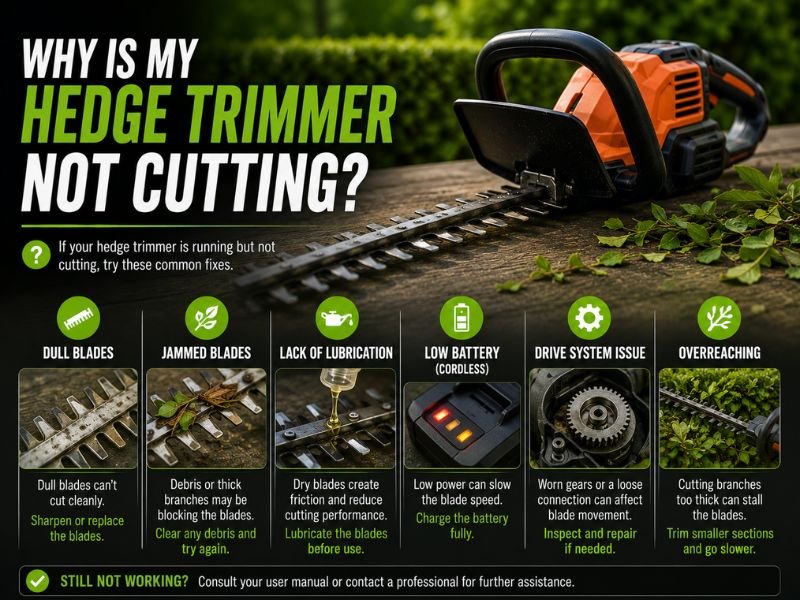
Several problems can reduce cutting performance:
- Dull blade edges
- Sap and plant residue
- Lack of lubrication
- Bent or damaged teeth
- Blade misalignment
- Branches beyond the rated cutting capacity
- Hard or dead wood
- Weak battery
- Low blade speed
- Electrical supply problems
- Internal drive wear
A useful first question is:
Are the blades moving at normal speed?
If they move normally but do not cut, focus first on blade sharpness, blade condition, and branch size.
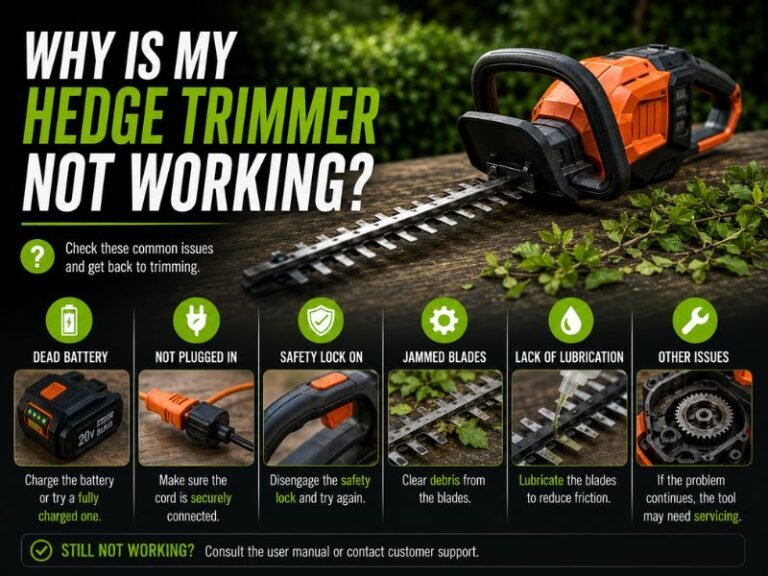
If they move slowly, jerk, or stop, check lubrication, binding, battery or electrical power, and the drive system.
Dull Hedge Trimmer Blades Are a Common Cause
A hedge trimmer works by shearing stems between moving cutting surfaces.
When those cutting edges become dull, vegetation may bend or tear instead of being sliced cleanly.
Signs of dull blades include:
- Ragged branch ends
- Leaves torn rather than cut
- Multiple passes required
- Branches bending away
- Slower cutting than before
- Increased effort on ordinary hedge growth
Dullness usually develops gradually, so it is easy not to notice until performance becomes significantly worse.
If your trimmer used to cut the same hedge easily but now struggles with similar growth, blade condition should be one of your first checks.
How Do You Know if Hedge Trimmer Blades Need Sharpening?
Inspect the cutting edges after fully disconnecting the tool from its power source.
Look for:
- Rounded edges
- Visible nicks
- Uneven cutting surfaces
- Areas that no longer feel or look sharp
- Teeth that leave crushed rather than clean cuts
Poor cutting does not always mean sharpening is the solution.
A blade that is badly bent, cracked, chipped, or misaligned may need service or replacement instead.
Follow the maintenance instructions for your specific hedge trimmer because blade designs and sharpening procedures vary.
Sap and Dirt Can Make a Hedge Trimmer Cut Poorly
Hedge trimming naturally deposits sap, leaves, dirt, and other plant material on the blades.
Over time, this buildup can create a sticky layer that increases friction and prevents vegetation from moving cleanly into the cutting teeth.
You may notice:
- Sticky blades
- Slower cutting
- Plant material collecting between teeth
- Increased motor effort
- Poor performance after trimming resinous plants
With the power disconnected, clean the blade according to the manufacturer’s recommendations.
After the residue is removed, lubricating the blade can help restore smooth movement.
The Blades May Need Lubrication
Hedge-trimmer blades move rapidly against each other.
Proper lubrication reduces friction between those surfaces.
When blades become too dry, you may notice:
- Slower blade movement
- More heat
- Increased noise
- Reduced cutting performance
- Faster battery drain
- More frequent binding
Lubrication can improve a dry, sticky blade, but it cannot correct every problem.
It will not repair:
- Dull edges
- Bent teeth
- Broken gears
- Cracked blades
- Serious alignment problems
Clean first, then lubricate as recommended for your model.
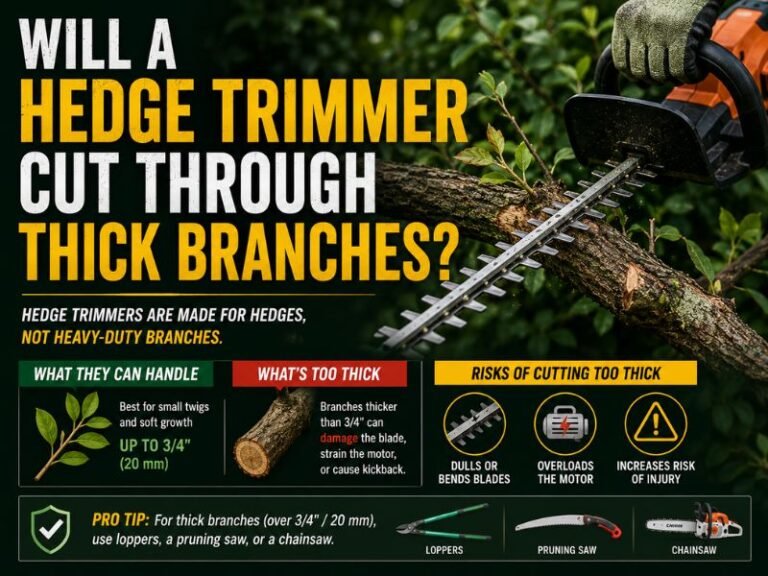
The Branches May Be Too Thick
Every hedge trimmer has a cutting limit.
If you attempt to cut branches beyond that capacity, the blades may:
- Push the branch aside
- Partially cut it
- Stall
- Jam
- Crush the wood
- Overload the tool
Do not assume a branch is safe to cut simply because it fits between the blade teeth.
The manufacturer’s rated cutting capacity is the better guide.
For branches that are too large, use:
- Hand pruners
- Loppers
- Pruning saw
Trying to force oversized branches through a hedge trimmer can damage both the blade and drive mechanism.
Hard or Dead Wood Can Be More Difficult to Cut
Branch diameter is not the only factor.
Fresh green growth is generally easier to shear than mature woody growth.
Dead branches can be harder and more brittle.
That means two branches with the same diameter may cut very differently.
A hedge trimmer that easily cuts a fresh stem may struggle with a dry branch of similar size.
If the tool handles soft growth normally but refuses older woody branches, the problem may be the material rather than the hedge trimmer.
Bent or Damaged Teeth Can Reduce Cutting Performance
Hedge-trimmer blades can be damaged by hitting objects such as:
- Fence wire
- Metal posts
- Rocks
- Garden stakes
- Thick branches
A bent tooth can interfere with normal shearing action.
Symptoms may include:
- One section of blade cutting poorly
- Repeated jams at the same location
- Uneven movement
- Scraping sounds
- Performance problems immediately after hitting something
Do not continue forcing a visibly damaged blade through vegetation.
A bent section may place extra stress on the drive system and other blade components.
Blade Misalignment Can Stop Clean Cutting
The moving blade sections must pass each other correctly to shear vegetation.
If they become misaligned, stems may slip through instead of being cut.
Misalignment can result from:
- Impact damage
- Loose hardware
- Wear
- Incorrect blade adjustment
- Bent components
You may notice that the blades move but leave stems partially cut.
Blade adjustment can be model-specific, so avoid randomly tightening bolts or changing clearances without the proper procedure.
Why Does My Hedge Trimmer Push Branches Instead of Cutting?
This is usually caused by one of four things:
- Dull blades
- Branches that are too thick
- Flexible stems bending away
- Low blade speed
A sharp blade moving at normal speed should trap appropriate-size growth between the teeth and shear it.
If the vegetation repeatedly bends instead, first test the tool on smaller fresh stems.
If it cuts those normally, the original branches may be too thick or hard.
If it also pushes smaller stems, blade sharpness or blade speed deserves closer inspection.
Why Does My Hedge Trimmer Cut Leaves but Not Branches?
Leaves require very little cutting force.
Woody stems demand substantially more.
If the trimmer cuts leaves easily but fails on branches, possible causes include:
- Branch diameter exceeds capacity
- Blades are dull
- Branches are old or hard
- Blade speed is below normal
- Teeth are damaged
If the tool previously cut similar branches successfully, inspect blade condition.
If it has always struggled with those branches, the vegetation may simply be beyond the tool’s intended capacity.
A Weak Battery Can Reduce Cutting Power
For cordless hedge trimmers, battery condition can affect blade speed and performance.
A weak or nearly discharged battery may cause:
- Reduced blade speed
- Tool stopping under load
- Short runtime
- Poor performance on thicker stems
Check:
- Battery charge
- Battery seating
- Contacts for dirt
- Whether another known-good compatible battery works normally
A battery may have enough power to operate the tool without load but struggle once the blade enters dense vegetation.
If performance is strong with a fresh battery and weak with another pack, the battery may be contributing to the problem.
Heat Can Cause a Cordless Hedge Trimmer to Slow or Stop
Heavy trimming generates heat.
Conditions that increase load include:
- Dense hedges
- Thick branches
- Dirty blades
- Poor lubrication
- Repeated jams
- Hot outdoor weather
Some cordless tools may reduce power or shut down to protect the battery or electronics.
If the trimmer becomes weak after heavy use, disconnect the battery, inspect the blade for binding, and allow both the tool and battery to return to a normal temperature before trying again.
Corded Hedge Trimmers Can Have Power-Supply Problems
A corded hedge trimmer may lose performance if it is not receiving proper electrical power.
Check:
- Outlet
- Plug
- Extension cord
- Cord connections
- Visible cable damage
An excessively long or unsuitable extension cord can contribute to voltage drop and poor tool performance.
Stop using the tool immediately if you see:
- Exposed wires
- Melted insulation
- Burn damage
- Damaged plug
Electrical damage should be repaired rather than worked around.
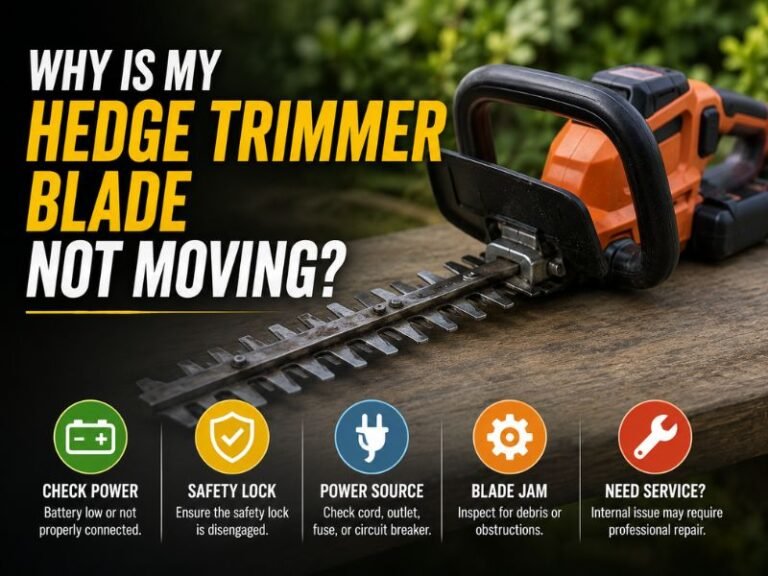
Why Is My Hedge Trimmer Blade Moving Slowly?
Slow blade speed usually points to a different problem than dull cutting edges.
Possible causes include:
- Weak battery
- Dry blades
- Heavy sap buildup
- Mechanical binding
- Bent blade
- Motor problem
- Gear or drive wear
Test the tool without vegetation around the blade.
If blade speed remains noticeably slow when unloaded, the hedge itself is probably not the main problem.
Clean and lubricate the blade, verify the power source, and inspect for visible damage.
Why Does My Hedge Trimmer Keep Jamming?
Repeated jamming may be caused by:
- Branches that are too large
- Dense vegetation
- Tangled vines
- Dull blades
- Sticky sap
- Bent teeth
- Too much material entering at once
Try smaller, controlled passes rather than pushing the entire blade deeply into dense growth.
If a few large branches are causing the jams, remove them separately with loppers or a pruning saw.
If the blade jams even on light growth, inspect the tool more closely.
Internal Gear or Drive Problems Can Reduce Cutting Power
If the blade is clean, lubricated, undamaged, and receiving adequate power but still performs poorly, the problem may be inside the drive mechanism.
A hedge trimmer typically uses a mechanical system to convert motor rotation into reciprocating blade movement.
Wear or damage can affect:
- Gears
- Drive cam
- Linkage
- Other internal components
Possible symptoms include:
- Jerky blade movement
- Reduced blade stroke
- Clicking
- Grinding
- Motor running normally while blade action seems weak
Internal mechanical faults may require professional service.
How to Fix a Hedge Trimmer That Is Not Cutting Properly
Use a simple troubleshooting sequence.
1. Disconnect the Power
Remove the battery or unplug the hedge trimmer before touching the blades.
2. Clean the Blade
Remove:
- Sap
- Leaves
- Dirt
- Twigs
- Other debris
3. Inspect the Teeth
Look for:
- Dull edges
- Bent teeth
- Cracks
- Chips
- Misalignment
4. Lubricate the Blade
Use the lubricant recommended for the tool.
5. Check the Vegetation
Make sure the stems are within the trimmer’s rated cutting capacity.
6. Check the Power Source
For cordless models:
- Fully charge battery
- Reseat battery
- Test another compatible battery if available
For corded models:
- Check outlet
- Inspect extension cord
- Check plug and cable
7. Test the Blade Unloaded
After safely restoring power, observe blade movement without vegetation.
It should move smoothly and at normal speed.
8. Listen for Unusual Sounds
Grinding, clicking, or severe vibration can point to internal mechanical damage.
Should You Sharpen or Replace the Blades?
Sharpening may be appropriate when:
- Cutting edges are simply dull
- Teeth remain straight
- Blade is otherwise undamaged
Replacement or professional service may be more appropriate when:
- Teeth are badly bent
- Blade is cracked
- Several teeth are damaged
- Blade cannot align properly
- The manufacturer does not recommend user sharpening
Do not try to sharpen away serious structural damage.
How to Keep a Hedge Trimmer Cutting Well
Regular maintenance can prevent many performance problems.
- Clean blades after use
- Lubricate as recommended
- Avoid cutting oversized branches
- Inspect hedges for wire and metal
- Keep cordless batteries charged
- Check blades for damage
- Avoid forcing dense vegetation
- Store the tool somewhere dry
- Maintain blades according to the manual
A clean, sharp, properly lubricated blade requires less effort from the motor and generally produces a cleaner hedge.
When Should You Stop Using the Hedge Trimmer?
Stop operating the tool if you notice:
- Smoke
- Burning smell
- Sparks
- Grinding sounds
- Severely bent blades
- Cracked blade sections
- Melted housing
- Damaged power cord
- Repeated unexplained shutdowns
- Dangerous or irregular blade movement
These symptoms suggest more than ordinary dullness or dirt.
Continuing to use the tool may worsen the damage.
Frequently Asked Questions
Why Is My Hedge Trimmer Not Cutting?
The most common causes are dull or dirty blades, insufficient lubrication, branches that are too thick, blade damage, low power, or internal drive problems.
Why Does My Hedge Trimmer Run but Not Cut?
If the blade moves normally but does not cut, check blade sharpness, sap buildup, tooth damage, and branch size.
How Do I Know if My Hedge Trimmer Blades Are Dull?
Dull blades often leave ragged cuts, require several passes, and push or crush stems instead of slicing cleanly.
Why Does My Hedge Trimmer Push Branches Instead of Cutting?
The blades may be dull, the branches may be too thick, or the blade may be moving too slowly.
Why Does My Hedge Trimmer Cut Leaves but Not Branches?
Leaves require little cutting force. The branches may exceed the tool’s capacity or expose dull blade edges that are not obvious when cutting soft leaves.
Can Sap Make a Hedge Trimmer Stop Cutting?
Yes. Heavy sap buildup increases friction and can prevent stems from moving cleanly through the blades.
Do Hedge Trimmer Blades Need Lubrication?
Yes. Proper lubrication reduces friction and helps the reciprocating blades move freely.
Can You Sharpen Hedge Trimmer Blades?
Many hedge-trimmer blades can be sharpened, but the correct method depends on the blade design and manufacturer instructions.
Why Is My Hedge Trimmer Blade Moving Slowly?
Possible causes include low battery power, dry blades, sap buildup, binding, bent blades, motor problems, or drive-system wear.
Why Does My Hedge Trimmer Keep Jamming?
Oversized branches, dense vegetation, vines, dirty blades, dull teeth, or damaged blade components can all cause repeated jams.
Can a Weak Battery Affect Hedge Trimmer Cutting Power?
Yes. A weak battery can reduce blade speed and cause the trimmer to stop when cutting under load.
When Should Hedge Trimmer Blades Be Replaced?
Replacement may be appropriate when blades are badly bent, cracked, severely damaged, or unable to align properly.
Conclusion
If you’re asking “why is my hedge trimmer not cutting,” start by checking the blades for dull edges, sap buildup, poor lubrication, damage, and misalignment, then confirm that the branches are within the tool’s cutting capacity and that the motor is receiving adequate power.
A hedge trimmer can run normally while still performing poorly. When the blades move at normal speed but leave ragged cuts or push stems aside, dullness, dirt, blade damage, or oversized vegetation are the most likely places to look.
If the blade also moves slowly, focus more closely on lubrication, binding, battery condition, electrical supply, or the internal drive system.
Avoid forcing the tool through branches it cannot cut cleanly. That can turn a simple cutting problem into damaged blades, worn gears, or an overheated motor.
Clean and lubricate the blade regularly, inspect it after striking hard objects, and switch to loppers or a pruning saw when branches exceed the hedge trimmer’s rated capacity.
If the blades are clean, sharp, properly lubricated, and receiving normal power but cutting remains weak or irregular, the drive mechanism may need professional inspection or repair.