Why Does My Cordless Drill Keep Stopping? Causes and Fixes
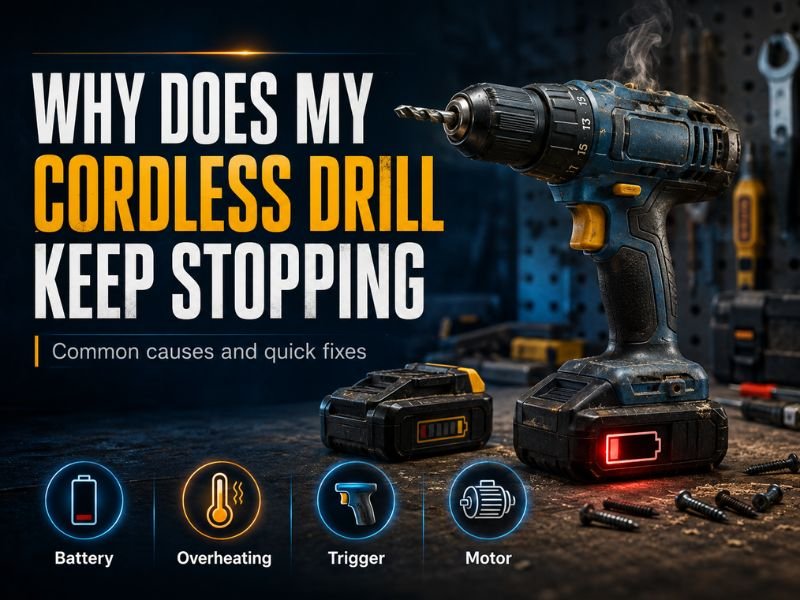
If you’re asking, “why does my cordless drill keep stopping?” the most common causes are a weak battery, overload, overheating, a low clutch setting, a binding drill bit, the wrong gear, or an electronic protection system shutting the tool down.
A drill that stops suddenly is not necessarily broken. Modern cordless drills can intentionally cut power when the tool or battery is overloaded, overheating, or experiencing a dangerous bind-up. Makita’s Star Protection, Milwaukee’s REDLINK PLUS protection, and Bosch’s KickBack Control are examples of systems that can interrupt operation under certain conditions.
The fastest way to diagnose the problem is to start with the battery and drill settings, then check the bit, workload, temperature, and safety electronics before assuming that the motor or gearbox has failed.
Why Does My Cordless Drill Keep Stopping?
A cordless drill may repeatedly stop for several different reasons:
- Low or deteriorating battery
- Battery not fully connected
- Overload
- Tool or battery overheating
- Clutch set too low
- Drill bit binding
- Incorrect mechanical gear
- Excessive drilling pressure
- Dull or inappropriate bit
- Anti-kickback protection activating
- Dirty or damaged battery contacts
- Faulty trigger or selector switch
- Chuck or gearbox problems
- Internal motor or electronic failure
DEWALT specifically explains that a drill may stall when overloaded or improperly used and advises releasing the trigger immediately rather than repeatedly trying to restart a stalled drill.
The symptoms usually tell you which cause is most likely.
1. The Battery Is Low
Start with the simplest possibility: the battery may not have enough charge to support the load.
A cordless drill can sometimes spin normally without resistance yet stop when the bit enters wood, metal, or another material. Drilling under load requires much more power than free-spinning the chuck.
Try this first:
- Remove the battery.
- Fully charge it with the correct charger.
- Reinstall it securely.
- Test the drill again.
- If available, try another known-good compatible battery.
If the second battery works properly under the same conditions, the first battery becomes a strong suspect.
Do not open a lithium-ion battery pack and attempt individual cell repairs simply because performance has declined. Power-tool manufacturers instruct users not to use damaged or modified battery packs, and battery servicing should follow manufacturer procedures.
2. The Battery May Be Overheating
A battery can also have plenty of charge and still stop powering the drill if its protection system detects excessive temperature.
High-load drilling places significant demand on a battery. Large hole saws, auger bits, dense lumber, and repeated drilling can generate substantial heat.
Makita’s Star Protection system, for example, allows compatible tools and batteries to exchange operating data. Makita states that the system monitors overload, over-discharge, and overheating conditions and can automatically stop the tool when a damaging condition is detected.
If your drill stops after prolonged heavy work and the battery feels unusually hot:
- Stop drilling.
- Remove the load from the tool.
- Allow the battery to cool naturally.
- Follow the manufacturer’s temperature requirements before charging it.
- Avoid exposing the battery to additional heat.
Do not place a hot lithium-ion battery in water, ice, or a freezer in an attempt to cool it quickly.
3. The Drill Itself Is Overheating
The battery is not the only component that can become hot.
The motor and electronics also generate heat under heavy load. Continuous drilling with large bits, excessive feed pressure, or repeated stalls can push the tool beyond the conditions it can sustain.
Milwaukee states that REDLINK PLUS intelligence in its current M18 FUEL drill/driver protects the system against overload, heating, and over-discharge. Makita likewise uses electronic protection against overload and overheating on compatible cordless drills.
Possible signs of thermal shutdown include:
- Drill operates normally when cold.
- It stops after several minutes of demanding work.
- The housing or battery becomes unusually hot.
- It works again after cooling.
- A status or protection indicator appears on models equipped with one.
If the tool repeatedly overheats during an application that should be within its capabilities, investigate the bit, speed setting, feed pressure, and battery condition.
4. The Drill Is Overloaded
Overload is one of the most common reasons a cordless drill stops under load.
DEWALT states that drills may stall when overloaded and warns that a stalled drill can produce sudden twisting reaction. The company’s guidance is to release the trigger immediately, remove the bit from the work, and determine why it stalled instead of repeatedly cycling the trigger.
Overloading often occurs while using:
- Hole saws
- Large spade bits
- Auger bits
- Self-feed bits
- Large twist bits
- Long screws
- Large-diameter fasteners
- Bits that have become trapped in a hole
Too much downward pressure can also overload the motor.
If the drill stops whenever you push harder, reduce your feed pressure. A sharp drill bit should remove material rather than requiring you to force the tool through it.
5. Your Clutch Setting Is Too Low
If your drill keeps stopping while driving screws, check the numbered collar behind the chuck.
Those numbers normally represent clutch settings.
The clutch limits the amount of torque delivered while driving fasteners. A lower setting causes the clutch to intervene at a lower torque level, while a higher setting allows more torque.
Bosch’s current drill/drivers, for example, use multiple clutch settings specifically to provide controlled fastening and reduce fastener damage.
If the drill stops or repeatedly clicks when the screw reaches a particular depth:
- Stop the drill.
- Increase the clutch one setting at a time.
- Test the screw again.
- Stop increasing once the fastener seats correctly.
This behavior is usually normal clutch operation, not a failing motor.
What About Drill Mode?
Many drill/drivers have a drill-bit symbol after the numbered clutch settings.
On the DEWALT DCD800/DCD805, for example, the drill does not use its normal clutch action when set to drilling mode.
Use drill mode for drilling. Do not automatically switch to unrestricted drill mode just to force a delicate screw farther into the material.
6. The Drill Bit Is Binding
A binding bit is another major cause of sudden stopping.
Binding means the bit’s rotation is unexpectedly restricted or stopped by the material.
This can happen when:
- A hole saw catches an edge.
- An auger bit jams.
- Wood closes around a bit.
- Chips pack into a deep hole.
- The drill moves off-axis.
- A bit breaks through the back of the material and grabs.
- Excessive pressure wedges the cutting edge.
A bind can create a strong reaction force at the drill body.
DEWALT warns users to expect sudden twisting if a drill stalls. Bosch’s KickBack Control goes further on selected drills by using sensors to detect a binding condition and shut the motor down rapidly.
If the bit binds, do not continue holding the trigger and trying to overpower it.
Release the trigger, remove the bit safely, clear the obstruction, and determine why it caught.
7. Anti-Kickback Protection May Be Stopping the Drill
Some high-torque drills intentionally stop when they detect excessive rotational movement.
That can make a perfectly functional drill appear defective if you do not know the feature exists.
Bosch KickBack Control
Bosch describes KickBack Control as a system that detects sudden rotational resistance when the accessory binds and responds by shutting down the motor.
Milwaukee AutoStop
Milwaukee’s M18 FUEL 1/2-inch drill/driver includes AutoStop Control Mode. Milwaukee states that the system is intended to prevent excessive tool rotation during a bind-up and provides a dedicated light to indicate an AutoStop protection event.
If your drill has a similar system and it stops when a large bit catches, the shutdown may mean the safety feature is working correctly.
Do not disable a protection feature simply because it interrupts the job. Correct the condition causing the bind.
8. You May Be Using the Wrong Gear
Most cordless drill/drivers have two mechanical speed ranges.
Although specifications vary by model, the usual arrangement is:
Gear 1: lower speed, suitable for higher-torque applications.
Gear 2: higher speed, suitable for many smaller-bit drilling applications.
Using a large bit in the high-speed range can cause the motor to slow, stall, or activate overload protection.
Bosch drill manuals identify dedicated gear/speed-range selectors, while current models combine their transmission ranges with adjustable clutch control.
If the drill stops with a large hole saw, auger, or other demanding accessory, check the manual to determine whether a lower speed range is recommended.
Always stop the drill before mechanically changing gears unless your specific manufacturer says otherwise.
9. You Are Applying Too Much Pressure
Pushing harder does not necessarily make a drill cut faster.
Excessive pressure increases load on:
- The motor
- The battery
- The bit
- The gearbox
- Your hands and wrists
It can also increase the likelihood of binding.
DEWALT recommends reducing pressure when a drill stalls or approaches breakthrough rather than forcing the bit through the material.
Use enough pressure to keep the cutting edges engaged, but let the bit do the cutting.
For deeper holes, periodically withdrawing the bit can also help remove chips that otherwise accumulate around the flutes.
10. Your Drill Bit Is Dull or Wrong for the Material
A drill may seem weak when the real problem is the bit.
A dull cutting edge requires greater pressure and torque to remove the same amount of material. That additional load can contribute to heat, slow drilling, binding, and electronic shutdown.
Use the appropriate bit for the application:
- Twist bit for appropriate wood or metal applications
- Brad-point bit for controlled woodworking holes
- Spade bit for larger wood holes
- Auger bit for deeper wood boring
- Hole saw for large circular openings
- Appropriate masonry bit with a suitable hammer drill when drilling masonry
Tool manufacturers instruct users to use accessories appropriate for the work and to maintain cutting tools so that cutting edges remain effective and less likely to bind.
If changing to a sharp, appropriate bit eliminates the stopping problem, the drill was probably not the cause.
11. The Battery Is Not Fully Seated
An intermittent battery connection can make the drill cut out when you move it, tilt it, or create vibration.
Remove the battery and inspect how it attaches.
Look for:
- Broken locking tabs
- Debris around the rails
- Loose engagement
- Visible housing damage
Then reinstall the pack completely.
If pressing or moving the battery changes whether the drill operates, stop using it until you determine why the connection is unreliable. A battery should remain securely attached during normal operation.
12. Battery Contacts Could Be Dirty or Damaged
Electrical power moves between the battery and drill through their contacts.
If those contact areas are damaged, heavily contaminated, overheated, or corroded, operation may become intermittent.
With the battery removed, visually check for:
- Dirt
- Corrosion
- Bent contacts
- Melted plastic
- Burn marks
- Cracks
- Other physical damage
Bosch recommends routinely inspecting batteries for damage such as cracks, swelling, or corrosion and avoiding continued use of damaged battery packs.
If you find burning, melting, swelling, or significant contact damage, do not keep testing the battery under load.
13. Electronic Battery Protection May Be Cutting Power
One of the biggest differences between older cordless drills and many modern models is electronic protection.
A current lithium-ion battery system can monitor operating conditions rather than simply delivering power until the battery is empty.
Makita’s Star Protection is a clear example. The manufacturer states that compatible tools and batteries communicate in real time and that the tool can stop automatically in response to overload, excessive discharge, or overheating.
Milwaukee similarly states that REDLINK PLUS protects its M18 FUEL drill system against overload, heating, and over-discharge.
Therefore:
Drill shuts off under extreme load and then works normally afterward: protection may be operating.
Drill repeatedly shuts off during easy work: investigate further.
Protection electronics should reduce damage, but repeated shutdowns are still a sign that something about the application, accessory, battery, or tool needs attention.
14. The Trigger Switch Could Be Failing
Not every stopping problem comes from the battery or workload.
A worn or faulty trigger can produce symptoms such as:
- Drill runs only at certain trigger positions.
- Speed fluctuates unexpectedly.
- Tool cuts out when the trigger is moved slightly.
- Drill stops under no load.
- Known-good batteries make no difference.
Power-tool safety instructions state that a tool that cannot be reliably controlled by its switch should be repaired rather than continued in service.
If the trigger behaves unpredictably, stop using the drill.
The electronic trigger assembly is not a good place for improvised repairs, particularly on a modern brushless tool.
15. Check the Forward/Reverse Selector
The forward/reverse selector can also prevent operation.
On many drills, the center position locks the trigger to reduce accidental activation.
If the selector is not pushed completely into forward or reverse, the drill may appear dead.
Before diagnosing an internal electrical fault:
- Release the trigger.
- Move the selector completely to one direction.
- Test again.
If the switch feels loose, damaged, or inconsistent, service may be necessary.
16. The Chuck or Gearbox Could Be Binding
Mechanical problems become more likely when the drill stops even under light load and produces abnormal sound or resistance.
Warning signs include:
- Grinding noise
- Excessive vibration
- Chuck difficult to rotate
- Gear selector will not fully engage
- Chuck wobble
- Repeated stopping with no significant load
- Metal-on-metal noises
Do not continue forcing the drill if the gearbox appears damaged.
Power-tool manufacturers recommend qualified service when a tool requires repair, using correct replacement parts to maintain the tool’s safety.
Why Does My Cordless Drill Stop Under Load but Run Normally?
If your drill spins perfectly in the air but stops when it begins cutting or driving, focus first on load-related causes.
The most likely possibilities are:
- Weak battery
- Overload
- Wrong gear
- Dull bit
- Oversized accessory
- Excessive pressure
- Bit binding
- Thermal protection
- Electronic overload protection
DEWALT identifies overload as a common cause of drill stalling, while Makita and Milwaukee explicitly incorporate electronic overload protection into current cordless systems.
Test the drill with a fully charged known-good battery and a small, sharp bit.
If it performs normally on light work but fails only on a demanding application, the load or setup is more likely than a general electrical failure.
Why Does My Drill Stop After a Few Seconds?
The timing can provide useful clues.
If it stops after a few seconds only during demanding drilling, consider:
- Overload
- Battery voltage dropping under load
- Electronic protection
- Binding
If it works for several minutes and then stops as the tool becomes hot, thermal protection becomes more likely.
If it stops after a few seconds even while free-spinning with a known-good battery, the trigger, contacts, electronics, or motor may require further diagnosis.
Why Does My Drill Stop and Then Start Again?
A drill that stops but works again after releasing and repressing the trigger may be responding to a temporary operating condition.
Possibilities include:
- Overload protection
- Anti-kickback activation
- Battery protection
- Intermittent electrical connection
Makita explicitly notes that Star Protection can stop a compatible tool when problematic conditions are detected; after the cause is addressed, the tool can be placed back into service.
However, automatic recovery behavior varies by manufacturer and model. Consult the exact manual rather than assuming all cordless drills reset the same way.
Why Does My Drill Keep Stopping When Driving Screws?
If stopping occurs only with screws, check the clutch first.
A low clutch setting is supposed to limit torque.
If the clutch is not the issue, consider:
- Screw is unusually long
- Dense wood
- Pilot hole is too small or absent where one is appropriate
- Battery is weak
- Wrong transmission gear
- Driver bit does not fit correctly
- Fastener has reached its intended depth
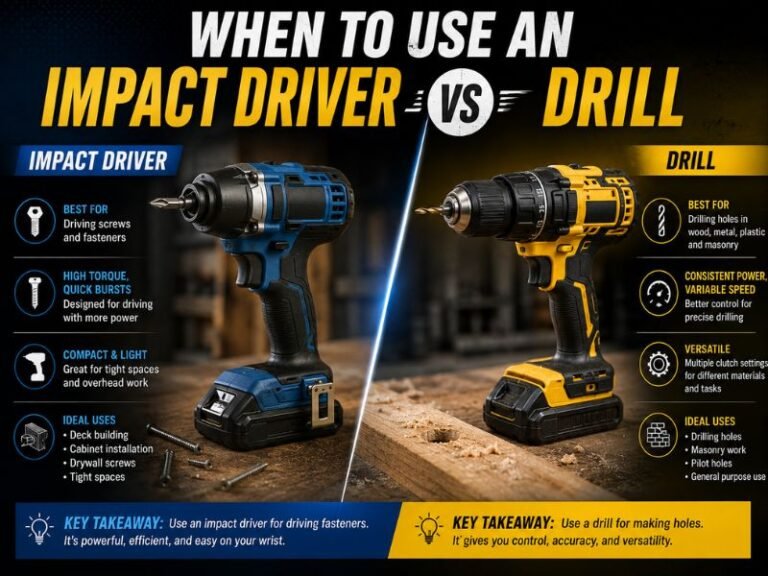
For frequent long or high-resistance screws, an impact driver may be more appropriate because it is specifically designed around demanding fastening.
But switching tools should not be used to hide a problem such as the wrong fastener, poor pilot-hole sizing, or a damaged driver bit.
Why Does My Drill Stop When Using a Hole Saw?
Hole saws place much greater load on a drill than small twist bits because a large cutting circumference is contacting the material.
Stopping can occur because:
- Teeth catch
- Saw becomes dull
- Drill is in the wrong gear
- Excessive pressure is applied
- Waste material is not clearing
- Hole saw tilts in the cut
- Tool capacity is exceeded
- Electronic anti-rotation protection activates
A hole saw can produce significant reaction torque when it binds. DEWALT specifically warns that a stalled drill can twist suddenly and advises maintaining firm control of the tool.
If your drill has a side handle and the manufacturer requires it for high-torque applications, use it according to the manual.
Is My Drill Broken or Is the Safety System Working?
You can often separate these possibilities by looking at when the stopping occurs.
A Protection System Is More Likely If:
- Drill stops only during heavy load.
- Bit just snagged or bound.
- Tool or battery is hot.
- A protection indicator appears.
- Tool returns to normal after the condition is corrected.
- Light drilling works normally.
Bosch, Milwaukee, and Makita all offer systems that can intentionally stop selected cordless tools in response to bind-up, overload, or temperature-related conditions.
A Tool Fault Is More Likely If:
- Drill stops under no load.
- It cuts out randomly during light work.
- Trigger response is inconsistent.
- Multiple known-good batteries produce identical symptoms.
- You hear abnormal grinding.
- There is a burning smell.
- Contacts show heat damage.
These symptoms do not identify a specific failed component by themselves, but they make proper inspection or professional service more appropriate.
Troubleshooting a Cordless Drill That Keeps Stopping
Work through the problem in this order:
- Fully charge the battery.
- Try another compatible known-good battery.
- Make sure the battery locks securely into place.
- Check the clutch setting.
- Confirm the drill is in the appropriate mode.
- Choose the correct mechanical gear.
- Inspect the drill bit for wear or damage.
- Make sure the bit matches the material.
- Reduce drilling pressure.
- Clear chips from deep holes.
- Allow a hot drill and battery to cool.
- Watch for an anti-kickback or overload indicator.
- Test the drill under a light load.
- Inspect the battery interface for visible damage.
- Seek service if the problem remains under light or no load.
This order starts with inexpensive, normal operating causes before moving toward potential internal failures.
When Should You Stop Using the Drill?
Stop troubleshooting through repeated operation if you notice:
- Smoke
- Burning odor
- Swollen battery
- Cracked battery housing
- Melted electrical contacts
- Unusual sparking
- Severe overheating
- Grinding noises
- Cracked tool housing
- Unpredictable trigger operation
Damaged or modified lithium-ion battery packs can behave unpredictably, and manufacturer safety instructions advise against continued use of damaged packs.
A drill that repeatedly stops under very light or no load with a verified good battery is also a better candidate for professional diagnosis than continued forced use.
How to Keep Your Cordless Drill From Stopping
Some stopping problems are preventable.
Use Sharp, Correct Bits
A sharp bit reduces the load required to remove material. Match the accessory to the material and application.
Choose the Correct Gear
Use the manufacturer’s recommended speed range. Large, torque-intensive accessories commonly benefit from a lower mechanical gear.
Avoid Excessive Pressure
Feed the bit rather than forcing it. DEWALT specifically recommends reducing pressure when managing stall conditions.
Clear Chips
Deep drilling can pack chips around the bit. Periodically withdrawing the bit can help clear the cutting path when appropriate.
Manage Heat
If the drill or battery becomes excessively hot, give the system a chance to cool and investigate why so much heat is being generated.
Stay Within the Tool’s Capacity
A compact drill is not automatically suitable for every hole saw or large boring bit.
Tool specifications and manuals often list maximum drilling capacities. Bosch, for example, publishes different capacity limits for wood, metal, and masonry on specific drill models.
For repeated very large holes, a larger drill or specialized drilling tool may be the appropriate solution.
Frequently Asked Questions
Why Does My Cordless Drill Keep Stopping?
A cordless drill commonly stops because of a weak battery, overload, overheating, low clutch setting, binding bit, incorrect gear, or built-in electronic protection. If it stops under light or no load as well, an electrical or mechanical fault becomes more likely.
Why Does My Drill Stop When I Apply Pressure?
Applying pressure increases motor load. If the bit is dull, the drill is in the wrong gear, or you are applying excessive force, the tool can stall or activate overload protection. DEWALT identifies overload as a common cause of drill stalling.
Why Does My Cordless Drill Stop Under Load?
A drill that runs normally with no load but stops while drilling may have a weak battery, excessive load, wrong speed setting, dull bit, binding accessory, or electronic overload protection.
Can a Weak Battery Make a Drill Keep Stopping?
Yes. A battery may have enough energy to spin the drill without resistance but struggle when the motor is heavily loaded. Testing with another fully charged compatible battery is a useful diagnostic step.
Does a Cordless Drill Shut Off When It Overheats?
Some models do. Makita’s Star Protection can automatically stop compatible tools when overheating, overload, or excessive discharge conditions are detected, while Milwaukee also incorporates electronic thermal and overload protection in selected drills.
Why Does My Drill Keep Clicking and Stopping?
If you are driving screws, the clutch may be reaching its selected torque limit. Increase the clutch setting gradually if the application legitimately requires more torque. Bosch uses multi-position clutches on current drill/drivers to control fastening force.
Why Does My Drill Stop When the Bit Gets Stuck?
A stuck bit creates a stall or bind-up. The motor may overload, or a drill equipped with an anti-kickback system may intentionally shut down. Bosch KickBack Control and Milwaukee AutoStop are examples of systems designed to respond to these conditions.
How Do I Know if My Drill Battery Is Bad?
Possible signs include unusually short runtime, repeated shutdown under loads the battery previously handled, excessive heat, visible damage, swelling, or poor performance compared with another known-good battery. Stop using a battery that is swollen, cracked, overheated, or otherwise visibly damaged.
How Do I Know if My Cordless Drill Motor Is Bad?
Suspect a tool-side problem when the drill cuts out under light or no load with multiple known-good batteries, produces abnormal grinding or burning smells, or has unreliable switch behavior. Those symptoms still require proper diagnosis before identifying the exact failed component.
Conclusion
If you’re wondering why does my cordless drill keep stopping, start by checking the battery, clutch, gear, bit, workload, and temperature before assuming the drill has failed.
Many modern cordless drills intentionally stop to protect themselves. Makita’s Star Protection can respond to overload, overheating, and excessive battery discharge; Milwaukee’s REDLINK PLUS includes overload and thermal protection; and selected Bosch and Milwaukee drills can stop during dangerous bind-up conditions through anti-rotation technologies.
The troubleshooting pattern is straightforward: test a fully charged known-good battery, verify the drill’s settings, inspect the bit, choose the appropriate gear, reduce excessive pressure, clear binding or packed chips, and allow an overheated system to cool.
Most importantly, do not keep pulling the trigger when the bit is stalled. DEWALT explicitly warns against repeatedly trying to restart a stalled drill because doing so can damage the tool, and a stall can also produce sudden twisting force.
If the drill continues cutting out under light or no load with a known-good battery—or you notice burning smells, excessive heat, damaged contacts, erratic trigger operation, or grinding noises—stop using it and move from basic troubleshooting to proper service.