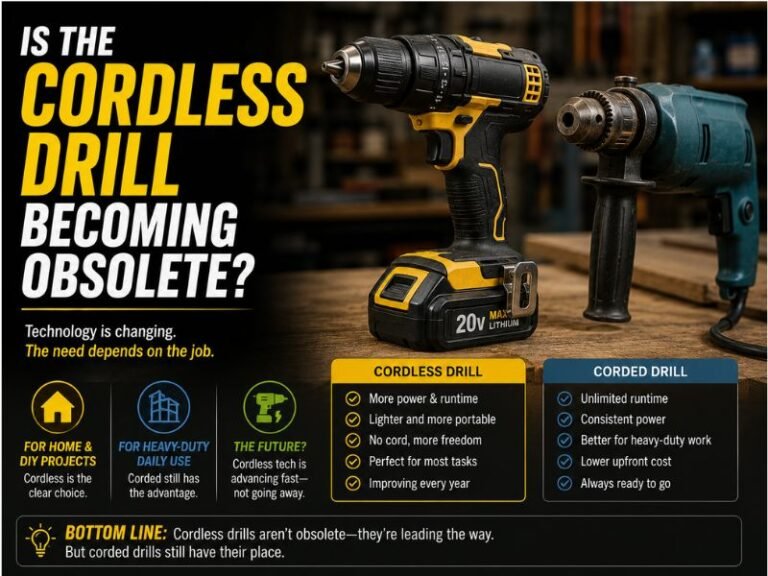
Are Corded or Cordless Drills Better: Clear Answers and Key Facts
Corded drills are better for sustained power and long jobs, while cordless drills are better for portability, convenience, and working where electricity is unavailable. Neither is universally superior; the right choice depends on the material, project length, workspace, and importance of mobility.
The drill is only one part of a larger work system. Power source affects how long you can work, how much torque remains available under load, what accessories you can use, and whether the tool is practical on a ladder, roof, jobsite, or remote property. A powerful drill that is difficult to position may be less useful than a slightly weaker one that is always ready.
This guide compares sustained output, battery limitations, weight, speed control, maintenance, safety, and operating cost. It also explains when a hammer drill or impact driver may be more appropriate, how to choose between models for common U.S. projects, and what trade-offs matter most before buying.
The Main Difference Between Corded and Cordless Drills
A corded drill receives continuous electricity from an outlet. As long as the circuit can supply the tool and the motor is not overloaded, it can run for extended periods without stopping to recharge or change a battery.
A cordless drill uses a rechargeable battery, usually a lithium-ion pack. The battery makes the tool independent of an outlet, but its charge, age, temperature, and workload affect how long the drill can operate and how much power it can deliver.
Both types can drill holes and drive screws effectively. The practical difference is the balance between uninterrupted power and freedom of movement.
When a Corded Drill Is the Better Choice
A corded drill is often the stronger choice for demanding, repetitive, or stationary work. It is especially useful when the drill will run for long periods or when stopping to recharge would interrupt the job.
Long drilling sessions
Large projects can quickly expose the limitations of batteries. Drilling through many pieces of lumber, mixing certain materials with a drill-rated accessory, or boring repeated holes in masonry may consume several battery packs. A corded model can continue working if the outlet and extension cord are properly rated.
This advantage is most noticeable in workshops, remodeling projects, and production-style tasks where the drill is used continuously rather than for a few quick holes.
Heavy-duty drilling
Corded drills are commonly preferred for high-load applications because the motor does not depend on a battery’s remaining charge. The tool can maintain consistent operation while drilling larger holes or working through dense material, although the correct bit, speed, and drill type still matter.
A standard corded drill is not automatically suitable for concrete, metal fabrication, or mixing. Those jobs may require a hammer drill, rotary hammer, low-speed high-torque drill, or specialized mixer. Continuous electrical power helps, but it does not replace the need for the right tool.
Lower purchase and operating complexity
A corded drill may cost less than a comparable cordless kit because it does not include a battery or charger. Replacement batteries also become a significant expense over time, particularly when a cordless tool is used heavily.
Corded models have fewer portable components to manage. There is no battery to store at the correct charge level, no pack to cool after heavy use, and no concern that a second battery is needed to avoid downtime.
When a Cordless Drill Is the Better Choice
For most household repairs, furniture assembly, light remodeling, and general maintenance, cordless drills are usually more convenient. The ability to work without a nearby outlet often saves more time than a corded model’s continuous power saves.
Working in difficult locations
A cordless drill is easier to use on a ladder, in a crawl space, inside a cabinet, or outdoors. There is no cord to drag across a floor, catch on framing, or pull against the tool while positioning a bit.
This mobility also reduces setup time. A charged drill can move from one part of a house to another without finding an outlet or routing an extension cord.
Better control for quick tasks
Modern cordless drills often include variable-speed triggers, adjustable clutches, compact brushless motors, and built-in lights. These features make them useful for driving screws without stripping heads or over-tightening fasteners.
For short tasks, a cordless drill may be ready faster even if its total power is lower. Convenience matters when the job involves only a few holes or screws.
Fewer cord-related hazards
Removing the cord eliminates one common trip and snag hazard. It also avoids the need to choose and inspect an extension cord, although cordless tools still require safe handling, proper bits, and attention to kickback or binding.
A cordless drill is not automatically safer. A high-torque model can twist suddenly when a bit catches, and a battery can become hot or damaged if abused. Safe operation remains essential with either power source.
Power, Torque, and Runtime Compared
Power ratings do not always provide a simple comparison between corded and cordless drills. Corded tools are often described by amperage, while cordless tools are commonly identified by battery voltage and sometimes torque ratings. These figures should not be treated as direct equivalents.
Torque is the turning force available at the chuck. It affects the drill’s ability to drive fasteners or turn a bit under resistance, but real performance also depends on gearing, motor design, bit sharpness, material, and the operator’s technique.
A cordless drill may produce strong initial performance with a fully charged battery but lose output as the battery discharges or heats up. A corded model generally offers more consistent operation, though it can still slow or overheat when pushed beyond its design limits.
Runtime depends on the battery’s capacity, measured in amp-hours, as well as the task. Driving small screws uses much less energy than drilling large holes with a spade bit. Cold weather, an aging battery, and frequent high-load use can reduce practical runtime.
Weight, Balance, and Ease of Use
A corded drill may be lighter than a cordless kit once the battery is removed from the comparison. However, the cord adds resistance and can make the tool feel less manageable in tight spaces.
Cordless drills carry battery weight at the base of the handle. That can improve balance in some designs but may make the tool tiring during overhead work. Compact batteries reduce weight, while high-capacity packs extend runtime but add bulk.
Grip shape and center of gravity often matter more than a small difference in listed weight. If possible, hold the drill in the position used for the intended work. A tool that feels balanced with the bit installed is easier to control accurately.
Which Drill Is Best for Common Projects?
Home repairs and furniture assembly
A cordless drill is generally the most practical option for hanging shelves, assembling furniture, installing curtain hardware, and completing minor repairs. A clutch helps limit driving force, reducing the chance of damaging screws or soft materials.
For these jobs, portability and low-speed control usually matter more than maximum continuous output.
Decks, fencing, and framing
Either type can work well for construction tasks, but the better choice depends on the size of the project. A cordless drill is convenient for moving around a deck or framing area, while a corded model is useful when many holes must be drilled from a fixed work position.
For driving large structural screws, an impact driver may be more suitable because its impact mechanism can deliver high fastening force with less reaction through the handle. A drill remains useful for drilling pilot holes and tasks requiring a clutch.
Metal drilling
Metal drilling requires controlled speed, a sharp bit, and suitable cutting lubricant when appropriate. A corded drill can be advantageous for repeated holes because runtime is not limited by a battery.
A cordless drill is still effective for occasional metalwork, particularly when mobility matters. Use the correct speed setting, secure the workpiece, and avoid holding loose metal by hand while drilling.
Masonry and concrete
Light masonry work may be possible with a hammer drill and the correct masonry bit. A basic drill without hammer action may drill slowly or overheat.
For frequent or deep holes in concrete, a rotary hammer is usually a better tool than either a conventional corded or cordless drill. The material and hole size should determine the tool category before power source becomes the deciding factor.
Remote outdoor work
Cordless drills are usually preferable for outdoor repairs, sheds, docks, fences, and properties where power is unavailable or inconvenient. Keep batteries protected from excessive heat, moisture, and physical damage.
A corded drill can work outdoors only when the electrical setup is suitable. Use outdoor-rated extension cords and appropriate ground-fault protection where required by the equipment, location, or local electrical safety practices.
Battery and Cord Limitations
The main cordless limitation is energy storage. Even a high-capacity battery eventually needs charging, and a spare battery adds cost and weight. Charging also takes time, especially when the tool is used continuously.
Battery performance can decline with age. A pack that once completed a project may later provide shorter runtime or shut down under heavy load. Use batteries from the tool’s intended system and replace packs that are swollen, cracked, leaking, unusually hot, or otherwise damaged.
The main corded limitation is access. An outlet may be too far away, unavailable, or positioned in a way that makes the cord interfere with the work. Extension cords can also create trip hazards and may overheat if they are too light for the tool or left coiled during heavy use.
Never carry a corded drill by its power cord, and inspect the cord, plug, and housing before use. Disconnect power before changing accessories or clearing a jam.
Safety and Tool Selection Checks
Choose the drill based on the job rather than the highest advertised power. A compact drill with a clutch is often ideal for screws, while a hammer drill or rotary hammer is better for masonry. A high-torque drill may be necessary for large bits, but it can also create stronger kickback.
- Use a sharp bit designed for the material.
- Secure the workpiece and keep both hands positioned to control torque.
- Wear eye protection when drilling, especially overhead or into brittle material.
- Check for hidden wiring, plumbing, and other obstructions before drilling into walls.
- Keep loose clothing, hair, and cords away from the rotating chuck.
- Let the bit and motor cool during demanding work instead of forcing a stalled tool.
- Remove the battery or unplug the drill before changing bits or performing maintenance.
If a hole requires unusual force, the bit may be dull, the speed may be wrong, or the drill may be unsuitable. Continuing to push can overheat the motor, damage the bit, or cause sudden tool movement.
How to Choose Between Corded and Cordless
Choose a cordless drill when the work is spread across different locations, most tasks are short, and convenience is more valuable than unlimited runtime. It is the better all-around option for many homeowners and mobile tradespeople.
Choose a corded drill when the work is intensive, repetitive, near a reliable outlet, or performed in a workshop. It is also attractive when minimizing battery costs and charging interruptions is important.
Before buying, consider these questions:
- How many holes or fasteners will the drill handle in one session?
- Will the work take place near an outlet or in a remote location?
- Does the material require hammer action, a rotary hammer, or a specialized drill?
- Is low weight more important than maximum runtime?
- Will existing batteries and chargers support the cordless model?
- Can the workspace accommodate a cord without creating a trip or snag hazard?
For frequent use, a combination can be sensible: a cordless drill for mobility and quick jobs, plus a corded or specialized tool for long, demanding work. Buying two tools is not necessary for everyone, but the approach prevents one drill from being forced into every application.
Frequently Asked Questions About Corded and Cordless Drills
Are corded or cordless drills better for home use?
Cordless drills are usually better for general home use. They handle common repairs, furniture assembly, and light drilling without requiring an outlet or extension cord. A corded drill makes more sense for long sessions or demanding workshop tasks.
Do corded drills have more power than cordless drills?
Corded drills usually provide more consistent power over extended use. A high-quality cordless drill can deliver substantial torque, especially with a fully charged battery, but its output and runtime can be affected by charge level, heat, and battery age.
Is a cordless drill strong enough for drilling into concrete?
A cordless hammer drill may handle light masonry work, but concrete often requires a rotary hammer. The correct choice depends on concrete hardness, hole diameter, depth, and the number of holes. A standard drill may be inefficient or suffer unnecessary wear.
Are corded drills safer than cordless drills?
Neither power source is automatically safer. Corded drills introduce cord, plug, and extension-cord hazards, while cordless drills can produce sudden torque and involve battery safety concerns. Proper accessories, secure workpieces, eye protection, and controlled handling matter more.
Which lasts longer, a corded or cordless drill?
A corded drill can remain usable for many years without a battery replacement. Cordless tools may also last a long time, but their batteries eventually lose capacity and need replacement. Motor quality, workload, storage, and maintenance affect the life of both types.
Is a corded drill better for mixing or large holes?
A corded drill can be better for extended high-load work, but the accessory and tool design must be suitable. Large hole saws, auger bits, and mixing attachments can create substantial torque and heat. Use a drill rated for the task, and consider a dedicated mixer or high-torque tool when appropriate.
Can one cordless drill replace a corded drill?
One cordless drill can replace a corded drill for many routine tasks but not every demanding application. Extra batteries can reduce downtime, yet sustained heavy drilling, specialized work, and workshop use may still favor corded or purpose-built equipment.
Choose the Power Source That Fits the Work
Corded drills are the better choice for consistent power, extended operation, and stationary heavy-duty work. Cordless drills are the better choice for mobility, quick jobs, and locations where a cord is inconvenient or unavailable.
The major limitation is that corded tools restrict movement while cordless tools depend on battery capacity and condition. Match the drill type to the material and workload, follow safe operating practices, and choose a hammer drill, rotary hammer, or impact driver when the task requires more than a standard drill can provide.