Are Cordless Drill Batteries Interchangeable: Explained Clearly
No, cordless drill batteries are not universally interchangeable. A battery typically fits and works only with tools in the same manufacturer’s voltage platform and battery system, although some physically similar packs may still be electrically or mechanically incompatible.
The practical distinction many shoppers miss is that a battery’s voltage label is only one part of the compatibility question. A 20-volt lithium-ion pack from one brand may look similar to another brand’s pack, yet the rails, terminals, locking tabs, electronics, and charging requirements can all be different.
A rushed substitution can create several problems: the pack may not slide into the tool, may connect without powering it, or may bypass protections that help prevent overheating and over-discharge. This article explains platform compatibility, voltage ratings, battery chemistry, chargers, adapters, and older nickel-cadmium tools so you can check a replacement safely and decide whether a battery is genuinely interchangeable or merely similar in appearance.
What Makes a Cordless Drill Battery Compatible?
Battery interchangeability depends on more than whether the pack fits into the handle. A compatible replacement must match the drill’s physical connection, electrical requirements, and control system closely enough for the tool and battery to operate safely.
The most important factors are:
- Brand and battery platform: The tool and pack must generally belong to the same compatible product family.
- Voltage: The battery’s nominal voltage must match the tool’s required voltage.
- Battery chemistry: Lithium-ion, nickel-cadmium, and nickel-metal hydride packs are not automatically interchangeable.
- Connector design: Rails, terminals, keying, locking tabs, and contact placement must align.
- Electronic communication: Some modern tools and packs use temperature, identification, or protection signals.
- Charger compatibility: The correct charger must support the battery’s chemistry and voltage.
For example, two batteries can both be labeled 18 volts and still be incompatible because one uses a slide-on rail system and the other uses a stem-style connection. Even batteries made by the same company may belong to separate platforms that do not share the same interface.
Battery Platforms Matter More Than Similar Labels
Manufacturers organize cordless tools around battery platforms. A platform usually includes a group of tools designed to accept the same battery family, such as drills, impact drivers, saws, lights, and other equipment.
When a manufacturer says a battery is compatible with a certain platform, that statement normally refers to the specific tool families and voltage class listed by the manufacturer. It does not mean every battery made by that brand fits every cordless tool.
Platform names can also change over time. A company may sell an older 18-volt line alongside a newer brushless or high-output line, and the packs may use different physical interfaces. Some newer batteries are backward-compatible with older tools, but that is a design feature that must be confirmed rather than assumed.
Check the label on the tool, battery, and charger for the exact series or platform name. A matching logo is helpful, but the platform designation and manufacturer compatibility information are more reliable than brand identity alone.
Can Batteries With the Same Voltage Be Swapped?
Usually, no. Voltage is necessary for compatibility, but it is not sufficient by itself.
Nominal voltage describes the approximate operating voltage of a battery pack. A lithium-ion pack marketed as 18 volts may be sold as 20 volts maximum by another manufacturer because of different labeling conventions. Those numbers can represent similar electrical characteristics, but the packs still may not share a connector or control system.
Even when the voltage is genuinely similar, the battery may have a different:
- Number and arrangement of cells
- Maximum discharge current
- Terminal layout
- Temperature-sensing circuit
- Battery-management system
- Physical shape and locking mechanism
Using a higher-voltage pack than the drill requires can damage the motor, switch, electronic controls, or other components. Using a lower-voltage pack may cause weak performance, unexpected shutdowns, or excessive current draw as the motor struggles to do the same work.
Never treat “18V,” “20V,” or a similar label as a universal battery standard. It is only one checkpoint in the compatibility process.
Why Physical Fit Does Not Prove Compatibility
A battery that slides into a drill is not automatically safe to use. Physical fit confirms only that the housing and locking features are close enough to connect; it does not confirm that the electrical contacts or protective electronics are correct.
Some battery packs have multiple contacts rather than simple positive and negative terminals. Additional contacts may support temperature monitoring, pack identification, cell balancing, or communication with the tool. If those signals are missing or misinterpreted, the drill may refuse to run or may operate without the safeguards intended by its design.
A forced fit is especially dangerous. Filing plastic, bending terminals, removing a key, or modifying a locking tab can create a short circuit or reverse-polarity connection. It can also leave the pack loose, causing arcing or intermittent contact under vibration.
Inspect the connection without modifying anything. The pack should seat fully, lock securely, and release normally; no unusual pressure, wobbling, scraping, or exposed metal should be necessary.
Are Batteries From Different Brands Interchangeable?
In most cases, batteries from different brands are not directly interchangeable, even if the tools have similar voltage ratings. Manufacturers generally use proprietary housings, terminals, rails, and battery-management arrangements.
Third-party replacement batteries may be advertised as compatible with a particular tool platform. Such a claim must be evaluated by the exact tool and battery model, not by a general statement such as “fits most 18-volt drills.” A reputable replacement should identify the supported platform and include appropriate protection against overcharge, over-discharge, overheating, and short circuits.
Some aftermarket packs copy the shape of an original battery but may use different cell quality or less robust protection electronics. That can affect runtime, charging behavior, operating temperature, and service life. A pack that is inexpensive because it omits necessary safety components is not a good substitute.
Brand-to-brand adapters are another option, but an adapter does not make every combination inherently safe. It may solve the mechanical connection while leaving questions about voltage, current capacity, communication contacts, balance protection, and warranty coverage.
Do Chargers and Batteries Need to Match?
Yes. A charger must be designed for the battery’s chemistry, voltage range, cell arrangement, and charging controls.
A lithium-ion pack should be charged with a charger intended for that specific battery system or an explicitly verified compatible replacement. Lithium-ion charging requires controlled voltage and current, along with protection against overcharging and overheating. A charger designed for nickel-cadmium batteries is not a safe substitute simply because the battery has a similar voltage label.
Using the wrong charger can cause excessive heat, battery damage, venting, or fire. The reverse problem also matters: a charger may appear to accept a pack physically but fail to recognize its electronics or charge it correctly.
Before charging a replacement battery, confirm all of the following:
- The chemistry matches the charger’s requirements.
- The nominal voltage and cell configuration are supported.
- The battery model or platform is listed as compatible.
- The pack is not swollen, cracked, leaking, unusually hot, or physically damaged.
- The charger and battery contacts are clean, dry, and undamaged.
Stop using a battery that becomes abnormally hot, smells unusual, swells, leaks, or shows signs of impact damage. Do not attempt to repair or open a lithium-ion pack unless the work is performed by a qualified battery professional with the correct equipment.
What About 12-Volt, 18-Volt, and 20-Volt Tools?
Voltage classes identify the general power range of a tool, but they do not create a universal interchangeability standard. A 12-volt battery normally belongs to a 12-volt platform, while an 18- or 20-volt battery belongs to a higher-voltage platform.
Manufacturers may use “maximum” and “nominal” voltage descriptions differently. A pack advertised as 20 volts maximum may have a nominal voltage near 18 volts during normal operation. This explains why some labels appear different even when the battery class is broadly similar, but it does not establish compatibility between brands or product lines.
Do not install a 20-volt-class pack in a 12-volt drill to gain more power. The drill’s motor, gearing, switch, and electronic controls were designed for a specific voltage range. Excess voltage can cause immediate failure or create a serious overheating hazard.
Likewise, a lower-voltage battery may not provide enough power for a larger drill. The tool may run slowly, cut out under load, or draw damaging current from the pack.
Can Older Ni-Cd Drill Batteries Use New Lithium-Ion Packs?
Not automatically. Older cordless drills often use nickel-cadmium, or Ni-Cd, battery packs, while newer tools commonly use lithium-ion packs. The two chemistries have different charging requirements, voltage behavior, protection needs, and sometimes different physical connections.
A lithium-ion replacement should be used in an older drill only when the manufacturer or a qualified battery supplier specifically confirms compatibility. The original charger may not control a lithium-ion pack correctly, and the tool may lack the electronics needed to manage the newer battery.
Even if an adapter makes the pack fit, the tool may have been designed around the discharge characteristics of Ni-Cd cells. Performance, low-voltage cutoff behavior, and heat management may not work as intended.
For an older drill, the safest choices are usually an original-style replacement pack with the correct chemistry or a clearly documented conversion system that includes a compatible charger and required protection circuitry.
How to Check Whether a Replacement Battery Fits
Use the tool and battery model numbers rather than relying on appearance. The model information is commonly printed on the drill body, original battery, charger, or product documentation.
- Identify the drill’s exact model and voltage class.
- Identify the battery platform or series listed for that model.
- Check whether the replacement battery names that exact tool family as compatible.
- Confirm the battery chemistry and charger requirements.
- Compare the connector, rails, terminals, and locking mechanism without forcing the pack.
- Verify that the replacement charger is approved for the battery if the original charger is not listed.
- Inspect the pack for damage before installing or charging it.
If the manufacturer’s documentation is unclear, contact its customer service department or a qualified tool-repair professional. A professional can also check terminal polarity, charger output, and battery-management behavior without relying on guesswork.
Do not test an uncertain battery by shorting terminals, bypassing a fuse, connecting loose wires, or using a homemade charger. These methods can release high current quickly and may cause burns, sparks, cell damage, or fire.
Common Signs of an Incompatible Battery
A battery does not need to fail dramatically to be unsuitable. Several warning signs indicate that the pack should not be used with the drill.
- The pack will not seat fully or does not lock securely.
- The drill runs only when the battery is held in a particular position.
- The charger rejects the pack or displays an error.
- The tool shuts off immediately under light load.
- The battery or terminals become unusually hot.
- The pack, adapter, or drill emits a burning smell.
- The battery swells, cracks, leaks, or shows melted plastic.
- The replacement requires filing, forcing, rewiring, or removing safety features.
Remove the battery and stop testing if any of these conditions occurs. Do not continue using a pack simply because the drill still spins; partial operation does not prove that the electrical system is safe.
Frequently Asked Questions About Drill Battery Compatibility
Are cordless drill batteries interchangeable between brands?
Usually, batteries from different brands are not interchangeable. Matching voltage does not overcome differences in connector design, terminals, battery-management electronics, and charger requirements.
Can I use any 20-volt battery in a 20-volt drill?
No, a 20-volt label does not make every battery compatible. Use a pack from the tool’s approved platform or a replacement that specifically identifies the exact drill model or battery system.
Can an 18-volt battery replace a 20-volt battery?
Only when the manufacturer treats those labels as the same supported platform. Some 20-volt maximum lithium-ion packs are marketed in an 18-volt nominal class, but the connector and electronics still must match.
Can I use a larger amp-hour battery in my drill?
Often, a higher amp-hour battery is acceptable within the same platform. It generally provides longer runtime, but it may be heavier and must still match the tool’s voltage, connector, and approved battery family.
Can I charge a replacement battery with the original charger?
Use the original charger only if it is listed as compatible with that replacement pack. Similar voltage ratings do not guarantee that the charger supports the battery chemistry, cell arrangement, or protection system.
Are cordless drill batteries interchangeable with impact-driver
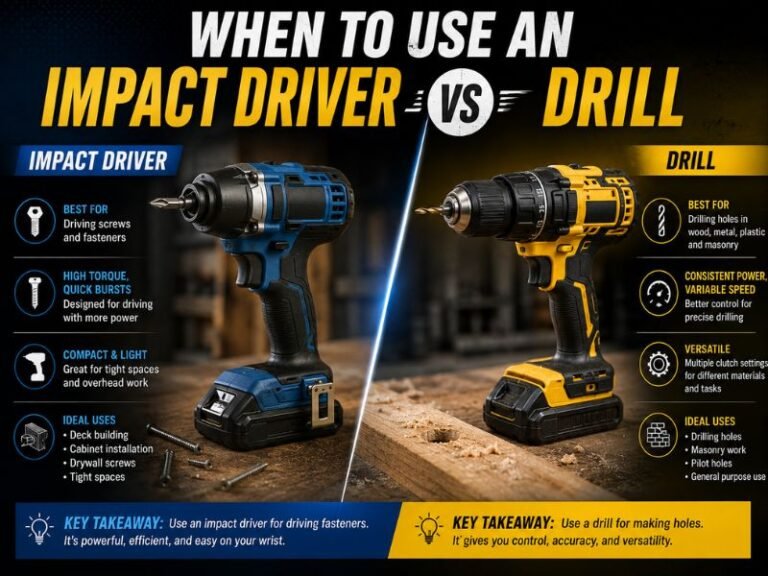
They can be interchangeable when both tools use the same battery platform. Drill and impact-driver compatibility depends on the manufacturer’s platform design, not on the fact that both tools use rechargeable packs.
Is a battery adapter safe for a cordless drill?
An adapter is safe only when its voltage, polarity, current capacity, mechanical fit, and protection features are verified for both devices. Avoid adapters that require rewiring, defeat temperature monitoring, or leave contacts exposed.
Conclusion: Match the Platform, Not Just the Voltage
Cordless drill batteries are interchangeable only within a confirmed compatible system. Check the exact platform, voltage, chemistry, connector, electronics, and charger before installing a replacement, and never force a pack or bypass its safety features.
The practical next step is to record the drill and battery model numbers, compare them with the manufacturer’s compatibility information, and choose a documented replacement. If the tool is old, damaged, or being converted between battery chemistries, have the combination checked by a qualified repair professional before charging or using it.