Are Corded Impact Wrenches Any Good: Clear Answers and Key Facts
Yes, corded impact wrenches can be very good when steady power, high torque, and frequent use matter more than portability. They are often a practical choice for garages, workshops, and heavy-duty jobs, but they are not automatically better than cordless or pneumatic models.
This article explains where corded impact wrenches excel, where they fall short, and which operating conditions determine whether one is a smart purchase. A corded tool is like a shop vacuum: it can run strongly for as long as it has electricity, but the power cord limits where and how conveniently it can work.
The right choice depends on the fasteners, available outlets, extension-cord setup, work location, and how much control the job requires. After reading, you will be able to compare corded impact wrenches with cordless and air-powered alternatives, recognize important safety limits, and decide whether continuous electric power is more valuable than mobility for your projects.
What Makes a Corded Impact Wrench Useful?
A corded impact wrench uses electricity from a household or shop outlet rather than a battery or air compressor. Its motor drives a hammer-and-anvil mechanism that delivers short bursts of rotational force, allowing the tool to loosen or tighten large fasteners more effectively than a standard drill or many ordinary drills with clutch settings.
The main advantage is continuous operation. As long as the outlet supplies power, the wrench can keep working without waiting for a battery to charge, changing battery packs, or managing compressor recovery time. That can make a significant difference when removing many lug nuts, suspension bolts, structural fasteners, or rusted hardware.
Corded models can also provide strong torque without the added weight of a large battery. Depending on the design, they may be easier to hold for extended periods than high-output cordless tools, although the cord itself introduces a different handling problem.
For a fixed workbench, home garage, farm shop, or repair bay, that tradeoff is often reasonable. The tool stays ready, operating costs are predictable, and performance does not gradually decline as a battery discharges.
Advantages of Corded Impact Wrenches
Consistent power for long jobs
A corded impact wrench can maintain its electrical supply throughout a long task. This is especially useful for repetitive work, such as servicing several vehicles, removing a large number of fasteners, or assembling and disassembling equipment.
Battery-powered tools may remain capable for a long time, but their performance can vary with charge level, temperature, battery age, and the quality of the battery pack. A corded tool generally offers more predictable operation when connected to a properly rated outlet and cord.
Strong performance without battery management
There is no battery to purchase, store, charge, or replace. That lowers the number of accessories needed for basic operation and avoids the gradual capacity loss that affects rechargeable packs.
This does not mean every corded model has more torque than every cordless model. Tool design, motor output, gearing, impact mechanism, and build quality matter more than the power source alone. Still, corded electric tools can deliver substantial breakaway torque for common automotive and maintenance applications.
Lower initial cost in some cases
A corded impact wrench may cost less than a comparable cordless kit, particularly when the cordless purchase includes batteries and a charger. This can make corded power attractive to occasional users who already have a suitable work area and do not need to carry the tool away from an outlet.
Price should not be the only consideration. A low-cost tool with weak gearing, poor durability, or inaccurate torque control may be a false economy. Look for a reputable design, a suitable torque range, an appropriately sized drive, and a warranty that matches the expected workload.
Important Limitations to Consider
The cord restricts mobility
The most obvious disadvantage is the cable. A corded impact wrench cannot be used conveniently at a roadside location, in a remote field, or beneath a vehicle that is parked far from a safe power source.
The cable can also snag on suspension parts, drag across a work surface, or become a trip hazard. Working around a vehicle requires deliberate cord placement so the cable does not contact hot components, rotating parts, sharp edges, or the impact socket.
Extension cords can reduce performance
An extension cord that is too long, too light, damaged, or poorly connected can cause voltage drop. The motor may run hotter, start less effectively, or deliver reduced performance. A cord can also become a fire or shock hazard if its insulation is cut or its connections are exposed to moisture.
Use an extension cord rated for the tool’s electrical requirements and length. Follow the tool manufacturer’s guidance for cord size, grounding, outdoor use, and circuit protection rather than assuming any household extension cord is adequate.
They are not ideal for final torque
An impact wrench is designed primarily to remove fasteners and run them down quickly. It should not normally be treated as a precision torque wrench, even when its advertised torque output appears suitable for a particular bolt.
Impact action, friction, thread condition, lubrication, socket fit, and impact duration can all affect the final clamping force. For wheel lug nuts, engine components, suspension hardware, and other safety-critical fasteners, use the manufacturer’s specified tightening procedure and finish with a calibrated torque wrench when required.
How Corded Models Compare With Other Impact Wrenches
Corded versus cordless
Cordless impact wrenches are usually more convenient because they can move freely around a vehicle or jobsite. Modern high-voltage battery tools can also provide impressive torque and may outperform older corded designs.
The disadvantages are added battery weight, charging time, battery cost, and performance changes as the battery loses charge. Cold temperatures and heavily used battery packs can make those issues more noticeable. Cordless is generally the better choice for mobile work, while corded is often better for a permanent workspace with dependable electricity.
Corded versus pneumatic
Pneumatic impact wrenches are common in professional automotive shops because an air system can support repeated use and the tool itself may be relatively light. However, an air setup requires a compressor with adequate capacity, an air hose, fittings, filtration, and regular maintenance.
A small compressor may run continuously without keeping up with a demanding impact wrench. In that situation, the tool can lose effective power while the compressor catches up. A corded impact wrench avoids compressor noise and air-system expense, making it simpler for many home garages.
Corded versus a breaker bar
A breaker bar is inexpensive, quiet, and independent of electricity. It can provide substantial manual leverage for loosening stubborn fasteners, but it is slower and more physically demanding than an impact wrench.
A practical setup may use an impact wrench for speed and a breaker bar for controlled initial loosening when appropriate. Neither tool should be forced beyond its safe capacity, and neither replaces proper inspection when a fastener is seized or damaged.
Where a Corded Impact Wrench Works Best
A corded model makes the most sense when the work occurs near a suitable outlet and the tool will be used often enough to justify keeping it ready. Common examples include home garages, repair benches, equipment sheds, fabrication areas, and maintenance stations.
It can be especially useful for removing automotive lug nuts, working on trailers, servicing agricultural equipment near a building, and handling repeated assembly tasks. The tool is also helpful when a battery-powered alternative would require several expensive battery packs to support a full day of work.
Its value decreases when the job requires climbing, moving across a large site, working outdoors in changing weather, or reaching areas where a cable could interfere with safe movement. In those conditions, portability may matter more than unlimited runtime.
Choosing the Right Corded Impact Wrench
Start with the fastener sizes and materials involved rather than choosing only by the highest torque number on the package. A compact tool may be sufficient for light automotive work, while larger bolts and repeated heavy use may require a more robust model with a larger square drive and stronger internal components.
Check the following characteristics before buying:
- Drive size: Common choices include 1/2-inch for general automotive work and 3/4-inch for larger, heavier fasteners.
- Rated torque: Compare loosening and tightening figures carefully because advertised values may describe different test conditions.
- Speed and impact rate: These affect how quickly the tool runs down or works through a stubborn fastener.
- Weight and grip: A powerful tool that is difficult to control can increase fatigue and handling mistakes.
- Trigger and direction control: A responsive trigger and clear forward-reverse switch improve control around delicate parts.
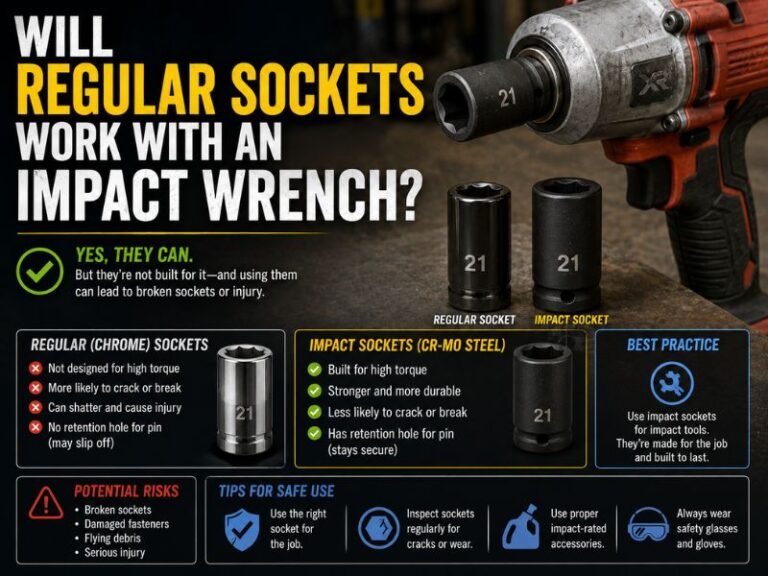
- Socket compatibility: Use impact-rated sockets rather than ordinary chrome sockets, which can crack or shatter under impact loading.
- Electrical rating: Confirm voltage, amperage, grounding requirements, and whether the tool is intended for the planned environment.
- Durability: A metal gear housing, reinforced cord, and serviceable construction may matter more than a dramatic peak-torque claim.
Do not confuse maximum torque with useful torque. Peak output may be measured during a short test and may not represent performance on a rusted fastener, a long extension, or a poorly powered circuit. Independent testing can help, but the tool’s intended duty cycle and warranty are also meaningful indicators.
Safe Operation and Torque Control
Inspect the cord, plug, housing, switch, and socket before every use. Do not operate the tool if the insulation is damaged, the grounding pin is missing, the plug is loose, or the housing shows signs of impact damage.
Keep the cord away from water, oil, heat, sharp edges, moving machinery, and vehicle components that may become hot. Never carry the tool by its cord or yank the cable from an outlet. Disconnect power before changing sockets, clearing a jam, or performing maintenance.
Wear eye protection because rust, dirt, and damaged socket fragments can become airborne. Keep hands clear of the socket and fastener, secure the workpiece, and use the correct impact-rated socket for the fastener size.
When removing a fastener, make sure the socket is fully seated and keep the tool aligned with the bolt. Excessive side pressure can damage the socket, round the fastener, or strain the impact mechanism. If the fastener does not move, stop and determine whether corrosion, cross-threading, inadequate tool capacity, or a hidden retaining feature is the cause.
For installation, use the impact wrench only for preliminary tightening unless the manufacturer specifically provides a controlled procedure for that application. Set the final torque with the correct hand tool, tighten in the required pattern, and verify that the threads and mating surfaces are in the condition specified for the job.
Signs a Corded Impact Wrench Is a Poor Fit
A corded tool is probably the wrong choice if most work takes place away from buildings or if carrying a cable creates more inconvenience than the tool saves. It is also a poor fit when the available electrical circuit cannot safely support the tool or when outdoor use would expose the connection to moisture.
Consider another type of impact wrench if precise electronic torque settings are central to the job, if quiet operation is important, or if the work requires frequent movement between vehicles and equipment. A cordless model may solve the mobility issue, while a pneumatic or specialized torque tool may better suit continuous professional production.
Repeatedly tripping breakers, a hot plug, unusual motor odor, sparking, severe vibration, or a sudden loss of power are warning signs. Stop using the tool, disconnect it safely, and have it inspected or replaced rather than continuing to test it under load.
FAQ About Corded Impact Wrenches
Are corded impact wrenches any good for changing car tires?
Yes, a suitable corded model can be effective for removing and initially installing tire lug nuts. It needs a safe outlet, a properly rated extension cord if necessary, and impact-rated sockets. Lug nuts should be finished with a torque wrench according to the vehicle manufacturer’s specification.
Do corded impact wrenches have more power than cordless models?
Not necessarily, because motor design and tool quality matter more than the power source alone. A modern high-output cordless wrench may produce more torque than an older corded model, while a well-designed corded tool can still offer consistent performance for long periods.
Can a corded impact wrench remove rusted or seized bolts?
It may remove stubborn fasteners, but no impact wrench guarantees success against severe corrosion or cross-threading. Use the correct socket, keep the tool aligned, and avoid prolonged operation that overheats the motor. Penetrating fluid, controlled manual leverage, heat applied by a qualified person, or professional repair may be necessary.
Is a corded impact wrench better than a breaker bar?
It is faster and less physically demanding, while a breaker bar offers simple, controlled leverage without electricity. Many users benefit from keeping both available, using the impact wrench for speed and the breaker bar when deliberate manual force is more appropriate.
Can an impact wrench tighten lug nuts completely?
It can run lug nuts down, but it should not be trusted as the final torque-setting tool. Impact duration and conditions can produce inconsistent clamping force. Tighten the lug nuts to the specified value with a calibrated torque wrench and follow the vehicle’s tightening sequence.
Are corded impact wrenches safe to use with extension cords?
They can be safe when the extension cord is correctly rated, undamaged, grounded, and suitable for the length and environment. An undersized or damaged cord can cause voltage drop, overheating, shock, or fire risk. Follow the tool instructions and applicable electrical safety requirements.
Conclusion: When a Corded Impact Wrench Is Worth It
Corded impact wrenches are good tools for users who need dependable power, long runtime, and fast fastener removal in a location with safe electrical access. They are less attractive when portability, outdoor mobility, quiet operation, or precise torque control is the priority.
The major limitation is the cord, followed closely by the risk of treating impact output as a substitute for final torque measurement. Choose a model that matches the fasteners and duty cycle, use the correct cord and impact sockets, and finish safety-critical installations with a torque wrench.
The next practical step is to identify where the tool will be used most often and verify the available circuit and extension-cord rating. If the workspace is fixed and the electrical setup is sound, a corded model can deliver useful, consistent performance without battery or compressor complications.