Can a Drill Be Used as an Impact Wrench: Detailed Guide and Facts
Yes, a drill can turn a socket and loosen or tighten some fasteners, but it does not perform the same job as an impact wrench. A drill lacks the impact wrench’s hammering mechanism, high breakaway torque, and purpose-built square drive.
This difference matters most when the fastener is tight, rusted, oversized, or safety-critical. A drill may handle light assembly work, small bolts, and some automotive tasks, but forcing it to replace an impact wrench can damage the tool, socket adapter, fastener, or workpiece.
Before choosing a tool, consider the fastener size, required torque, available clearance, and whether the connection must be tightened to a precise specification. Could a cordless drill remove a vehicle lug nut after it has already been loosened, or would a seized suspension bolt demand a different tool? This guide explains the required adapter, torque and speed differences, suitable applications, common risks, and the point at which an impact wrench or calibrated torque wrench becomes the safer choice.
How a Drill Differs From an Impact Wrench
A standard drill uses a motor and gearbox to rotate the chuck continuously. Its clutch may limit torque, while its variable-speed trigger helps control drilling and screwdriving. The tool applies rotational force smoothly rather than delivering repeated blows.
An impact wrench also rotates a socket, but it contains an impact mechanism. When resistance becomes high, the internal hammer and anvil assembly strike repeatedly in the direction of rotation. Those short pulses can produce much greater breakaway force than a similarly sized drill motor can apply continuously.
The two tools are also built around different connections. Most drills use a keyed or keyless chuck that grips round shanks, while an impact wrench normally uses a square drive, such as 1/4-inch, 3/8-inch, or 1/2-inch, for sockets.
- Drill: Smooth rotation, chuck-based accessories, useful clutch, and broad general-purpose use.
- Impact wrench: Hammering torque, square-drive sockets, stronger fastener removal capability, and better suitability for heavy bolts.
- Impact driver: A different tool from both; it uses a hex collet and a lighter impact mechanism for screws and smaller fasteners.
A drill may have enough power to rotate a socket, but rotation alone does not make it an impact wrench. A hammer drill is not an impact wrench either. Its hammer function moves the bit axially for masonry drilling; it does not deliver the same rotational impacts used to remove stubborn bolts.
What You Need to Use a Drill With a Socket
To use a drill for nuts or bolts, install a socket adapter in the chuck. The adapter has a round shank for the drill and a square drive on the other end, allowing a compatible socket to attach.
Choose an adapter that matches the socket drive size and is rated for the tool’s intended use. A standard chrome hand-tool socket may work for light drilling applications, but an impact-rated adapter and socket are preferable whenever the drill will encounter substantial resistance.
Check the chuck before operating the tool. Tighten a keyless chuck firmly around the adapter’s shank, or use the chuck key if the drill has a keyed chuck. A poorly secured adapter can slip, wobble, or eject when the trigger is released or the fastener binds.
Keep the socket straight on the fastener. An angled socket places side loading on the adapter and can round the fastener head, bend the adapter, or cause the tool to twist unexpectedly. A short extension can improve access, but every additional connection can increase flex and reduce control.
Why the Adapter Matters
The chuck is not designed to absorb the repeated shock generated by an impact mechanism. For that reason, an impact wrench should never be operated through a conventional drill chuck adapter. The drill itself produces smooth torque, but a loose or poorly fitting adapter still creates a failure point.
Do not use a bit-holder extension or a standard screwdriver bit holder as a substitute for a square-drive socket adapter. Those accessories may not be designed for the torque required to turn a nut, especially when the fastener is stuck.
When a Drill Can Handle the Job
A drill can be practical for low-torque fastening when the nut or bolt turns freely. Examples include assembling light-duty equipment, installing small machine screws with a nut driver, tightening hardware on furniture, or spinning a nut down a long exposed thread after it has been started by hand.
It can also help with repetitive work when the final tightening force is modest and consistent. Set the clutch to a low or medium position, use a slow speed, and stop before the fastener is overtightened. A drill’s clutch is useful for preventing damage, but it should not be treated as a precision torque-control system unless the tool and setting are specifically documented for that purpose.
For automotive work, a drill may remove a lug nut only if the nut has already been loosened. It can then spin the nut off quickly, but it should not be relied on to break loose a properly tightened or corroded lug nut.
The same principle applies during installation. A drill can run a nut onto a bolt, but the final tightening should be done with the appropriate hand tool and, where required, a calibrated torque wrench. This is especially important for wheels, brake components, steering parts, engine fasteners, and structural connections.
When a Drill Is Not a Suitable Substitute
A drill is a poor replacement for an impact wrench when the fastener requires high breakaway torque. Rust, corrosion, thread damage, thread-locking compound, excessive clamping force, and long periods of disuse can all make a connection difficult to remove.
Large fasteners are another warning sign. The torque required to loosen a bolt generally rises with fastener size and installation force, although the exact requirement depends on the fastener grade, thread condition, lubrication, and joint design. A drill may stall before the fastener moves, overheat while trying, or damage the gearbox.
Be cautious with situations that require sudden force. When a drill stalls, its motor stops but the tool body can rotate sharply in the operator’s hands. This reaction torque can injure a wrist or cause loss of control, particularly with a high-torque drill and a long socket extension.
- Do not depend on a drill for stuck automotive lug nuts.
- Do not use it as the primary tool for suspension, axle, or structural fasteners.
- Do not keep holding the trigger after the motor stalls.
- Do not use a drill to guess the final torque on safety-critical hardware.
- Do not assume a higher battery voltage automatically makes the drill suitable.
A higher-voltage cordless drill may have impressive specifications, but peak torque claims do not turn it into an impact wrench. The drill still lacks the impact mechanism, and its chuck and gearbox may not tolerate repeated high-load use.
Drill, Impact Driver, and Impact Wrench Compared
Confusion often comes from the similar names. A drill, impact driver, and impact wrench can all rotate fasteners, but their interfaces and intended workloads differ.
A drill accepts round-shank drill bits and many general accessories. It offers smooth speed control and often includes a clutch, making it versatile for drilling and light fastening. Its chuck is convenient but not ideal for heavy torque or repeated shock.
An impact driver uses a 1/4-inch hex collet and an internal rotational impact mechanism. It is designed primarily for driving screws, lag screws, and smaller hex-head fasteners. With the right hex-to-square adapter, it may operate small sockets, but the adapter and tool are not automatically suitable for large automotive bolts.
An impact wrench uses a square drive and is designed specifically for sockets. Its motor, gearbox, hammer assembly, housing, and grip are built around high-torque fastening and removal. It is generally the correct choice for lug nuts and heavy mechanical fasteners, although its output can still be excessive for delicate hardware.
Tool labels and published torque figures require careful interpretation. Some manufacturers list fastening torque, breakaway torque, or nut-busting torque under different test conditions. These numbers are not directly interchangeable, and real results vary with the battery, socket, fastener condition, and time spent applying force.
Safe Technique If You Use a Drill
Use the drill only when the application is clearly within its capability. Inspect the fastener, select the correct socket, and make sure the socket sits fully on the nut or bolt head before applying power.
- Disconnect power while installing the adapter and socket.
- Inspect the socket and adapter for cracks, deformation, or excessive wear.
- Secure the adapter in the chuck and verify that it runs without noticeable wobble.
- Set the drill to low gear and use a controlled trigger speed.
- Keep both hands positioned to resist tool rotation when practical.
- Stop immediately if the socket slips, the fastener rounds, or the drill begins to stall.
- Finish critical tightening with the specified manual procedure and torque tool.
Wear eye protection because a damaged socket, adapter, or fastener can fragment. Keep loose clothing, hair, and fingers away from the rotating assembly, and remove the battery before changing accessories or inspecting a jammed socket.
Use the drill’s clutch for light fastening, but understand its limitation. The clutch is intended to limit output under certain conditions; it does not guarantee that the fastener has reached a particular torque, and its behavior can change with speed, battery charge, temperature, and tool wear.
For a vehicle wheel, lower the vehicle only after the lug nuts have been started correctly, and tighten them in the manufacturer’s specified sequence and range. A drill can assist with removal or initial run-down, but the final wheel torque belongs to a torque wrench or another approved procedure.
How to Choose the Right Tool
Start with the task rather than the tool already in the toolbox. If the job involves drilling holes and occasionally spinning small nuts, a drill and socket adapter may be the most practical combination. If it involves repeated heavy bolts, a dedicated impact wrench will provide better control and durability.
Match the impact wrench drive size to the socket range. A compact 3/8-inch model may suit smaller mechanical work, while a 1/2-inch model is more common for automotive lug nuts and larger fasteners. Larger drive sizes can accommodate heavier sockets, but the tool’s actual torque rating and physical access still matter.
Use a breaker bar when the main need is controlled manual breakaway force. A breaker bar gives direct mechanical leverage and avoids relying on a drill’s motor for a seized fastener. After loosening the connection, a drill can sometimes spin the fastener out efficiently.
For installation, consider whether the joint requires exact torque. Neither a drill nor an impact wrench should replace a torque wrench when the manufacturer specifies a measured value. An impact wrench can bring a fastener close to the target, but its output changes with trigger time, impact duration, battery condition, and joint resistance.
Common Mistakes to Avoid
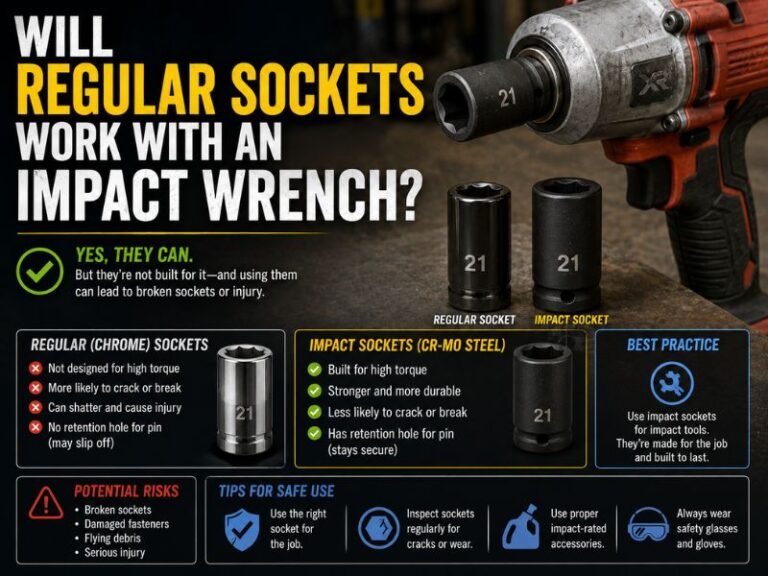
One common mistake is using a regular socket with a high-impact tool. Chrome sockets can be harder and more brittle than impact sockets, increasing the risk of cracking under repeated impacts. A drill does not create those impacts, but impact-rated accessories remain the safer choice when substantial torque is possible.
Another mistake is assuming that tightening until the drill stops is enough. A stalled drill may have reached excessive torque, insufficient torque, or simply a condition where the motor cannot overcome resistance. The sound of the motor is not a measurement of clamping force.
Some users also confuse an impact driver with an impact wrench and select an adapter that is too small for the job. The adapter may shear at the hex shank, while the socket can remain stuck on the fastener. Always follow the accessory’s torque and drive-size limitations.
Finally, avoid using powered tools to start a cross-threaded nut. Start the nut by hand for several turns, confirm that the threads engage smoothly, and only then use a tool. Cross-threading can permanently damage the fastener or the threaded component.
FAQ: Using a Drill as an Impact Wrench
Can a drill be used as an impact wrench
A drill can spin lug nuts that are already loose, but it usually should not be used to break them loose. Lug nuts may be tightened to a specified torque or stuck by corrosion, and a drill generally lacks the breakaway force and impact mechanism needed for dependable removal.
Can a cordless drill remove a stuck bolt?
A cordless drill may remove a lightly stuck bolt, but a breaker bar or impact wrench is usually more appropriate for a genuinely seized fastener. If the drill stalls, continued trigger pressure can overheat the motor, drain the battery, damage the gearbox, or cause sudden reaction torque.
What adapter lets a drill use sockets?
A drill uses a round-shank-to-square-drive socket adapter. The shank fits the drill chuck, while the square end accepts the socket. Select the correct drive size and use an adapter that is rated for the expected load.
Is a hammer drill the same as an impact wrench?
No, a hammer drill is not the same as an impact wrench. A hammer drill adds axial blows to help drill masonry, while an impact wrench delivers rotational impacts to turn sockets and high-resistance fasteners.
Can a drill tighten bolts accurately?
A drill can provide repeatable light fastening when its clutch is properly set, but it is not automatically a precision torque tool. Use a torque wrench for connections with specified torque values, particularly wheels, brakes, steering, suspension, and structural hardware.
Can an impact driver replace an impact wrench?
An impact driver can handle smaller socket work but is not a universal replacement for an impact wrench. Its 1/4-inch hex connection and lower intended capacity may be unsuitable for large bolts, lug nuts, or repeated heavy-duty use.
Conclusion: Use a Drill for Light Socket Work
A drill can operate a socket with the correct adapter and is useful for low-torque fastening or spinning off hardware that has already been loosened. Its major limitation is the absence of a rotational impact mechanism, so it should not be expected to replace an impact wrench for seized, large, or safety-critical fasteners.
Use low speed, secure the adapter, protect against reaction torque, and finish specified connections with a torque wrench. For stubborn automotive or heavy mechanical work, choose a breaker bar or properly sized impact wrench instead of forcing the drill beyond its design.