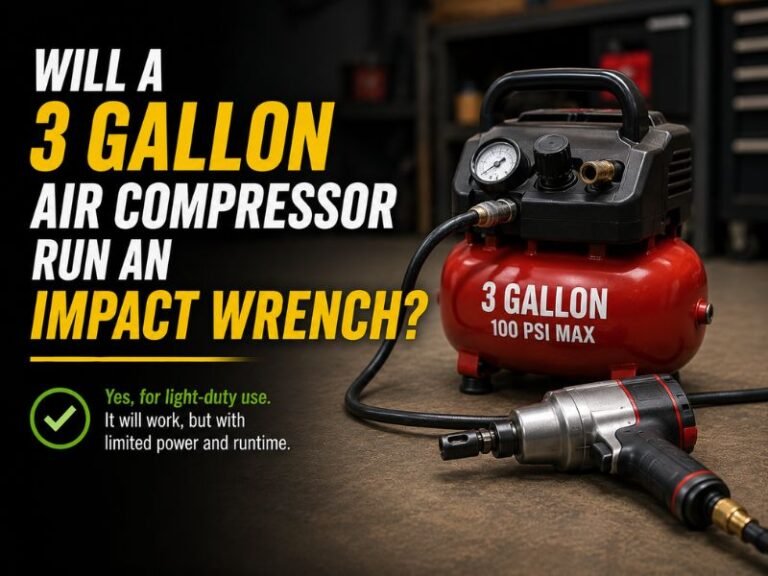
Will a 6 Gallon Air Compressor Run an Impact Wrench: Overview
Yes, a 6-gallon air compressor can run an impact wrench for short, intermittent jobs, especially when loosening a few lug nuts or removing small-to-medium fasteners. It usually will not keep a high-demand impact wrench operating continuously because the compressor cannot replace air as quickly as the tool consumes it.
The decision depends on more than tank size. A 6-gallon tank stores a useful burst of compressed air, but the compressor’s SCFM output at 90 PSI, the impact wrench’s air demand, the fastener size, and the amount of time between applications determine how well the setup performs. A compact pancake compressor may work acceptably with a moderate-duty wrench yet struggle with stubborn truck lugs or repeated suspension work.
That makes one-size-fits-all advice unreliable when you are deciding whether to use the equipment you already own or buy a larger compressor. This article explains how tank capacity, airflow, pressure, fittings, and impact-tool size interact; it also covers realistic jobs, warning signs, operating techniques, and safety limits. By the end, you can compare the compressor and wrench specifications, decide whether the combination is practical, and recognize when an electric or higher-capacity pneumatic setup is the better choice.
What a 6-gallon compressor can realistically do
A typical 6-gallon portable compressor is designed for intermittent air tools. Depending on the model, it may deliver roughly 2 to 4 SCFM at 90 PSI, although the exact rating must be checked on the nameplate or manual. The tank can supply air faster than the pump for a short period, which is why an impact wrench may work at first even when the compressor’s continuous output is modest.
For occasional automotive work, that stored air is often enough to remove several lug nuts, install fasteners, or handle a few short bursts. The compressor then needs time to recover pressure before the next demanding task. A short duty cycle is the key limitation, not necessarily an immediate lack of usable power.
Performance becomes less predictable when the fasteners are heavily rusted, the vehicle has large wheels, or the impact wrench is used continuously. The wrench may slow down as tank pressure falls, and the motor may run almost constantly while the tool still fails to produce consistent torque.
Why tank size alone does not answer the question
The “6 gallon” label describes the receiver tank’s internal volume. It does not describe how quickly the pump makes air or how efficiently the tool uses it. Two compressors with the same tank size can have noticeably different results if one produces much more air at the tool’s operating pressure.
Tank capacity affects available reserve air. A larger tank generally allows a longer burst before pressure drops, while a smaller tank reaches its cut-in pressure sooner. However, a large tank paired with a weak pump will eventually run out of air during extended use.
Airflow is the more important specification for sustained operation. Look for SCFM at 90 PSI, not only “maximum PSI.” Maximum pressure indicates the highest stored pressure the compressor can reach; it does not tell you how fast the pump can replenish air while an impact wrench is running.
Pressure also matters because impact wrenches are commonly rated around 90 PSI. Operating below the tool’s recommended pressure can reduce speed and torque, but raising pressure beyond the tool or accessory rating is not a safe substitute for adequate airflow.
Compare the wrench’s air requirement with compressor output
Impact wrenches list air consumption in different ways. A specification may show average SCFM, free speed consumption, air consumption under load, or a short “burst” figure. These numbers are not always directly comparable, so read the definitions in the wrench manual instead of relying on a single impressive-looking rating.
A compact 3/8-inch impact wrench may require less air than a 1/2-inch high-torque model. A 1/2-inch mid-torque tool can sometimes work with a 6-gallon compressor for intermittent automotive jobs, while a large 1/2-inch or 3/4-inch high-torque wrench can overwhelm a small compressor quickly.
As a practical rule, the compressor should produce at least as much air as the wrench needs at its working pressure, with some reserve. If the wrench requires 5 SCFM at 90 PSI and the compressor supplies only 2.6 SCFM at 90 PSI, the tool can still operate from the tank briefly, but it cannot be supported continuously.
Do not confuse a tool’s maximum breakaway torque with its normal operating requirement. A wrench might advertise very high torque, yet the actual result depends on pressure at the inlet, hose size, lubrication, socket condition, joint corrosion, and how long the tool is allowed to impact.
Which jobs are suitable for a 6-gallon setup?
A 6-gallon compressor is most useful when the impact wrench runs in short bursts and the work allows recovery time. Removing lug nuts from one wheel, changing a few brake components, or installing and removing moderate-size fasteners may be reasonable if the tool and compressor are properly matched.
It can also be practical for light-duty shop tasks where fasteners are not seized and the operator does not need maximum torque for a long period. The compressor may cycle between fasteners, allowing tank pressure to rebuild while the next part is positioned.
Problems are more likely during jobs such as repeated wheel removal across several vehicles, long suspension repairs, commercial truck work, or any task involving a high-torque pneumatic wrench. These applications demand a steady air supply rather than occasional stored-air bursts.
Fastener condition is another major variable. A clean, correctly torqued lug nut may loosen quickly, while a rusted or over-tightened nut can consume several seconds of continuous impact. That single fastener may lower tank pressure enough to affect every fastener afterward.
How to get better performance from a small compressor
Start with a fully charged tank and set the regulator to the wrench manufacturer’s recommended pressure. Check the pressure while the tool is actually running if possible, because a gauge can show adequate static pressure even though pressure drops sharply at the wrench inlet.
Use an air hose and fittings that can deliver the required flow. A long, narrow hose, restrictive coupler, clogged filter, or undersized fitting can create a pressure drop that makes a capable compressor feel weak. For many impact tools, a properly sized 3/8-inch inside-diameter hose is more suitable than a small coiled line, particularly when the hose is long.
Keep the compressor close enough to reduce unnecessary hose length, but leave proper ventilation around the motor and pump. Drain moisture from the tank after use, inspect the air filter, and follow the compressor’s lubrication and maintenance instructions.
Use short trigger pulls instead of holding the trigger continuously. Apply the wrench for a few seconds, release it, and let the compressor recover. This approach reduces heat and gives the pump a chance to restore pressure, although it cannot overcome a severe mismatch between tool demand and compressor output.
- Charge the tank fully before beginning.
- Use impact-rated sockets and a suitable hose.
- Inspect couplers, fittings, and the regulator for leaks.
- Let the compressor recover when pressure falls noticeably.
- Stop if the motor overheats, the pump cannot keep up, or the tool behaves erratically.
Pressure, torque, and the danger of guessing
An impact wrench does not automatically deliver its advertised torque in every situation. The published figure is usually associated with specific pressure, airflow, lubrication, fastener conditions, and test methods. A small compressor may provide enough pressure for the wrench to spin while still failing to provide enough air for full impact force.
That matters most during installation. An impact wrench should not be used as the final method for tightening wheel lug nuts unless the manufacturer specifically permits that procedure and the operator verifies the final torque. Use a calibrated torque wrench for the final tightening step, following the vehicle manufacturer’s torque specification.
Over-tightened lugs can damage studs, distort brake components, or make future roadside removal difficult. Under-tightened lugs are also dangerous because wheel attachment can be compromised. The air compressor’s ability to run the wrench does not determine whether the fastener has reached the correct torque.
Use only sockets and extensions marked for impact use. Ordinary chrome sockets can crack under impact loading and may send fragments outward. Keep hands clear of pinch points, wear eye and hearing protection, and disconnect the air supply before changing sockets or servicing the tool.
Signs the compressor is too small
The clearest sign is a rapid pressure drop followed by a weak or slow impact wrench. If the tool starts strongly but loses speed after several seconds, the tank reserve is being consumed faster than the pump can replace it.
A compressor that runs continuously without regaining cut-out pressure is also working beyond its practical duty cycle. Occasional cycling is normal, but relentless operation can overheat the motor and pump, especially in a hot or poorly ventilated area.
Other warning signs include repeated thermal overload trips, excessive moisture, unusual pump noise, and a wrench that stalls on ordinary fasteners. Air leaks can produce similar symptoms, so inspect the hose, couplers, regulator, drain valve, and tool connection before replacing equipment.
If the tool only fails on difficult fasteners, the compressor may not be the sole problem. A worn impact mechanism, inadequate lubrication, a damaged socket, low inlet pressure, or a seized fastener can also reduce performance. Do not keep increasing pressure to compensate without checking the tool’s maximum rated pressure.
When a larger compressor or different tool makes sense
Consider a larger compressor when the impact wrench will be used repeatedly, when several people need air at the same time, or when the work involves high-torque tools. A compressor with greater tank capacity and higher SCFM at 90 PSI will recover more effectively and maintain more consistent tool performance.
For occasional tire and vehicle work, a corded electric or cordless impact wrench may be more convenient than upgrading a pneumatic system. These tools avoid hose restrictions and compressor recovery time, although battery condition, voltage, fastening requirements, and tool quality still affect results.
Buying the largest compressor possible is not always necessary. Match the equipment to the duty cycle: intermittent home use, professional automotive use, and continuous production work have very different air requirements. Check both the impact wrench consumption and the compressor’s delivered SCFM before making a purchase.
How to test your existing equipment
Read the compressor label for tank size, maximum pressure, and delivered SCFM at 90 PSI. Then check the wrench manual for operating pressure and air consumption. If the compressor’s 90-PSI output is lower than the wrench’s demand, expect short bursts and recovery pauses rather than continuous operation.
Next, inspect the air path. Confirm that the regulator is open enough, the couplers are fully seated, and no hose or fitting is unusually restrictive. Spray a small amount of soapy water around suspected connections and look for bubbles, keeping the compressor depressurized before tightening or replacing components.
With eye and hearing protection in place, test the wrench on a suitable fastener for a short interval. Watch the tank gauge and listen for the compressor. A gradual pressure decline followed by normal recovery may be acceptable for occasional use; a rapid decline, stalling tool, or overheating motor indicates that the setup is not suitable for the intended job.
For wheel work, use the impact wrench only to remove fasteners or snug them lightly. Complete installation with a torque wrench and recheck the result according to the vehicle or component instructions.
Frequently asked questions
Will a 6 gallon air compressor run an impact wrench?
Yes, usually for short bursts, but not necessarily continuously. A 6-gallon compressor can often operate a small or mid-sized impact wrench for intermittent automotive work. The compressor’s SCFM at 90 PSI and the wrench’s air consumption matter more than the six-gallon label by itself.
Can a 6-gallon compressor remove lug nuts?
It can remove many lug nuts when the wrench is properly matched and the nuts are not severely seized. Work one fastener at a time and pause if tank pressure drops. Rusted, over-tightened, or large vehicle lug nuts may require a higher-capacity compressor or a stronger cordless impact wrench.
Will a pancake compressor power a 1/2-inch impact wrench?
A pancake compressor may power a moderate-duty 1/2-inch wrench intermittently. It is less likely to sustain a high-torque 1/2-inch model, especially when loosening stubborn fasteners. Compare the compressor’s SCFM at 90 PSI with the tool’s stated requirement before relying on the combination.
What PSI is needed for an impact wrench?
Many impact wrenches are designed to operate around 90 PSI. Follow the specific tool’s instructions and measure pressure at the tool when possible. Higher regulator settings cannot replace inadequate SCFM and may damage the tool or create an unsafe condition if they exceed its rating.
Why does my impact wrench run but lack power?
Low airflow is a common cause, but it is not the only one. A restrictive hose, leaking coupler, low running pressure, dirty air filter, poor lubrication, worn tool, or damaged socket can reduce torque. Check the complete air path before assuming the compressor tank is too small.
Can an impact wrench damage a small compressor?
Occasional short use is normally less demanding than continuous operation. Holding the trigger for long periods can make a small compressor run constantly, overheat, or trip its thermal protection. Stop when the motor becomes excessively hot and follow the compressor’s duty-cycle instructions.
Can I tighten lug nuts completely with an impact wrench?
Do not rely on the impact wrench for final wheel-lug torque. Use it only for removal or light snugging, then tighten each lug with a calibrated torque wrench to the vehicle manufacturer’s specification. This prevents both dangerous under-tightening and damage from excessive torque.
Conclusion: Use it intermittently and verify the specifications
A 6-gallon air compressor can run an impact wrench for short, practical tasks when its delivered SCFM, the wrench’s air demand, and the fastener difficulty are compatible. The major limitation is recovery: a small tank and modest pump cannot support continuous high-airflow use, and inadequate airflow can also produce unreliable torque.
Check the 90-PSI SCFM ratings, use a properly sized hose and impact sockets, allow recovery pauses, and stop if the compressor overheats or the wrench loses power. For wheel installation, always finish with a torque wrench; for frequent or heavy work, choose a compressor or electric impact tool designed for that duty cycle.