Will a 3 Gallon Air Compressor Run an Impact Wrench?
A 3-gallon air compressor may run a pneumatic impact wrench for a very short burst, but most small 3-gallon compressors do not provide enough stored air or continuous airflow for practical, repeated impact-wrench use.
The important issue is not simply whether the compressor can reach 125 or 150 PSI. An impact wrench also needs enough airflow, usually measured in CFM or SCFM at its specified working pressure. A small compressor can initially supply air from its tank, which may let the wrench operate normally for a few seconds. Once that reserve drops, however, the compressor pump has to replace the air being consumed.
For most conventional 3-gallon compressors, that is where the limitation becomes obvious.
Will a 3 Gallon Air Compressor Run an Impact Wrench?
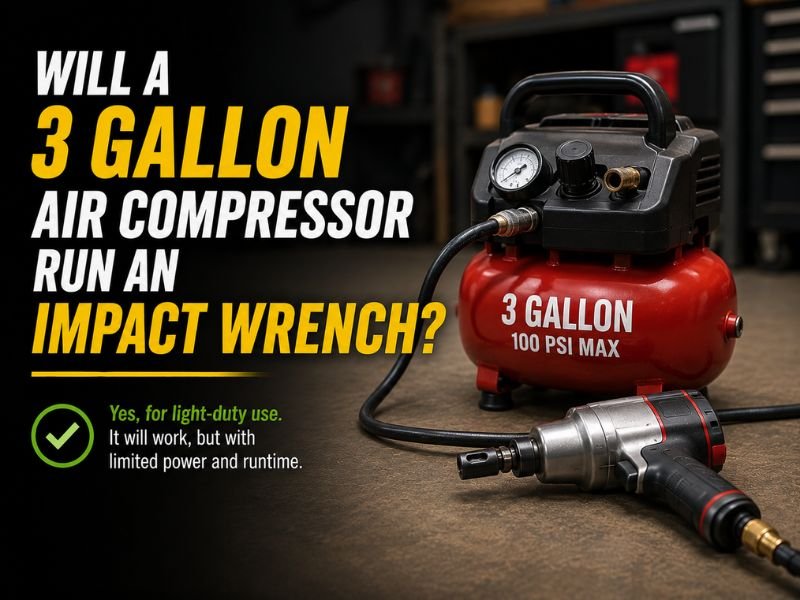
Technically, it can in some situations.
Practically, it is usually a poor match for regular impact-wrench work.
A 3-gallon compressor may be able to handle:
- One or two short trigger bursts
- An easy fastener that loosens immediately
- Occasional testing of a pneumatic impact wrench
- A relatively low-air-demand impact tool
It will usually struggle with:
- Multiple lug nuts
- Rusted fasteners
- Suspension work
- Long impact cycles
- Repeated 1/2-inch impact use
- High-air-consumption pneumatic tools
The reason is simple: a 3-gallon tank does not contain much reserve air, and many compressors in this size class also have relatively low pump output.
Why a 3 Gallon Tank Is So Limiting
An air compressor tank is essentially a reservoir.
Before you begin working, the pump fills the tank with compressed air. When you pull the impact-wrench trigger, the tool draws air from that reserve.
The cycle looks like this:
- Tank starts fully charged.
- Impact wrench begins consuming air.
- Tank pressure falls.
- Compressor motor starts.
- Pump attempts to replace the air.
- Tool continues consuming air.
- If tool demand exceeds pump output, pressure keeps falling.
With a large tank, you have more stored air before performance drops.
With only 3 gallons, the reserve can disappear quickly when connected to an air-hungry tool.
That does not mean the wrench instantly stops working. It means useful runtime between compressor recovery cycles may be very short.
Tank Size and SCFM Are Not the Same Thing
This distinction is essential.
Tank Size
Tank capacity tells you how much compressed air can be stored.
A bigger tank can provide:
- Longer bursts
- More reserve
- More time before pressure falls significantly
SCFM
SCFM tells you how much airflow the compressor can continuously produce under specified conditions.
That determines:
- Recovery speed
- Continuous tool performance
- How quickly the compressor replaces used air
For an impact wrench, SCFM is usually the more important compatibility specification.
A 3-gallon compressor with weak pump output will struggle even if its tank pressure rating sounds impressive.
How Much Air Does an Impact Wrench Need?
There is no single airflow requirement for every pneumatic impact wrench.
Requirements vary according to:
- Drive size
- Tool design
- Torque capability
- Internal motor
- Operating pressure
- Duty cycle
A compact 3/8-inch impact may consume less air than a full-size 1/2-inch wrench.
A heavy-duty 3/4-inch impact may require substantially more.
You may also encounter different specifications such as:
- Average air consumption
- Air consumption under load
- Required operating pressure
These numbers need to be interpreted carefully.
Average CFM vs. Air Consumption Under Load
Impact wrenches are often used intermittently.
You pull the trigger for several seconds, release it, move to another fastener, and repeat.
Because of this operating pattern, a manufacturer may list an average air-consumption figure that is much lower than what the tool consumes while the trigger is continuously held.
Average Air Consumption
Useful for estimating intermittent operation.
Loaded Air Consumption
Represents a more demanding operating condition.
This difference explains why a small compressor may appear capable during occasional short bursts but quickly fall behind when the wrench is held on a seized bolt.
Why Can the Impact Wrench Work at First?
Because the wrench is initially using the compressed air stored inside the tank.
Imagine a 3-gallon compressor has reached full pressure.
You connect a pneumatic impact wrench and pull the trigger.
For the first moment:
- Tank is full
- Pressure is available
- Wrench receives a strong burst of air
- Tool may sound and feel normal
Then the air reserve begins disappearing.
If the compressor pump cannot replace it quickly enough:
- Pressure drops
- Wrench speed falls
- Impact strength decreases
- Compressor continues running
Release the trigger and wait for the tank to refill, and the wrench may become strong again.
This is why a small compressor can technically “run” an impact wrench while still being poorly matched for the job.
Will a 3 Gallon Compressor Run a 1/2-Inch Impact Wrench?
It may operate one briefly, but most typical 3-gallon compressors are not ideal for regular 1/2-inch impact-wrench work.
A full-size 1/2-inch pneumatic impact can have considerable airflow requirements.
The setup has the best chance when:
- Tank is fully charged
- Fastener loosens almost immediately
- Trigger bursts are short
- Hose is properly sized
- Tool has relatively modest air consumption
It performs poorly when:
- Bolt is seized
- Wrench must hammer continuously
- Several fasteners must be removed quickly
- Compressor recovery is slow
- Hose or fittings restrict airflow
For one easy bolt, the compressor may appear completely adequate.
For removing an entire wheel or working on stubborn suspension hardware, its limitations can become obvious very quickly.
Can a 3 Gallon Compressor Remove Lug Nuts?
Possibly, but it is not an ideal tire-service setup.
Whether a lug nut comes loose depends on more than tank size.
Important factors include:
- Impact wrench torque
- Available airflow
- Regulated pressure
- Hose diameter
- Fitting restriction
- Lug-nut condition
- Corrosion
- How tightly the nut was previously installed
If a lug nut breaks loose immediately, a small compressor may supply enough stored air to finish the job.
If the nut requires several seconds of hard impacting, the tank can drain quickly.
After one or several lug nuts, you may need to stop and wait for recovery.
For frequent tire changes, a compressor with substantially greater airflow and air storage is more practical.
Will a 3 Gallon Compressor Run a 3/8-Inch Impact Wrench?
Potentially, and this may be a better combination than a high-demand 1/2-inch impact.
However, do not choose only by drive size.
Two 3/8-inch impact wrenches can have very different airflow requirements.
A compact, efficient model may work reasonably well in short bursts.
Another tool may still demand more air than the compressor can replenish.
Always compare the exact wrench’s air requirement with the compressor’s SCFM rating.
Is 125 PSI Enough for an Impact Wrench?
The compressor reaching 125 PSI does not automatically make it suitable.
Many pneumatic tools operate at a regulated pressure lower than the compressor’s maximum tank pressure.
The important question is:
How much airflow can the compressor deliver at the wrench’s required pressure?
A compressor may reach 125 PSI but produce very little SCFM.
Another compressor can have a similar pressure rating while supplying several times more airflow.
The second compressor will generally support an impact wrench much better.
Is 150 PSI Enough for an Impact Wrench?
The same principle applies.
150 PSI sounds powerful, but maximum tank pressure and airflow are separate specifications.
You should not solve an airflow shortage by simply raising tool pressure beyond its specified limit.
That can:
- Increase wear
- Damage the tool
- Stress hoses or fittings
- Create unsafe operating conditions
Use the pressure recommended for the impact wrench and make sure the compressor provides adequate airflow at that pressure.
Why Does My Impact Wrench Start Strong and Then Get Weak?
This is one of the clearest signs of an undersized air supply.
The sequence is usually:
- Full tank provides strong airflow.
- Wrench begins consuming air.
- Tank pressure drops rapidly.
- Pump turns on.
- Pump cannot match the tool’s demand.
- Wrench becomes weaker.
If the wrench becomes strong again after the compressor refills, the air system is likely the limiting factor.
Possible contributing problems include:
- Low compressor SCFM
- Small tank
- Undersized hose
- Restrictive couplers
- Air leaks
- Incorrect regulator setting
Does Hose Size Matter?
Yes.
An already marginal compressor performs even worse when the air path restricts flow.
Important factors include:
- Hose inside diameter
- Hose length
- Coupler design
- Regulator capacity
- Fittings
A narrow or unnecessarily long hose can create pressure loss before the air reaches the impact wrench.
Use the hose size recommended for your exact tool.
If the manufacturer calls for a larger hose, using a small hose simply because it came with the compressor can reduce performance.
Can You Add a Larger Tank to a 3 Gallon Compressor?
An auxiliary tank can increase stored-air capacity.
That may let the impact wrench operate longer before pressure falls.
However:
A larger tank does not increase compressor SCFM.
Suppose your pump cannot keep up with the wrench.
Adding another tank gives you:
- More initial reserve
- Longer burst runtime
But eventually the stored air is still consumed.
Then the same small pump must refill a much larger volume.
So an auxiliary tank can improve burst duration, but it does not transform a low-output compressor into a high-airflow shop compressor.
3 Gallon vs. 6 Gallon vs. 20 Gallon Compressor
| Compressor Size | Typical Impact-Wrench Suitability |
| 3 gallon | Very limited; brief bursts |
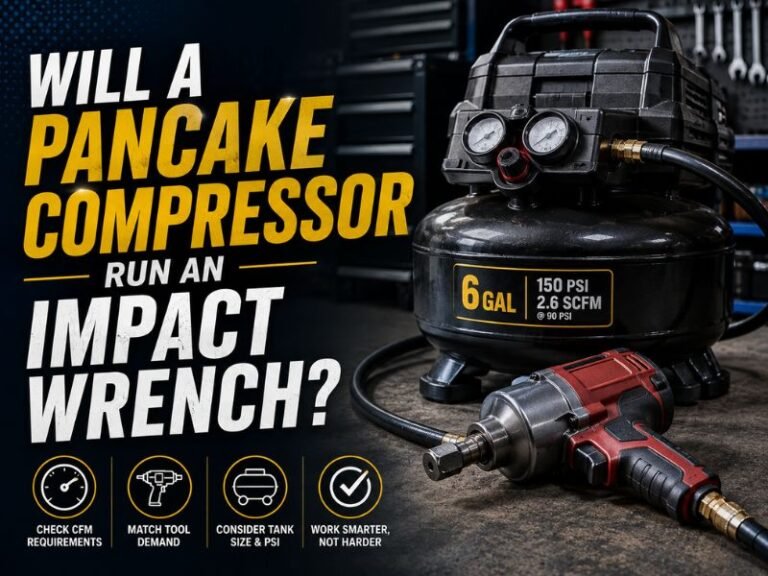
| 6 gallon | Better reserve but often still airflow-limited |
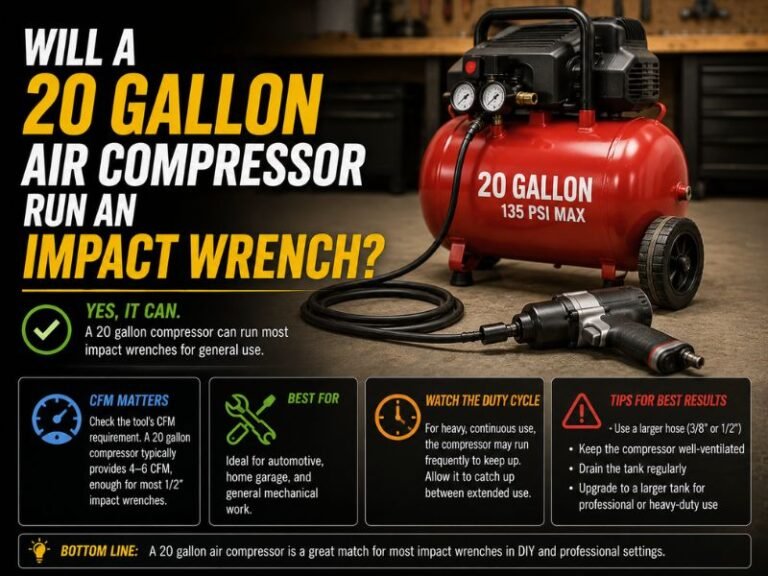
| 20 gallon | Much more practical when SCFM is adequate |
Tank size is not the only factor.
A well-designed compressor with strong airflow can outperform another unit with a larger tank but a weaker pump.
Still, for impact-wrench use, a 20-gallon system usually gives you much more useful reserve than a 3-gallon tank.
What Is a 3 Gallon Compressor Better Suited For?
Small compressors make sense for tools that use relatively little air or operate in very short cycles.
Common applications may include:
- Tire inflation
- Sports-equipment inflation
- Brad nailers
- Staplers
- Air brushing
- Blow-off work in short bursts
These tasks fit the strengths of a small, portable compressor.
A pneumatic impact wrench has a very different airflow profile, particularly when it is working hard against stubborn hardware.
Signs Your 3 Gallon Compressor Is Too Small
Look for these symptoms:
- Wrench is powerful for only a few seconds
- Tank pressure falls almost immediately
- Compressor motor runs continuously
- You need long pauses between bolts
- Impact strength decreases rapidly
- Tool works again after tank recovery
- Several lug nuts take much longer than expected
If those problems occur consistently, better hose or fittings may help slightly, but they cannot compensate for a major compressor-airflow shortage.
How to Get the Best Performance From a 3 Gallon Compressor
If a 3-gallon compressor is all you currently have, you can improve the setup within its limits.
Start With a Full Tank
Let the compressor finish filling before using the impact wrench.
Set the Correct Pressure
Follow the wrench manufacturer’s operating-pressure specification.
Use the Correct Hose
Avoid unnecessarily restrictive hose.
Keep the Hose Reasonably Short
Long hose runs can increase pressure loss.
Check Couplers and Fittings
Small passages can restrict airflow.
Repair Air Leaks
Leaks waste an already limited air supply.
Use Short Bursts
Avoid holding the trigger continuously when unnecessary.
Allow Recovery Time
Give the compressor time to rebuild tank pressure.
Never Exceed Tool Pressure Limits
More pressure is not a substitute for adequate airflow.
Would a Cordless Impact Wrench Make More Sense?
For someone who owns only a small 3-gallon compressor, a cordless impact wrench can avoid the compressor limitation entirely.
A cordless wrench does not depend on:
- Tank size
- SCFM
- Air hose
- Couplers
- Compressor recovery
That does not make pneumatic tools obsolete. A pneumatic impact wrench can perform very well when connected to a properly sized compressed-air system.
But pairing a high-air-demand pneumatic wrench with a tiny compressor often creates more inconvenience than benefit.
Common Mistakes
Avoid these common errors:
- Choosing a compressor based only on gallons
- Looking only at maximum PSI
- Ignoring SCFM at working pressure
- Assuming stored tank air equals continuous airflow
- Holding the impact trigger continuously
- Using an undersized hose
- Ignoring restrictive couplers
- Increasing pressure beyond tool limits
- Assuming an auxiliary tank increases pump output
- Assuming all 3-gallon compressors perform the same
Frequently Asked Questions
Will a 3 Gallon Air Compressor Run an Impact Wrench?
It may run one briefly, but most conventional 3-gallon compressors are poorly suited to repeated pneumatic impact-wrench use because of limited storage and airflow.
Can a 3 Gallon Compressor Run a 1/2-Inch Impact Wrench?
Possibly for a few short bursts, but a typical 1/2-inch pneumatic impact often demands more airflow than a small 3-gallon compressor can continuously provide.
Can a 3 Gallon Compressor Remove Lug Nuts?
It may remove an easy lug nut if the wrench has enough torque and the tank is fully charged. Repeated lug-nut work can quickly exhaust the available air.
Is 3 Gallons Enough for an Impact Wrench?
Usually not for convenient repeated use. The small tank provides only a short air reserve.
How Much CFM Does an Impact Wrench Need?
It varies by model. Check the exact tool’s average and loaded air-consumption specifications rather than relying on drive size alone.
Is 125 PSI Enough for an Impact Wrench?
Pressure may be sufficient, but the compressor also needs adequate airflow at the tool’s specified operating pressure.
Is 150 PSI Enough for an Impact Wrench?
Maximum tank PSI alone does not determine compatibility. SCFM is equally important.
Why Does My Impact Wrench Lose Power?
The tank may be draining faster than the compressor can replenish it. Hose restrictions, leaks, low regulator pressure, or tool problems can also contribute.
Can I Add an Auxiliary Tank to a 3 Gallon Compressor?
Yes, but it only adds stored air. It does not increase the pump’s SCFM output.
Will a 3 Gallon Compressor Run a 3/8-Inch Impact?
It may handle some compact 3/8-inch impacts in short bursts. Check the exact wrench’s airflow requirement.
What Size Air Compressor Is Better for an Impact Wrench?
Rather than choosing by gallons alone, select a compressor that provides enough SCFM at the wrench’s operating pressure, then choose sufficient tank capacity for the runtime you need.
Conclusion
If you’re asking “will a 3 gallon air compressor run an impact wrench,” it may operate one for a brief burst, but most conventional 3-gallon compressors are not well suited to repeated pneumatic impact-wrench work.
The biggest limitation is the combination of a very small air reserve and typically modest pump airflow. A fully charged tank may make the impact wrench feel strong for the first few seconds, but the tool can consume that stored air quickly. If the compressor cannot replace it fast enough, pressure and wrench performance fall.
Maximum PSI does not solve this problem. A compressor can reach 125 or 150 PSI and still lack the SCFM needed for an impact wrench.
For the best possible performance, use the correct regulated pressure, an appropriately sized hose, unrestricted fittings, and short trigger bursts. Allow the compressor to recover whenever tank pressure falls.
An auxiliary tank can extend burst runtime, but it cannot increase the pump’s airflow.
A 3-gallon compressor may be enough to make an impact wrench work briefly, but for regular lug-nut removal or automotive repairs, a compressor with substantially greater SCFM and air storage is usually the more practical setup.