What Is an Impact Wrench Used for: Clear Answers and Key Facts
An impact wrench is used to tighten or loosen nuts and bolts with high torque, especially when a standard wrench or drill cannot provide enough force. It is commonly used for lug nuts, automotive repairs, construction fasteners, equipment maintenance, and other jobs involving stubborn or heavily tightened hardware.
The tool combines motor-driven rotation with repeated hammering impacts. That action delivers short bursts of torque while reducing the continuous twisting force transferred to the operator, making difficult fasteners faster to remove. However, an impact wrench is not automatically the right choice for every bolt: excessive torque can damage threads, snap fasteners, distort parts, or overtighten a wheel nut.
This guide explains how impact wrenches work, where they are most useful, how they differ from impact drivers and drills, and which power source and drive size fit common tasks. It also covers sockets, torque control, safety precautions, situations where another tool is better, and the practical limits to consider before deciding whether an impact wrench belongs in a toolbox.
What an Impact Wrench Does
An impact wrench applies rotational force through a hammer-and-anvil mechanism. When the fastener resists turning, the internal hammer strikes the anvil repeatedly, producing brief, powerful torque pulses instead of relying only on steady motor rotation.
This mechanism gives an impact wrench two important advantages. It can break loose fasteners that are seized, rusted, over-tightened, or exposed to years of vibration, and it can install large fasteners much more quickly than a manual ratchet.
Most models use a square drive that accepts impact sockets. Common drive sizes include 1/4-inch, 3/8-inch, 1/2-inch, 3/4-inch, and 1-inch, although the most useful size depends on the fastener and the amount of torque required.
Impact wrenches are available in cordless electric, corded electric, and pneumatic versions. Cordless models are popular for vehicle and job-site work because they do not require an air compressor or nearby outlet. Pneumatic models remain common in professional garages because a suitable compressor can support repeated use with relatively low tool weight.
Common Uses for an Impact Wrench
Removing and installing wheel lug nuts
One of the most familiar uses is removing and installing automotive lug nuts. A properly sized impact wrench can remove lug nuts quickly during tire changes, brake work, suspension repairs, and wheel replacements.
It is especially helpful when a lug nut has been overtightened or exposed to corrosion. The impact action may loosen a nut without requiring a long breaker bar, although severely seized hardware can still require penetrating oil, heat, or additional mechanical force.
Installation requires more care than removal. An impact wrench should generally be used only to run a lug nut down or snug it lightly. Final tightening should be performed with a calibrated torque wrench according to the vehicle or wheel manufacturer’s specification.
Automotive repair and maintenance
Beyond lug nuts, an impact wrench is useful for removing or installing many automotive fasteners, including suspension bolts, brake components, engine mounts, exhaust hardware, axle nuts, and some steering components.
The tool saves time when a repair involves many large bolts. It can also make work more manageable in confined areas where swinging a long hand tool would be awkward, provided the socket and access angle are appropriate.
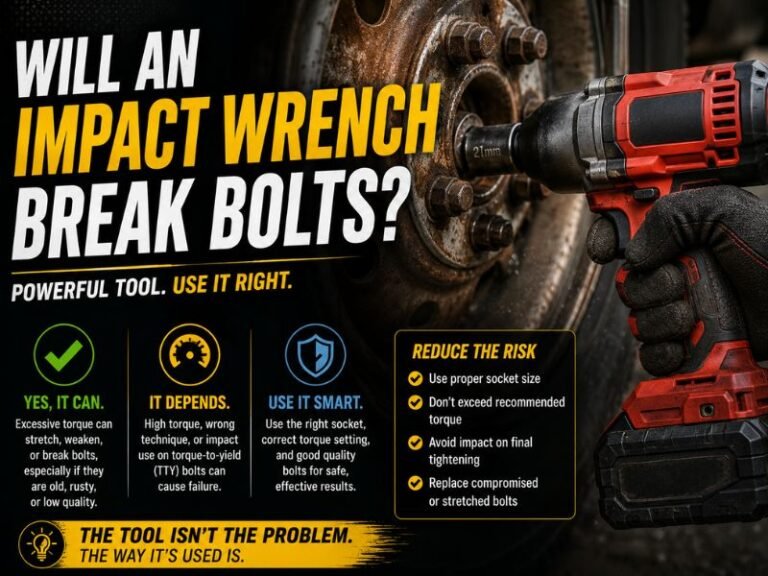
Not every automotive fastener should be handled at full power. Aluminum components, small bolts, wheel studs, sensors, delicate brackets, and fasteners threaded into soft materials can be damaged by excessive torque or impact force.
Construction and structural fastening
Construction workers use impact wrenches for large lag screws, structural bolts, concrete anchor hardware, steel connections, scaffolding components, and heavy-duty equipment assembly. The tool is valuable when a project involves repeated fastening rather than only a few small screws.
For structural connections, the required installation method matters. Some applications require a specified torque, a calibrated tool, a particular tightening sequence, or a method such as turn-of-nut installation. An impact wrench can assist with the work, but its use does not replace the project specification.
Equipment, machinery, and agricultural repairs
Farm equipment, trailers, generators, industrial machinery, and outdoor power equipment often contain large fasteners that are difficult to turn by hand. An impact wrench can speed repairs in workshops and field conditions where time and access are limited.
It is also useful for removing blades, pulleys, guards, wheels, and other assemblies. Before applying impact force, confirm that the fastener is meant to be removed in the selected direction and that nearby parts can withstand the vibration.
Heavy-duty assembly and maintenance
Large impact wrenches are used in manufacturing, fleet maintenance, rail work, shipyards, and other settings involving high-strength bolts. These tools may provide substantially more torque than consumer-grade cordless models.
High output is not automatically an advantage. A tool that is too powerful for the fastener can stretch a bolt, damage threads, crack a housing, or make later removal more difficult. Matching the wrench to the hardware is more important than choosing the highest torque number.
Why Use an Impact Wrench Instead of a Hand Tool?
The main benefit is speed. A powered wrench can remove or install a fastener in seconds, while a ratchet may require repeated swinging, repositioning, and significant physical effort.
It also reduces fatigue during repetitive work. The operator does not need to maintain constant leverage throughout the entire removal process, which can be useful when working on multiple vehicles or large mechanical assemblies.
The hammering action can help overcome breakaway torque, the initial force needed to start a stuck fastener turning. Because the impact pulses occur rapidly, the tool may succeed where smooth rotation from a drill or standard electric wrench stalls.
There are tradeoffs. Impact wrenches are louder, heavier, and less precise for final tightening than hand tools. They can also damage hardware quickly when used with the wrong socket, excessive power, or poor technique.
Impact Wrench vs. Impact Driver vs. Drill
An impact wrench and an impact driver both use impact mechanisms, but they are designed for different hardware. An impact wrench typically has a square drive for sockets and is built for nuts and bolts. An impact driver usually has a 1/4-inch hex chuck for screwdriver bits and smaller socket adapters.
An impact driver is well suited to driving deck screws, wood screws, lag screws, and small-to-medium fasteners. An impact wrench is generally better for automotive lug nuts, large bolts, and high-torque mechanical work.
A drill provides smooth rotation and adjustable speed, making it useful for drilling holes and driving smaller screws. It usually does not produce the same breakaway force as an impact wrench and may be damaged or stalled when used against large, seized fasteners.
Adapters can make these tools appear interchangeable, but an adapter does not change the tool’s design limits. A small impact driver with a socket adapter is not a substitute for a high-torque impact wrench when large fasteners demand substantial force.
Choosing the Right Impact Wrench
Drive size
The square drive determines which sockets fit and usually indicates the general class of work. A 1/2-inch wrench is a versatile choice for many automotive and general repair jobs. A 3/8-inch model is more compact and suitable for smaller fasteners, while 3/4-inch and 1-inch models target heavy equipment and industrial applications.
Drive size alone does not determine power. Two 1/2-inch impact wrenches can have very different torque outputs, dimensions, battery systems, and operating characteristics.
Torque ratings
Manufacturers may list breakaway torque, fastening torque, maximum torque, or several operating modes. These figures are useful for comparison, but they are not always directly equivalent across brands or testing conditions.
Look for a tool with enough capacity for the hardest regular task without being unnecessarily powerful for everything else. A lower setting or speed mode can improve control when working with smaller fasteners.
Power source
Cordless impact wrenches offer portability and are convenient for roadside work, home garages, and construction sites. Battery capacity affects runtime, while battery voltage often correlates with the tool’s size and potential output, but neither number alone guarantees performance.
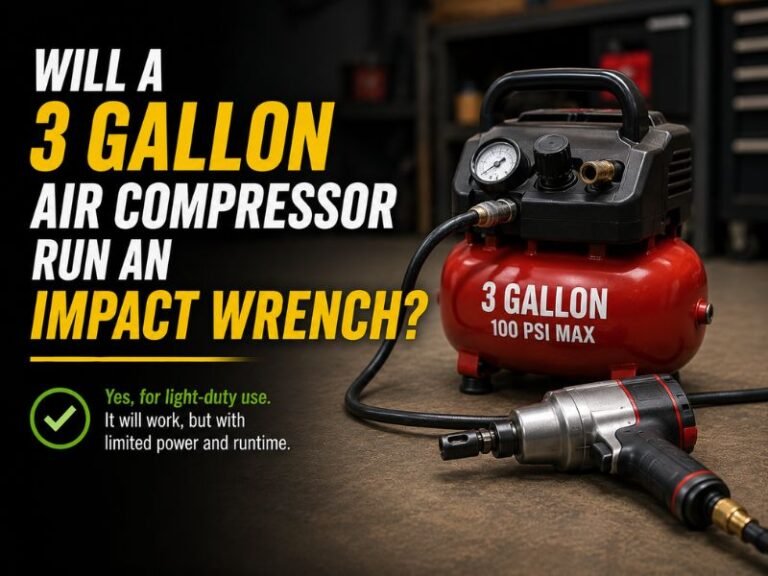
Pneumatic impact wrenches can be compact and durable for frequent shop use. Their actual performance depends on compressor capacity, hose size, fittings, and sustained air delivery, not merely the pressure setting shown on the compressor.
Corded electric models provide consistent power near an outlet but are less convenient in vehicles, outdoor work, or unfinished construction areas. They may still make sense for stationary maintenance tasks.
Size, weight, and access
A compact wrench can reach fasteners inside wheel wells, engine compartments, and machinery frames more easily. A larger model may produce greater torque but become difficult to position or tiring to hold for extended periods.
Consider the tool’s head length, battery placement, grip, lighting, and balance. Access often matters more than maximum output when a fastener sits between brackets or behind another component.
Using an Impact Wrench Safely and Correctly
Use only sockets and extensions rated for impact tools. Standard chrome sockets can crack or shatter under impact force because they are not designed for the same repeated shock loads. Impact sockets are typically made from tougher materials and have a dull, dark finish.
Wear safety glasses and suitable hearing protection. Keep fingers away from the socket and moving parts, secure loose clothing, and make sure the vehicle or equipment is properly supported before removing a fastener that carries a load.
Before starting, inspect the socket, drive, fastener, and surrounding area. A worn socket can slip, while a damaged fastener may round off or break. Confirm that the tool is set to the correct forward or reverse direction.
Use controlled bursts rather than holding the trigger continuously. This helps prevent overtightening and gives time to observe whether the fastener is moving. If it does not move after reasonable attempts, stop and reassess instead of repeatedly applying more power.
- Use the correct impact-rated socket and size.
- Keep the socket fully seated on the fastener.
- Use the lowest practical power setting for the job.
- Support vehicles and machinery with approved stands or blocking.
- Finish critical joints with a torque wrench when a specification applies.
- Stop if the bolt stretches, the socket slips, or the fastener begins to deform.
An impact wrench should not be used to determine final torque on safety-critical connections unless the specific tool and process are approved for that purpose. For wheels, suspension parts, structural bolts, and other specified joints, verify the final result with the required procedure.
When an Impact Wrench Is Not the Best Tool
A manual ratchet or breaker bar may be better when precision, feedback, or delicate control matters more than speed. Hand tools make it easier to feel thread engagement and resistance, which is important when starting a bolt in aluminum or another soft material.
A torque wrench is the appropriate tool for accurate final tightening. An impact wrench can bring a fastener close to tight, but it does not reliably replace torque measurement unless the application has been specifically validated.
For rusted hardware, penetrating oil, a correctly sized breaker bar, heat, or a specialized extractor may be more effective than repeated impact. If a fastener is part of a loaded assembly, release the load safely before attempting removal.
Professional help is sensible when a broken stud, seized axle nut, damaged structural bolt, or inaccessible fastener could affect vehicle control or equipment safety. The risk of damaging an expensive component can outweigh the time saved by applying more torque.
Frequently Asked Questions About Impact Wrench Uses
What is an impact wrench used for?
An impact wrench is used to remove and tighten nuts and bolts with high torque. Typical jobs include lug nuts, automotive repairs, machinery maintenance, construction fasteners, trailer hardware, and large bolts that are difficult to turn with a hand tool.
Can an impact wrench remove lug nuts?
Yes, an impact wrench is commonly used to remove lug nuts. It can quickly loosen many lug nuts, including some that are stuck or overtightened. The vehicle must be safely supported, and final installation should normally be checked with a torque wrench.
Can an impact wrench be used to tighten bolts?
Yes, but it should usually be used for initial tightening rather than final torque. Run the bolt or nut down at a controlled setting, then use the specified torque procedure. Full-power tightening can stretch bolts, damage threads, or make a joint unsafe.
What is the difference between an impact wrench
An impact wrench uses a square-drive socket for nuts and bolts, while an impact driver uses a hex bit holder for screws and smaller fasteners. The wrench is generally the better choice for automotive and heavy mechanical work; the driver is often more convenient for construction screws and general fastening.
Can an impact wrench remove rusted or seized bolts?
It can remove some seized bolts, but it cannot overcome every type of corrosion or mechanical failure. Penetrating oil, heat, a breaker bar, an extractor, or professional repair may be necessary. Stop if the bolt begins twisting, rounding, or breaking.
What size impact wrench is best for automotive work?
A 1/2-inch impact wrench is a versatile option for many automotive repairs. A compact 3/8-inch model may be better for smaller fasteners and tight spaces, while larger drive sizes are intended for heavy trucks, equipment, and industrial hardware.
Do impact wrenches need special sockets?
Yes, use sockets specifically rated for impact tools. Impact sockets are designed to tolerate repeated shock loads. Ordinary chrome sockets may crack or shatter, creating a safety hazard.
Conclusion: Use the Torque, but Control It
An impact wrench is primarily a high-torque tool for quickly removing and installing nuts and bolts, especially on vehicles, machinery, construction projects, and heavy equipment. Its greatest strengths are speed, breakaway power, and reduced physical effort.
Its major limitation is limited precision during final tightening. Choose the correct drive size, use impact-rated sockets, work in controlled bursts, and verify critical fasteners with the specified torque method. For a general automotive toolbox, a 1/2-inch cordless model is a practical starting point; choose a smaller or larger tool when access and fastener size demand it.