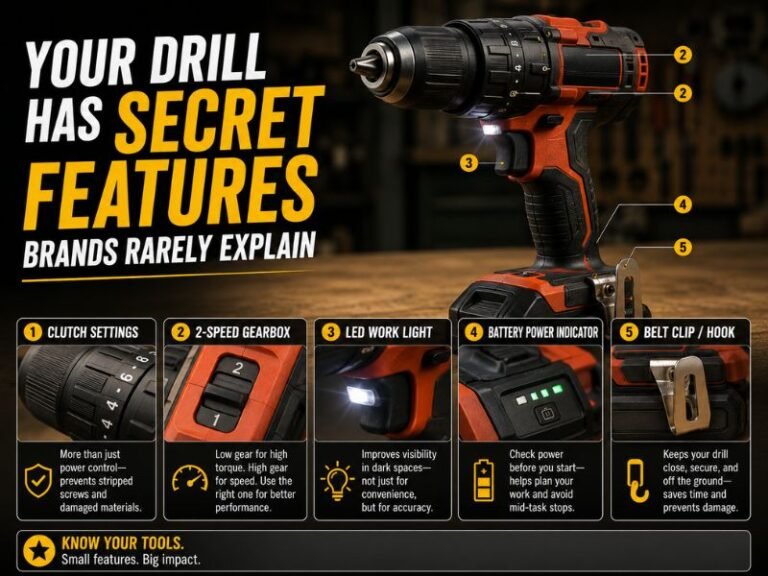
How Long Do Cordless Drill Batteries Last: Key Facts and Guidance
Most cordless drill batteries last about 2 to 5 years, while a single charge may provide anywhere from a few minutes to several hours of drilling depending on the battery, material, and workload. A battery that appears weak is not automatically unsafe or finished; reduced runtime, charging behavior, and physical condition provide a better diagnosis. This article explains the difference between useful life per charge and overall battery life, along with the conditions that shorten or extend both.
Runtime can change dramatically even when the battery itself has not failed. A compact 12-volt battery used for light assembly may handle many small jobs, while a high-capacity 18- or 20-volt pack driving large screws through dense lumber may need recharging quickly. Heat, cold, heavy resistance, storage habits, charger compatibility, and the drill’s condition all affect the result.
What looks like ordinary aging should be separated from genuine risk. The following guidance covers expected service life, charge-cycle limits, warning signs, testing steps, storage practices, and replacement decisions. By the end, you should be able to judge whether a pack needs charging, conditioning, careful monitoring, or replacement.
Two Different Meanings of Battery Life
When someone asks how long cordless drill batteries last, the question usually refers to one of two measurements. Runtime means how long the drill operates between charges, while service life means how many months or years the battery remains useful before its capacity falls too far.
A battery can have a long overall service life but short runtime on a particular job. Conversely, a new high-capacity pack can run a drill for a long session but still age quickly if it is exposed to heat, stored empty, or repeatedly pushed beyond its intended workload.
Runtime is commonly described by voltage and amp-hours. Voltage identifies the tool’s electrical class, such as 12 volts or 18/20 volts, while amp-hours indicate approximate energy capacity. A 4.0 Ah pack generally stores about twice the energy of a 2.0 Ah pack in the same voltage family, although actual runtime depends on load and battery design.
Typical Cordless Drill Battery Lifespan
Modern lithium-ion drill batteries commonly remain useful for two to five years under normal homeowner or light professional use. Some last longer when lightly used and stored properly; others lose noticeable capacity in a much shorter time when subjected to daily heavy loads, extreme heat, or poor charging conditions.
Manufacturers often discuss lithium-ion durability in charge cycles rather than calendar years. One cycle represents the equivalent of using 100% of the battery’s capacity, even if that energy is consumed through several partial discharges. For example, using half the capacity twice roughly equals one full cycle.
A broad expectation for many lithium-ion packs is several hundred full-equivalent cycles, sometimes approaching or exceeding 1,000 depending on cell quality, battery management, operating temperature, and depth of discharge. This is a general engineering range, not a guaranteed result for every brand or model.
Older nickel-cadmium and nickel-metal-hydride batteries may have different aging patterns. They can often tolerate certain charging conditions differently from lithium-ion packs, but they are heavier, may lose capacity more noticeably, and can suffer from age-related deterioration even when used infrequently. The chemistry and charger must always match the tool system.
How Long a Cordless Drill Runs Per Charge
There is no single runtime that applies to every drill battery. A small battery performing light assembly work may last through dozens of short fasteners, while drilling large holes in hardwood, masonry, or metal can drain the same pack rapidly.
The most important factors include:
- Battery capacity: A higher amp-hour rating normally provides longer runtime but adds weight and charging time.
- Drill load: Large bits, high torque settings, and difficult materials draw more current.
- Operating mode: Hammer drilling generally consumes more energy than ordinary drilling or screwdriving.
- Tool efficiency: A worn motor, damaged chuck, or obstructed ventilation can increase power demand.
- Battery temperature: Cold temporarily reduces available output, while excessive heat accelerates permanent aging.
- Battery condition: An older pack may show a full charge but deliver only a fraction of its original runtime.
For practical planning, compare batteries within the same voltage platform and amp-hour rating rather than relying on a universal number of minutes. Runtime claims from manufacturers or users are usually based on specific tasks and cannot predict every drilling application.
Signs a Battery Is Near the End of Its Life
Shorter runtime is the most common sign of capacity loss, but it is not conclusive by itself. A blunt bit, excessive pressure, unsuitable speed, or a demanding material can drain a healthy pack just as quickly.
More reliable warning signs include a combination of reduced runtime and abnormal charging or operating behavior. Watch for these symptoms:
- The drill stops much sooner than it did under the same type of work.
- The battery indicator drops sharply from full to nearly empty.
- The pack charges unusually quickly but also runs out unusually quickly.
- The battery or charger becomes excessively hot during ordinary use.
- The battery swells, cracks, leaks, smells unusual, or has damaged contacts.
- The pack no longer locks securely into the tool or charger.
- The charger repeatedly rejects the battery or shows a persistent fault.
A battery that becomes mildly warm during charging or use may be operating normally, especially under a heavy load. Swelling, smoke, leaking, melting, or a sharp chemical odor is not normal and calls for immediate removal from service.
Why Cordless Drill Batteries Wear Out
Lithium-ion cells gradually lose their ability to store and deliver energy. Chemical reactions inside the cells become less efficient with age, and high current, heat, deep discharge, and prolonged full-charge storage can speed that process.
Heat is one of the biggest causes of accelerated aging. Leaving a battery in a hot vehicle, charging it immediately after intense drilling, or storing it beside a heater can stress the cells and internal electronics. A battery that is hot from use should usually cool to a safe temperature before charging, following the tool manufacturer’s instructions.
Heavy loads also increase wear. Driving long structural screws, using oversized hole saws, or forcing a bit through resistant material can create high current demand. Occasional demanding work is expected, but repeated stalls and sustained overload generate heat and may shorten the pack’s life.
Deep discharge can be harmful, although most modern packs include protective circuitry that disconnects the cells before they reach a damaging level. Repeatedly running the drill until it stops is still less desirable than recharging when the battery becomes low. Do not attempt to bypass the battery’s protection system.
Storage affects aging even when the battery is not being used. A pack left completely empty for a long period may fall below the voltage required for safe charging, while a pack stored at maximum charge in a hot location can lose capacity faster. A cool, dry location and the manufacturer’s recommended storage charge are safer choices.
How to Check Whether the Battery or Drill Is
Before replacing an expensive battery, rule out problems with the tool, charger, and work material. A drill with a slipping clutch, worn motor, damaged chuck, or blocked vents may seem to have poor battery performance because it demands more power than normal.
- Fully charge the battery using the correct charger for that battery platform.
- Let the pack cool if it was recently used or charged in a warm area.
- Test the drill with a sharp, properly sized bit on a familiar task.
- Compare the result with a second compatible battery if one is available.
- Try the suspect battery in another compatible tool only if the manufacturer permits that use.
- Inspect the contacts for dirt, corrosion, looseness, or visible damage.
If one battery performs poorly in multiple compatible tools while another battery performs normally, the battery is the likely problem. If every battery struggles in the same drill, inspect the tool, bit, settings, and mechanical condition instead.
Do not open a lithium-ion battery pack to test individual cells. The pack may contain high-energy cells and protective electronics that can short, ignite, or become unsafe when damaged. Voltage measurements and repairs are best left to a qualified service professional with the correct equipment.
Ways to Extend Cordless Drill Battery Life
Good habits cannot stop normal chemical aging, but they can preserve usable capacity and reduce avoidable stress. Use the battery that matches the task instead of selecting the largest pack for every job; a compact pack may be more comfortable for light work, while a higher-capacity pack can reduce charging interruptions during demanding work.
- Use the manufacturer-approved charger designed for the battery system.
- Keep ventilation openings clear during drilling and charging.
- Allow a hot battery to cool before charging when the instructions require it.
- Avoid repeatedly forcing the drill to stall under extreme resistance.
- Store batteries away from direct sun, moisture, and freezing or excessive heat.
- Keep terminals clean and prevent metal objects from touching the contacts.
- Follow the manufacturer’s storage-charge guidance for extended periods of disuse.
- Remove a damaged or swollen pack from service rather than trying to revive it.
There is usually no benefit to intentionally running a lithium-ion battery completely empty before recharging it. Partial charging is generally more practical for this chemistry, though the exact charging and storage instructions for a particular battery take priority.
When to Replace a Cordless Drill Battery
Replacement makes sense when runtime has fallen enough to interrupt normal work, when the pack fails to charge reliably, or when its physical condition creates a safety concern. A battery may still power the drill briefly and nevertheless be unsuitable for dependable use.
Compare the price of a genuine replacement pack with the age and condition of the drill. If the tool is otherwise sound and compatible batteries are readily available, a new pack may restore useful performance. If the drill is old, damaged, or tied to an obsolete battery platform, replacing the entire tool may be more practical.
Choose a battery with the correct voltage, connection style, chemistry, and platform compatibility. Avoid counterfeit or poorly specified packs, especially when they lack recognizable safety markings or come from an uncertain seller. The charger must also be designed for that battery system.
Do not place lithium-ion batteries in household trash or curbside recycling unless the local program specifically accepts them. Cover exposed terminals with nonconductive tape, keep damaged batteries isolated from flammable materials, and use a battery recycling or hazardous-waste service that accepts the relevant chemistry.
Frequently Asked Questions About Cordless Drill Battery Life
How long do cordless drill batteries last on one charge?
Most packs last from several minutes to several hours per charge, depending on capacity and workload. Light screwdriving with a high-capacity battery may provide a long session, while large holes, masonry, hardwood, or repeated high-torque work can drain it quickly.
How long do cordless drill batteries last before they need
Many lithium-ion drill batteries remain useful for about two to five years. Heavy daily use, heat, deep discharge, poor storage, and repeated overload can shorten that period, while occasional moderate use and careful storage may extend it.
Does a higher amp-hour battery last longer?
Yes, a higher amp-hour rating normally provides more runtime within the same voltage platform. It also tends to be heavier and may take longer to charge, and it will not eliminate rapid drain caused by a demanding bit, stalled motor, or failing drill.
Is it bad to leave a cordless drill battery
Leaving a modern pack on its approved charger is not automatically dangerous, but long-term storage on the charger is unnecessary. Follow the manufacturer’s instructions, and avoid leaving batteries or chargers in hot areas or connected to an incompatible charging device.
Can a cordless drill battery be revived after it stops
A pack may recover from a temporary charger or temperature issue, but a deeply discharged or damaged lithium-ion battery should not be jump-started. Bypassing protective electronics or opening the case can cause fire, injury, or further damage; use an authorized service option instead.
Why does my cordless drill battery die so quickly?
Rapid drain may result from an aging battery, heavy workload, cold temperature, inefficient drill operation, or a poor connection. Test the battery on a familiar light task and compare it with a known-good compatible pack before deciding which component needs replacement.
Should a cordless drill battery feel warm while charging?
Slight warmth can be normal, but excessive or rapidly increasing heat is a warning sign. Stop using the pack if it swells, smokes, leaks, smells strongly, or becomes too hot to handle, and keep it away from combustible materials.
Conclusion: Judge Runtime, Age, and Safety Together
A cordless drill battery commonly provides several minutes to several hours of work per charge and remains serviceable for roughly two to five years, with wide variation by chemistry, capacity, workload, temperature, and care. Short runtime alone does not prove failure, so compare the same task with a known-good battery and inspect the drill before buying a replacement.
The major limitation is safety: swollen, cracked, leaking, smoking, or abnormally hot lithium-ion packs should not be repaired or forced back into service. For a healthy but aging battery, the useful next step is to check compatibility, storage history, and charging performance, then replace it with a genuine approved pack when dependable runtime has clearly declined.