Will a Leaf Blower Work on Pine Needles? What to Know
Yes, a leaf blower can work very well on pine needles, especially when the needles are dry, loose, and sitting on a firm surface. Wet, matted, or deeply embedded pine needles are harder to move and may require stronger airflow, several passes, or a rake.
Pine needles behave differently from ordinary leaves. They are narrow enough to settle between grass blades, gravel, mulch, deck boards, and other small gaps. Once they become wet, they may stick together and form dense mats that are much harder to blow away.
The good news is that a leaf blower is still one of the most useful tools for routine pine-needle cleanup. The key is adjusting your technique and blower power to the surface you are cleaning.
Will a Leaf Blower Work on Pine Needles?
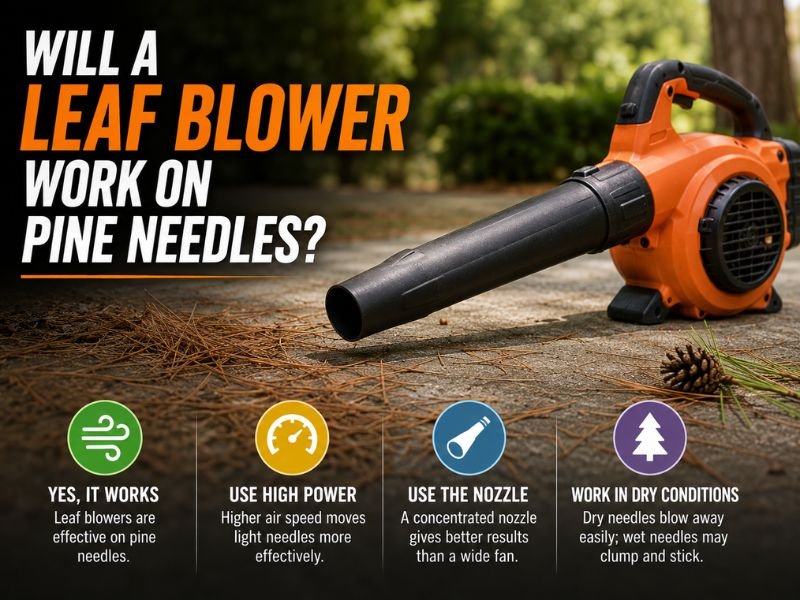
Yes, in most situations.
A leaf blower generally works very well on:
- Dry pine needles
- Loose needles on pavement
- Needles on decks and patios
- Light accumulation on lawns
- Needles along walkways
- Freshly fallen needles
It becomes more difficult when needles are:
- Wet
- Packed together
- Mixed with mud
- Deeply embedded in grass
- Settled between gravel
- Buried in mulch
The easiest pine needles to remove are dry needles resting loosely on a smooth surface.
The most difficult are usually wet needles that have been sitting long enough to become tangled, compressed, or mixed with other yard debris.
Why Are Pine Needles Harder to Blow Than Regular Leaves?
Pine needles are lightweight, but their shape creates some unique cleanup problems.
Unlike broad leaves, pine needles are:
- Long and narrow
- Able to overlap and interlock
- Easy to push into small gaps
- Capable of settling deep into turf
- Likely to disappear beneath mulch or gravel
Dry broad leaves often sit on top of the ground where airflow can get underneath them easily.
Pine needles can work their way downward.
On a lawn, for example, they may settle between grass blades instead of remaining on the surface. In gravel, they can fall into spaces between stones. In mulch, they may become mixed with bark chips.
That is why surface type matters almost as much as blower power.
Can a Leaf Blower Remove Dry Pine Needles?
Yes. Dry pine needles are generally the easiest to remove.
When dry, they tend to be:
- Lightweight
- Loose
- Easy to separate
- Responsive to airflow
A leaf blower can usually move dry needles quickly from:
- Driveways
- Patios
- Sidewalks
- Decks
- Smooth walkways
You often do not need maximum blower power on these surfaces.
In fact, excessive airflow may scatter needles farther than necessary.
Use enough power to keep them moving toward a collection point rather than blasting them in every direction.
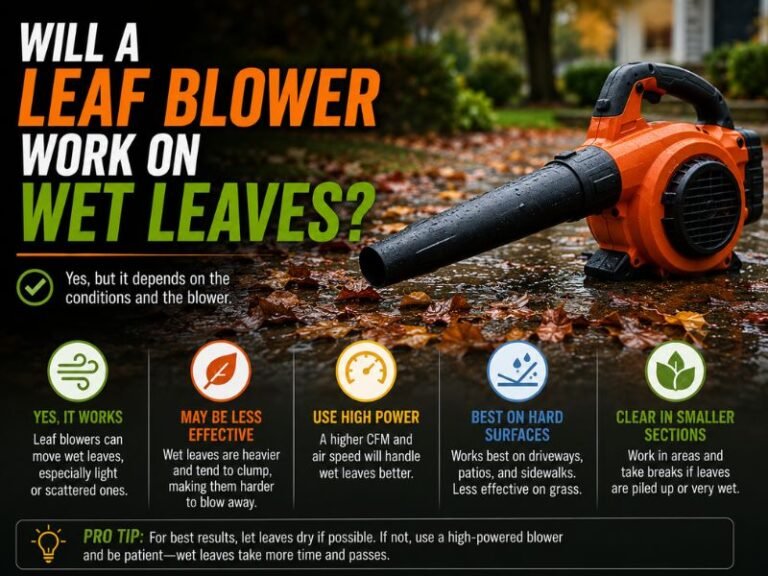
Will a Leaf Blower Move Wet Pine Needles?
Yes, but wet pine needles are considerably harder to move.
Moisture makes the needles:
- Heavier
- Stickier
- More likely to clump
- More likely to stick to pavement or soil
A layer of wet pine needles can almost behave like a mat.
If possible, allow them to dry before cleanup.
When waiting is not practical, try:
- Breaking up thick patches first
- Using several controlled passes
- Increasing blower power gradually
- Using a rake on stubborn areas
A blower may still remove some wet needles, but do not expect the same performance you get from dry material.
Can a Leaf Blower Remove Pine Needles From Grass?
Usually, yes.
Pine needles on a lawn are a little more challenging because they can become trapped between grass blades.
Results depend on:
- Grass height
- Needle depth
- Moisture
- How long the needles have been sitting
- Whether the turf is dense
Fresh, dry needles sitting near the top of the grass are relatively easy to blow.
Older needles that have settled deep into the turf may resist airflow.
A good technique is to aim the blower at a shallow angle rather than pointing the nozzle directly downward.
The goal is to lift the needles and move them across the lawn.
If you blast straight down, you may push them deeper into the grass.
For heavily embedded needles, a rake may be more effective for the final cleanup.
Will a Leaf Blower Work on Pine Needles in Gravel?
Yes, but this is one of the situations where airflow control matters most.
Too much blower power can move more than just pine needles.
It may also disturb:
- Small gravel
- Decorative stones
- Dust
- Loose soil
Start at a lower blower speed.
Keep the nozzle farther from the ground than you would on pavement and direct the airflow across the surface at a shallow angle.
This helps lift the needles without aggressively pushing the stones.
If some needles remain trapped between gravel pieces, several lighter passes are usually better than one full-power blast.
On gravel, control is often more useful than maximum power.
Can a Leaf Blower Remove Pine Needles From Mulch?
It can, but mulch requires an even lighter touch.
Strong airflow may blow away:
- Bark pieces
- Wood chips
- Lightweight landscaping material
Start with low power.
Keep the nozzle elevated and blow across the mulch rather than directly into it.
This technique works best for needles lying on top.
Needles that have already settled deep into mulch may be difficult to remove without disturbing the landscaping material.
In those cases, hand cleanup or a light rake may be a better choice.
Trying to remove every individual needle with maximum blower power can create more work by scattering the mulch.
Can You Blow Pine Needles Off a Deck?
Yes, and decks are generally one of the easiest places to use a leaf blower for pine needles.
A flat deck provides little resistance, so dry needles move easily.
They may collect:
- Along railings
- In corners
- Between boards
- Around furniture
Start from the side farthest from your collection area and work toward an open edge.
Wet needles may stick to the deck surface and require more airflow or a second pass after drying.
Needles lodged deeply between deck boards may not come out completely with airflow alone.
Can a Leaf Blower Remove Pine Needles From a Driveway?
Yes. A driveway is another ideal surface.
Hard pavement allows the needles to slide freely.
A leaf blower can usually gather them quickly into:
- A pile
- A lawn edge
- A collection area
The most efficient approach is to work systematically.
Begin at one end of the driveway and move the needles in a consistent direction.
Randomly blowing from several directions tends to spread them around rather than collect them.
Dry needles on a smooth driveway may require surprisingly little blower power.
Can You Use a Leaf Blower for Pine Needles on a Roof?
A leaf blower can move dry pine needles from a roof, but safety is more important than cleanup speed.
Roof needles often collect:
- In valleys
- Near gutters
- Behind roof features
- Around flashing
Loose dry material can respond well to airflow.
However, operating a blower while standing on a roof can affect balance, especially on steep, wet, or slippery surfaces.
Do not take unnecessary risks simply to remove pine needles.
Safer ground-based equipment, appropriate extensions, or professional roof maintenance may be preferable when access is difficult.
Can a Leaf Blower Remove Pine Needles From Gutters?
It may help with loose, dry needles when safe access and suitable equipment are available.
The job becomes harder when needles are mixed with:
- Wet leaves
- Mud
- Roof granules
- Standing water
Wet pine needles can pack tightly inside gutters and around downspout openings.
Airflow may remove the loose top layer while leaving compacted material behind.
Avoid unsafe ladder positions or leaning while operating a blower.
If the gutter is heavily clogged, physical removal may be necessary.
Is MPH or CFM More Important for Pine Needles?
Both can influence blower performance.
MPH
MPH describes how fast the air is moving.
Higher air speed can help:
- Break loose stuck needles
- Lift material from grass
- Free debris from corners
CFM
CFM describes how much air volume the blower moves.
Higher airflow volume can help:
- Push larger quantities of needles
- Move broad piles
- Clear wider areas
For pine needles, variable-speed control is particularly useful.
You may want stronger airflow on grass but much gentler airflow around gravel or mulch.
That is why one specification alone does not determine how well a blower will handle pine needles.
Is a Backpack Blower Better for Pine Needles?
A backpack blower can be useful when you have a large area or heavy needle accumulation.
It may make sense for:
- Large yards
- Long driveways
- Properties with several pine trees
- Repeated seasonal cleanup
A handheld blower may still be completely adequate for:
- Small lawns
- Patios
- Decks
- Short driveways
- Light needle accumulation
The best choice depends more on the size of the cleanup job than on pine needles themselves.
Cordless vs. Gas vs. Corded Blowers for Pine Needles
All three types can work.
Cordless Blower
Advantages include:
- Easy mobility
- Quick startup
- No extension cord
- Good variable-speed control on many models
The main limitation is battery runtime.
Gas Blower
Gas blowers can be practical for larger areas and prolonged cleanup.
They also involve:
- Fuel
- Engine maintenance
- Exhaust
- Additional noise and weight
Corded Blower
Corded models can work well for smaller properties near electrical power.
Advantages include continuous operation.
The main limitation is managing the extension cord while moving around trees, landscaping, and piles of needles.
For pine-needle cleanup, sufficient airflow and good control matter more than the power source alone.
Why Won’t My Leaf Blower Move Pine Needles?
If the blower seems ineffective, consider the condition of the needles before blaming the machine.
Possible causes include:
- Needles are wet
- Needles are matted
- They are deeply embedded
- Blower speed is too low
- Nozzle is too far away
- Nozzle angle is poor
- Needles are mixed with soil or mud
- Surface traps the needles
A useful test is to try the blower on a small patch of dry needles on pavement.
If it moves those easily but struggles on grass or mulch, the surface is probably the main limitation.
How to Blow Pine Needles Efficiently
A good technique can make a major difference.
Work When They Are Dry
Dry needles require much less effort.
Choose a Collection Direction
Decide where you want the needles to end up before starting.
Begin at the Outer Edge
Work systematically toward the collection area.
Angle the Nozzle
Use shallow airflow to lift and push the needles rather than blasting straight downward.
Adjust Power to the Surface
Use stronger airflow on:
- Grass
- Pavement
- Large open areas
Use lower airflow around:
- Gravel
- Mulch
- Loose landscaping material
Build Manageable Piles
Several smaller piles are often easier to control than one massive pile.
Finish Stubborn Areas Manually
A rake is still useful for deeply embedded needles.
Leaf Blower vs. Rake for Pine Needles
| Situation | Better Tool |
| Dry needles on driveway | Leaf blower |
| Dry needles on deck | Leaf blower |
| Loose needles on lawn | Leaf blower |
| Deep needles in grass | Rake may work better |
| Needles in gravel | Leaf blower with controlled speed |
| Needles buried in mulch | Light rake or hand cleanup |
| Large dry accumulation | Leaf blower |
| Wet matted needles | Rake may be more effective |
The two tools are not mutually exclusive.
For a large yard, the most efficient strategy may be to blow the majority of the needles into piles and then use a rake for stubborn sections.
Can Pine Needles Damage a Leaf Blower?
Simply blowing pine needles is unlikely to damage a leaf blower under normal use.
The concern changes if you use a blower-vacuum function.
Wet or densely packed needles may clog:
- Vacuum tubes
- Intake openings
- Collection systems
Small stones can also become mixed with pine needles on gravel surfaces.
Avoid vacuuming materials the tool is not designed to handle.
Should You Use a Leaf Blower Vacuum for Pine Needles?
A blower-vac can be useful for small amounts of dry pine needles, especially on hard surfaces.
Advantages include:
- Direct collection
- Less pile handling
- Convenient cleanup in limited areas
However, vacuum mode may be less suitable for:
- Wet needles
- Thick mats
- Gravel-covered surfaces
- Debris mixed with stones
Check what materials the specific machine is intended to vacuum before using it.
Common Mistakes
Avoid these common mistakes:
- Blowing wet needles when they could dry first
- Using full power around mulch
- Blasting gravel directly
- Pointing the nozzle straight down
- Blowing without choosing a collection direction
- Creating large uncontrolled piles
- Expecting airflow to remove deeply embedded needles
- Using unsafe positions on roofs or ladders
- Vacuuming stones mixed with pine needles
Frequently Asked Questions
Will a Leaf Blower Work on Pine Needles?
Yes. Dry, loose pine needles generally respond very well to a leaf blower.
Can a Leaf Blower Pick Up Wet Pine Needles?
A standard blower moves rather than picks up material. Wet pine needles can be blown, but they are harder to move because they become heavier and stick together.
Can You Blow Pine Needles Out of Grass?
Yes. Fresh needles can often be blown from grass, while deeply embedded needles may require a rake.
Will a Leaf Blower Remove Pine Needles From Gravel?
Yes, but use controlled airflow to avoid moving the gravel along with the needles.
Can a Leaf Blower Remove Pine Needles From Mulch?
It can remove loose surface needles, but high airflow may disturb the mulch.
Can You Blow Pine Needles Off a Deck?
Yes. Decks are one of the easiest surfaces for pine-needle cleanup.
Can a Leaf Blower Remove Pine Needles From a Driveway?
Yes. Dry pine needles usually move very easily across a paved driveway.
Can You Use a Leaf Blower for Pine Needles on a Roof?
It can move loose needles, but roof safety and stable access are more important than blower performance.
Is CFM or MPH More Important for Pine Needles?
Both matter. MPH helps loosen stubborn material, while CFM helps move larger quantities. Variable-speed control is also valuable.
What Blower Speed Should I Use Around Gravel?
Start low and increase power only as needed. The goal is to move the needles without scattering stones.
Is a Backpack Blower Better for Pine Needles?
It can be more convenient for large properties and heavy accumulation, but a handheld model is often sufficient for smaller cleanup jobs.
Is a Leaf Blower or Rake Better for Pine Needles?
A leaf blower is usually faster for dry, loose needles. A rake may be better for wet, matted, or deeply embedded material.
Conclusion
If you’re asking “will a leaf blower work on pine needles,” the answer is yes, especially when the needles are dry, loose, and resting on a relatively firm surface.
Driveways, decks, patios, and sidewalks are usually the easiest areas to clean. Lawns are also manageable, although needles that settle deep into the grass may require additional raking.
Gravel and mulch demand more control. Too much airflow can scatter stones, bark, or wood chips along with the needles, so lower power and a shallow nozzle angle usually work better.
Wet pine needles are much more difficult because they become heavier, stick together, and can form dense mats. Whenever practical, allow them to dry before cleanup.
CFM, MPH, and blower control all affect performance, but technique is just as important. Work in one direction, adjust airflow to the surface, and avoid pointing the nozzle straight downward.
A leaf blower is one of the most efficient tools for removing loose pine needles, but the best results come from cleaning them while they are dry and before they become wet, compacted, or deeply embedded in grass, gravel, or mulch.