Will a Stud Finder Work Through Plaster? Complete Guide
Yes, a stud finder can work through some plaster walls, but traditional lath-and-plaster construction can make stud detection much less reliable than it is through ordinary drywall.
The plaster itself is only part of the problem. What sits behind it matters just as much. A relatively thin, uniform plaster layer over gypsum board may be fairly easy to scan, while old plaster over wood lath can contain irregular changes in thickness and density that confuse conventional electronic stud finders. Metal lath creates an even bigger challenge because the wall may contain metal across a large area.
The type of stud finder also matters. A basic electronic finder may struggle where a deeper multi-sensor model, metal-scanning tool, or advanced wall scanner produces more useful results. Before assuming your stud finder is defective, identify the wall construction and use a detection method appropriate for it.
Will a Stud Finder Work Through Plaster?
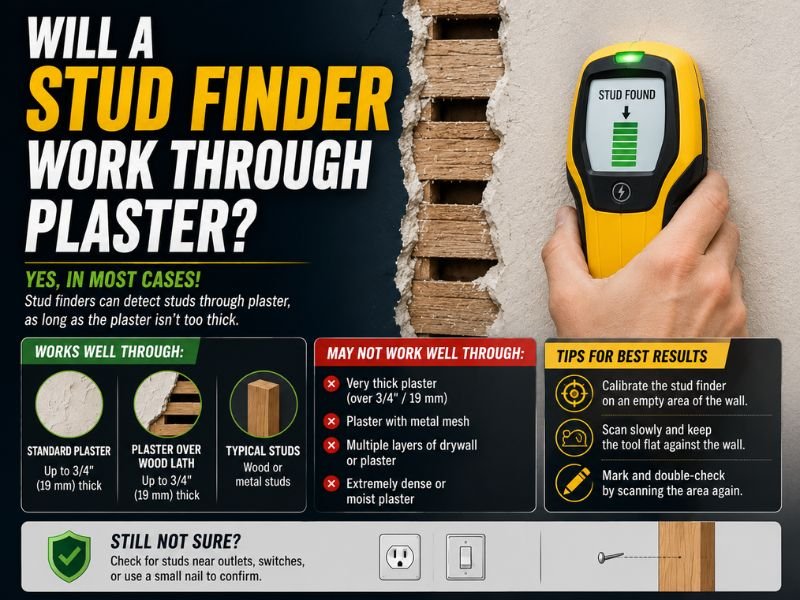
A stud finder can work through plaster, but there is no universal yes-or-no result for every plaster wall.
Performance depends on:
- Plaster thickness
- Material behind the plaster
- Wood lath versus metal lath
- Stud depth
- Surface texture
- Stud finder technology
- Scan mode
- Wall consistency
A basic finder may work surprisingly well on a thin, relatively uniform plaster wall. The same finder may produce constant false readings on an old lath-and-plaster wall.
The important distinction is that plaster walls are construction systems, not simply thicker versions of drywall.
Knowing what is behind the finished surface makes it much easier to choose the right detection method.
Why Is Plaster Harder Than Drywall for a Stud Finder?
Drywall is relatively uniform.
A sheet of drywall generally maintains a fairly consistent thickness and density until the sensor reaches a framing member behind it. That creates a clearer change for an electronic stud finder to recognize.
Traditional plaster walls are different.
In older lath-and-plaster construction, wet plaster was applied over narrow strips of wood called lath. Some of the plaster squeezed through the gaps between those strips and hardened behind them.
These hardened areas create irregular thickness and density throughout the wall.
As a result, a conventional stud finder may encounter a density change and interpret it as a stud even when the actual stud is somewhere else.
That can produce:
- Multiple false edges
- Stud readings that disappear
- Stud indications in unexpected places
- Nearly continuous readings
- Different results at different heights
A perfectly smooth-looking plaster surface can therefore hide a very irregular structure underneath.
What Type of Plaster Wall Do You Have?
Before choosing a scanning method, it helps to understand the main types of plaster construction.
Plaster Over Wood Lath
This is common in many older homes.
Narrow wooden strips run horizontally across the studs, and plaster covers the lath.
This construction presents two challenges:
- The wood lath itself creates material changes across the entire wall.
- Plaster keys behind the lath create additional irregular density.
A conventional density-based stud finder may therefore have difficulty separating the stud from everything surrounding it.
Fortunately, the fasteners holding the wood lath to the studs can provide another way to locate framing.
Plaster Over Metal Lath
Metal lath is considerably harder for ordinary stud-finding methods.
Instead of wood strips, a metal mesh or similar reinforcement sits behind the plaster.
A metal-detection mode may then respond across much of the wall rather than only at the stud.
This can make it difficult to distinguish:
- Metal lath
- Metal fasteners
- Metal studs
- Pipes
- Conduit
A magnet can have the same problem because ferrous metal is present over a large area.
Plaster Over Gypsum Board
Some walls use a gypsum base with a plaster finish coat.
This construction can be easier to scan because the substrate is more uniform than traditional wood lath.
If the total wall thickness remains within the finder’s detection range, performance may be closer to what you would expect on drywall.
Can a Regular Stud Finder Work Through Plaster?
Sometimes.
A basic electronic stud finder has the best chance when:
- Plaster is relatively thin
- Wall density is reasonably uniform
- No metal lath is present
- Studs are within the rated scanning depth
- The sensor maintains good wall contact
Traditional lath-and-plaster walls are much less predictable.
If your finder repeatedly identifies wide sections of wall as studs or gives different readings every time you scan, the problem may be the wall construction rather than the tool.
Before buying another basic finder, check whether the model is actually designed or recommended for lath-and-plaster surfaces.
Will Deep Scan Work Through Plaster?
Deep Scan can help, but it does not solve every plaster problem.
A deeper scanning mode primarily addresses distance.
If the combination of finish plaster, base coat, and lath places the framing farther from the sensor than normal drywall does, extra detection depth may help the finder reach the stud.
But depth is only half of the problem.
A stud finder can be capable of sensing deep enough while still being confused by:
- Uneven plaster
- Wood lath
- Plaster keys
- Metal reinforcement
- Nearby pipes
That means:
Greater scan depth does not automatically mean greater accuracy on plaster.
If irregular density is causing the problem, simply switching to Deep Scan may produce deeper false readings rather than a clear stud location.
Can a Multi-Sensor Stud Finder Work Better Through Plaster?
Often, yes.
A multi-sensor finder examines a larger area of the wall simultaneously instead of relying on one narrow sensing location.
That can make it easier to recognize the broader shape of a framing member.
Some modern multi-sensor finders also include modes specifically intended for:
- Layered walls
- Thick surfaces
- Lath and plaster
- Double drywall
- Tile
They still have limitations.
If the plaster wall is highly inconsistent or contains metal reinforcement, even an advanced stud finder may fail to produce a trustworthy result.
The advantage is better information—not a guarantee.
How to Find Studs Through Wood Lath and Plaster
If normal Stud Scan works consistently, you can use it.
If it does not, finding the metal fasteners holding the lath to the studs can be more effective.
Wood lath is attached to framing with nails or similar fasteners.
Those fasteners tend to align along the studs.
Instead of trying to detect the wood stud directly through several irregular layers, you can look for the line of metal fasteners attached to it.
Step 1: Try Normal Stud Scan
Start with your finder’s recommended stud mode.
Scan slowly across the wall.
Mark probable edges or centers.
Step 2: Repeat the Scan
Scan the same area from the opposite direction.
If the readings move significantly each time, do not trust the first marks.
Step 3: Scan at Another Height
Move higher or lower on the same wall and repeat the scan.
A real stud should generally continue vertically.
Step 4: Switch to Metal Scan
If your finder has a dedicated metal mode, scan for localized metal targets.
Step 5: Mark the Metal Targets
Look for small, repeated signals rather than one huge metal area.
Step 6: Scan Vertically
If several metal targets line up vertically, they may be nails or screws fastening the lath to a stud.
This can provide a much stronger clue to the framing position.
Will a Magnetic Stud Finder Work Through Plaster?
A magnetic finder can be surprisingly useful on wood-lath plaster walls.
It does not need to sense the wood stud directly.
Instead, the magnet can locate steel nails or screws that attach the lath to the framing.
When several magnetic hits form a vertical line, that pattern may reveal the stud.
Advantages include:
- No calibration
- No battery
- Simple operation
- Useful for locating ferrous fasteners
However, a magnet does not tell you what the metal object actually is.
It may also react to:
- Pipes
- Corner bead
- Protective metal plates
- Random nails
- Metal lath
Use the pattern of detections rather than trusting one magnetic spot.
Will a Stud Finder Work Through Metal Lath and Plaster?
This is one of the most difficult conditions for stud detection.
Metal lath can interfere with both electronic and magnetic methods.
In normal Stud Scan, the combination of plaster and metal mesh may produce inconsistent sensor behavior.
In Metal Scan, the finder may detect metal across a broad section of wall.
A magnet may similarly respond at many locations.
When that happens, isolating an individual stud becomes difficult because the detection tool cannot easily separate the framing-related metal from the wall reinforcement.
An advanced wall scanner may provide more information, but even advanced tools have limitations in complex layered construction.
If your detector appears to show metal almost everywhere, do not assume there are studs everywhere. Metal reinforcement may be responsible.
How Do You Know If a Wall Has Metal Lath?
It may not be obvious from the finished surface.
Possible clues include:
- Metal Scan responds over a broad area
- Magnet attracts at many locations
- Electronic stud finder produces nearly continuous readings
- Wall construction or renovation records indicate metal lath
- Stud readings remain inconsistent despite repeated scanning
These clues are not absolute proof.
Pipes, foil-backed materials, or other metal components can also affect scans.
But widespread metal response is a good reason to question whether a simple metal-fastener method will work.
Why Does My Stud Finder Show Studs Everywhere on Plaster?
This is a common problem.
Possible causes include:
- Uneven plaster thickness
- Plaster keys
- Wood lath
- Metal lath
- Metal reinforcement
- Pipes
- Electrical conduit
- Dense repair patches
- Incorrect calibration
- Surface moisture
A conventional electronic finder may interpret many of these conditions as changes consistent with framing.
If the tool seems to detect a stud across an extremely wide area, repeat the scan at another height.
Real framing usually creates a repeatable vertical pattern.
Random or constantly changing indications are less convincing.
Why Does My Stud Finder Find Nothing Through Plaster?
The opposite problem can also happen.
Possible causes include:
- Wall is too thick
- Stud is beyond the finder’s rated depth
- Surface is too uneven for proper contact
- Metal lath is interfering
- Tool is not designed for plaster
- Finder is incorrectly calibrated
- Finder battery is weak
- Wrong scanning mode is selected
Try a different location on the wall before deciding that the finder is defective.
If normal Stud Scan fails, use Deep Scan if the model supports it.
For wood lath, try locating fasteners with Metal Scan or a magnet.
How to Use a Stud Finder on a Plaster Wall
A systematic approach is more reliable than repeatedly sweeping the wall until the finder beeps.
1. Identify the Wall Type
Determine whether you likely have:
- Wood lath and plaster
- Metal lath and plaster
- Plaster over gypsum board
- An unknown layered wall
2. Check Your Finder’s Capabilities
Look for:
- Stud Scan
- Deep Scan
- Metal Scan
- Layered-wall mode
- Manufacturer guidance for plaster
3. Choose a Flat Area
Begin away from:
- Corners
- Outlets
- Door frames
- Window frames
- Obvious plumbing locations
These areas may contain additional framing or metal that makes initial scanning harder to interpret.
4. Scan Slowly
Keep the sensor flat against the wall.
Avoid tilting or lifting it during the pass.
5. Mark the Reading
Use a pencil to mark the indicated edge or center.
6. Scan From the Other Direction
Compare the marks.
7. Repeat at Multiple Heights
A real wall stud should generally continue vertically.
8. Use a Second Detection Method
Depending on the wall, confirm with:
- Metal Scan
- Magnet
- Fastener pattern
- Adjacent framing pattern
- More advanced wall scanner
The more independent clues agree, the more confidence you can have in the result.
How to Confirm a Stud Behind Plaster
Plaster walls reward confirmation.
Do not treat one beep as enough.
Scan From Both Directions
Left-to-right and right-to-left readings should be reasonably consistent.
Follow the Target Vertically
Check higher and lower areas along the same line.
Look for Neighboring Studs
Framing tends to form a pattern.
Door openings, windows, corners, and unusual construction can change spacing, so use it as supporting evidence rather than a guaranteed measurement.
Look for Fastener Alignment
With wood lath, a vertical series of nails or screws can be especially useful.
Use Electrical Boxes as Clues
Some electrical boxes are attached to studs.
But not all are, especially retrofit or old-work boxes.
Never probe blindly around an electrical box simply to find framing.
How Thick Can Plaster Be Before a Stud Finder Stops Working?
There is no universal thickness.
Detection depends on the entire distance and material between the sensor and stud, including:
- Finish coat
- Base plaster
- Lath
- Air gaps
- Other layers
Every finder has its own rated detection depth.
A model capable of deeper scanning generally has an advantage on thick walls, but maximum depth does not guarantee reliable results through irregular plaster.
This distinction is important:
The sensor may be able to reach the stud but still fail to distinguish it clearly from the surrounding wall.
Will a Stud Finder Work Through Textured Plaster?
Possibly.
Heavy texture can cause another problem: poor sensor contact.
Electronic finders generally perform best when the sensing surface remains flat against the wall.
Deep ridges or uneven plaster can make the tool rock or leave gaps.
If the surface is rough:
- Move slowly
- Keep contact as consistent as possible
- Avoid pressing so hard that the tool tilts
- Repeat the scan several times
A wide multi-sensor design may perform better on some textured surfaces, but the underlying plaster construction remains important.
Will a Stud Finder Work Through Venetian Plaster?
It depends more on what is underneath than on the decorative finish name.
A relatively thin Venetian plaster finish over drywall may still allow normal stud detection.
A thicker multilayer finish over traditional lath can be more difficult.
When evaluating decorative plaster, consider:
- Total thickness
- Backing material
- Wall age
- Presence of lath
- Presence of metal reinforcement
A thin decorative finish should not automatically be treated like a traditional lath-and-plaster wall.
Will a Stud Finder Work Through Plaster Over Brick?
Stud finding may not be the correct task if the wall is primarily masonry.
A plastered brick wall may not contain conventional wood studs behind the surface.
There could instead be:
- Masonry
- Furring strips
- Pipes
- Wiring
- Other embedded materials
An advanced wall scanner is more appropriate when the goal is identifying hidden objects inside or behind masonry.
Before searching for studs, determine whether the wall construction actually uses studs.
Is a Wall Scanner Better for Plaster?
For difficult plaster walls, an advanced wall scanner can provide more useful information than a basic stud finder.
Depending on the technology, a wall scanner may detect several material categories, including:
- Wood
- Metal
- Wiring
- Pipes
- Other embedded objects
Some advanced scanners also provide an estimated depth.
This can be particularly useful when the wall consists of several layers and you need to understand more than simply where a stud begins.
However, an advanced scanner is still not an X-ray machine.
Complex combinations of materials, metal reinforcement, moisture, or unusual construction can reduce accuracy.
Stud Finder vs. Metal Detector vs. Wall Scanner for Plaster
| Tool Type | Wood Lath and Plaster | Metal Lath | Main Advantage |
| Basic electronic stud finder | Variable | Poor | Simple framing scan |
| Deep-scan finder | Better depth | Poor | Thicker walls |
| Multi-sensor finder | Often better | Variable | Wider sensing area |
| Metal detector | Good for lath fasteners | Difficult | Locating nails/screws |
| Magnetic finder | Useful for fasteners | Poor | Simple confirmation |
| Advanced wall scanner | Often most informative | Model-dependent | Multi-material detection |
No single tool is best for every plaster wall.
Is the Knock Test Reliable on Plaster?
Tapping or knocking on a wall can sometimes provide clues, but it is not a precise stud-locating method.
The sound can be affected by:
- Plaster thickness
- Lath
- Wall cavities
- Blocking
- Repairs
- Nearby framing
The difference between a hollow and solid sound may help narrow your search, but it should not be the only evidence used for precise drilling or mounting.
Can You Find Studs From Electrical Outlets?
Sometimes.
Electrical boxes are often installed next to framing, so an outlet can provide a starting clue.
But there are important exceptions.
A retrofit box can be attached directly to the wall material rather than a stud.
Older homes may also contain unusual electrical installations.
Do not insert tools around an electrical box or remove components unless you understand the electrical hazards involved.
Use the box location only as supporting information.
Safety Before Drilling Into a Plaster Wall
Finding a likely stud does not mean every part of that stud is automatically safe to drill.
Wall cavities may contain:
- Electrical wiring
- Plumbing
- Metal conduit
- Protective plates
If you encounter unexpected metal while drilling, stop rather than forcing the bit through it.
A protective plate may have been installed specifically to prevent screws or drill bits from reaching plumbing or electrical wiring.
Also remember that a stud finder’s live-wire warning, if equipped, has limitations.
Likewise, no warning does not guarantee that the wall is free of wires or pipes.
Common Mistakes When Finding Studs Through Plaster
Treating Plaster Like Drywall
The hidden wall structure can be completely different.
Trusting One Scan
Repeat the test from multiple directions and heights.
Assuming Deep Scan Solves Everything
Depth does not correct irregular wall density.
Ignoring Metal Lath
Metal reinforcement can make both stud and metal scanning difficult.
Treating Every Metal Detection as a Stud
A metal signal can also be a nail, pipe, conduit, corner bead, or protective plate.
Moving Too Quickly
Slow scans usually produce more useful results.
Ignoring Fastener Patterns
On wood lath, aligned nails can be one of the best clues to stud position.
Drilling Through Unexpected Metal
Stop and investigate before proceeding.
Frequently Asked Questions
Will a Stud Finder Work Through Plaster?
Yes, some stud finders work through plaster, but traditional lath-and-plaster construction can make detection less reliable than scanning through drywall.
Can a Regular Stud Finder Find Studs Through Plaster?
Sometimes. It works best on relatively thin and uniform plaster. Traditional lath-and-plaster walls can produce false or inconsistent readings.
Why Doesn’t My Stud Finder Work on Plaster?
Uneven plaster thickness, wood lath, plaster keys, metal lath, excessive depth, or poor calibration can all interfere with detection.
Can a Stud Finder Work Through Lath and Plaster?
It can, but results vary considerably. On wood lath, finding the metal fasteners that attach the lath to the studs may work better than direct stud scanning.
Will Deep Scan Work Through Plaster?
Deep Scan can help when wall thickness is the problem, but it cannot eliminate false readings caused by irregular plaster or lath.
Can a Stud Finder Detect Through Metal Lath?
Metal lath can make stud detection very difficult because metal may be present over a broad area of the wall.
How Do You Find Studs Behind Wood Lath and Plaster?
Try normal scanning first. If readings are unreliable, use Metal Scan or a strong magnet to locate a vertical pattern of nails or screws attaching the lath to the studs.
Can You Use a Magnet to Find Studs Through Plaster?
Yes. A magnet can locate ferrous fasteners that may reveal the stud position, especially in wood-lath construction.
Why Does My Stud Finder Show Studs Everywhere on Plaster?
Irregular plaster thickness, lath, metal reinforcement, pipes, or other density changes can create continuous or false readings.
How Thick of Plaster Can a Stud Finder Scan Through?
There is no universal maximum. It depends on the finder’s rated detection depth, wall layers, and how consistently the wall is constructed.
Does a Stud Finder Work Through Textured Plaster?
It may, but heavy texture can reduce sensor contact and make readings more difficult to reproduce.
Is a Wall Scanner Better for Plaster Walls?
An advanced wall scanner can be more useful on complicated or thick plaster walls because it may provide multi-material detection and greater depth capability.
How Do I Confirm a Stud Behind Plaster?
Scan from both directions, check the same line at multiple heights, look for neighboring framing, and use aligned metal fasteners as confirmation when dealing with wood lath.
Is It Safe to Drill After Finding a Stud Through Plaster?
A stud reading alone does not guarantee the drill path is free of wiring, plumbing, conduit, or protective plates. Investigate unexpected readings or metal before drilling.
Conclusion
If you’re asking “will stud finder work through plaster,” the answer is yes in some plaster walls, but traditional lath-and-plaster construction can make ordinary electronic stud finders considerably less reliable than they are on drywall.
The biggest factor is what lies beneath the plaster. Wood lath and hardened plaster keys create irregular density that can confuse conventional sensors. Metal lath is more difficult because the wall may contain metal across a broad area, reducing the usefulness of both standard and metal scanning.
When normal Stud Scan produces consistent results, confirm the location from both directions and at several heights. If wood lath is present and normal scanning is unreliable, Metal Scan or a strong magnet can help locate the vertical pattern of fasteners attaching the lath to the studs.
Deep Scan may help with thicker walls, but increased depth alone does not solve inconsistent wall density. Multi-sensor finders and advanced wall scanners can provide better results in some difficult plaster constructions, although no scanner is guaranteed to work through every wall.
The best approach is to identify the wall construction, use the detection method suited to it, and confirm the suspected stud with more than one clue.
For relatively uniform plaster, an appropriate stud finder may work well. For wood lath and plaster, fastener detection can be more dependable. For metal lath or highly irregular walls, a basic stud finder may simply not be the right tool for the job.