How to Find Metal Studs: 7 Reliable Methods That Work
If you want to know how to find metal studs, the most reliable method is to use a stud finder with metal-detection or center-finding capability, scan the wall slowly from both directions, and confirm the location with a strong magnet or another method before drilling. Metal studs are usually easier to detect than wood studs with the right scanner because the framing itself is metal, but drywall fasteners, electrical wiring, pipes, and other metal objects can create misleading readings.
Metal studs are common in commercial construction, apartments, basements, offices, and some newer residential buildings. They are typically made from light-gauge galvanized steel and are installed vertically behind drywall in much the same way that wood studs are.
However, finding a metal stud is only part of the job. You also need to identify the stud’s center, distinguish it from pipes or electrical components, understand what kind of fastener the installation requires, and avoid assuming that a lightweight metal stud can support the same load as a solid wood 2×4.
In this guide, I’ll explain how to find metal studs behind drywall, how electronic and magnetic stud finders work, how to identify metal framing without a stud finder, how far apart metal studs are commonly installed, how to confirm the center before drilling, and what you should know before mounting anything heavy.
How to Find Metal Studs Behind Drywall

Finding metal framing is easiest when you combine more than one clue.
A quality electronic wall scanner is usually the best starting point. Many models can detect changes in wall density, while more advanced scanners can specifically identify metal.
Once you find a suspected framing location, scan the same area several times. Check it from left to right, then from right to left. Repeat the scan several inches higher and lower.
If the readings continue vertically in approximately the same position, you probably found a framing member.
Then confirm it using another method, such as a magnet that detects drywall screws.
Metal studs normally run vertically from the floor track to the ceiling track, so a consistent vertical pattern is one of the most useful clues.
Quick Comparison of Metal Stud Finding Methods
| Method | Best For | Reliability | Main Limitation |
| Electronic stud finder | Fast everyday locating | High | Can react to pipes or wiring |
| Metal-detection scanner | Identifying steel framing | Very high | More expensive |
| Strong magnet | Finding drywall screws | High | Detects fasteners, not always stud edges |
| Electrical outlet clues | Narrowing search area | Moderate | Boxes are not always stud-mounted |
| Measuring stud spacing | Predicting nearby studs | Moderate | Spacing can vary |
| Tapping the wall | Rough locating | Low to moderate | Hard to distinguish metal framing |
| Visible drywall fasteners | Confirmation | Moderate | Fasteners may be hidden |
For an important mounting job, I recommend using at least two methods rather than relying on a single scanner alert.
Method 1: Use an Electronic Stud Finder
An electronic stud finder is usually the fastest way to locate metal studs behind drywall.
Many standard stud finders do not directly identify the material behind the wall. Instead, they sense changes in density or electrical capacitance. Because the area over a metal stud differs from the hollow cavity beside it, the scanner can often locate the edges of the framing.
More advanced wall scanners may include a dedicated metal mode.
That can be particularly useful if you already know the wall contains steel studs.
How to Scan Correctly
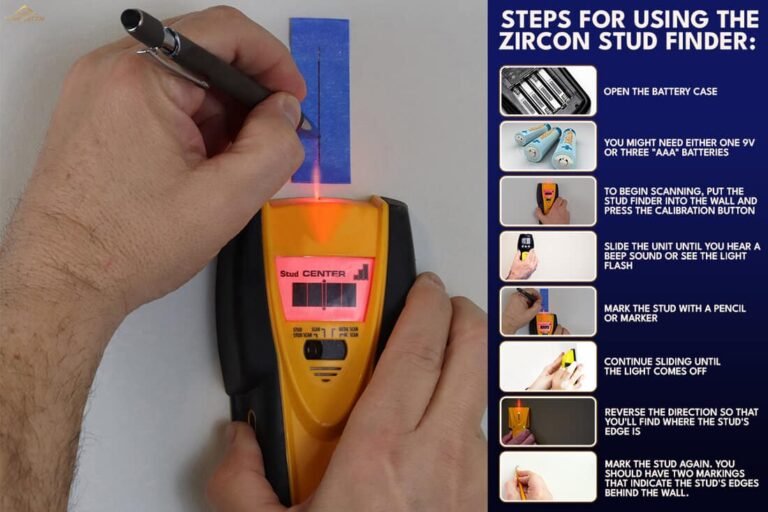
Place the stud finder flat against the wall and calibrate it according to the manufacturer’s instructions.
Start several inches away from where you expect the stud to be.
Move horizontally across the wall slowly.
When the finder indicates an edge, make a light mark.
Continue moving until you locate the second edge.
The midpoint between those two marks should approximately represent the center of the stud.
Do not stop there.
Move approximately 8 to 12 inches higher and repeat the process.
Then scan again lower on the wall.
If all three scans identify roughly the same vertical position, your confidence increases significantly.
Scan From Both Directions
Always scan left to right and then right to left.
Stud finders can occasionally shift their indicated edge slightly depending on calibration, surface texture, movement speed, and nearby objects.
If both directions consistently identify the same narrow vertical zone, the reading is much more useful.
Use Normal Stud Mode First
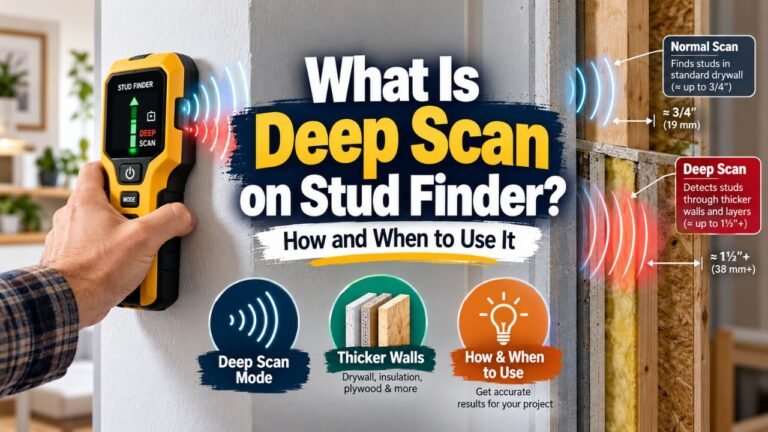
If your scanner offers normal and deep-scanning modes, begin with normal stud mode on ordinary drywall.
Deep mode is intended for thicker wall surfaces and may detect more objects deeper inside the wall. That can sometimes create additional readings that are harder to interpret.
Use deep scanning when the wall covering is unusually thick or when the normal mode cannot locate anything reliably.
Method 2: Use a Stud Finder With Metal Detection
A scanner with dedicated metal detection is one of the best tools for this job.
Unlike a basic density-sensing finder, metal mode can react directly to conductive or metallic objects behind the surface.
This sounds perfect for metal studs, but there is one complication.
Walls can contain plenty of other metal.
Possible objects include electrical conduit, copper pipes, steel pipes, screws, protective nail plates, corner bead, ductwork, and electrical boxes.
Therefore, one metal reading does not automatically mean “stud.”
How to Distinguish a Stud From Another Metal Object
Look at the shape and continuity of the reading.
A vertical metal stud normally produces a consistent line extending upward and downward through a substantial portion of the wall.
A short metal object, such as a protective plate, may only appear across a limited area.
A pipe can also run vertically, so shape alone is not enough. Compare the suspected location with plumbing fixtures and electrical components.
If the metal reading is directly above a sink, shower, radiator connection, or plumbing fixture, consider the possibility of a pipe.
If it follows a vertical path beside an outlet or switch, it may be framing, electrical conduit, or both.
That is why confirmation matters.
Key Takeaways:
- Electronic stud finders work well for many metal-framed walls.
- A dedicated metal scanner can improve detection, but other metal objects can create false positives.
- Scan at several heights and from both directions before marking the stud center.
Method 3: Find Drywall Screws With a Strong Magnet
A strong magnet is one of the simplest and most reliable ways to confirm metal stud locations.
Drywall is normally secured to metal studs with steel screws.
A powerful rare-earth magnet can detect those screws through drywall and joint compound.
When you find several screws aligned vertically, the line usually follows a stud.
How to Use the Magnet Method
Move the magnet slowly across the wall.
When you feel it strongly pull toward one point, mark that location with painter’s tape.
Then move approximately 8 to 12 inches higher and repeat the search.
Continue lower as well.
If the magnet repeatedly finds fasteners on the same vertical line, you have strong evidence that framing is behind that location.
Why This Works Especially Well With Metal Studs
With a wood-framed wall, the magnet detects the drywall screws rather than the stud itself.
With steel framing, the magnet may respond to both the screws and the stud depending on the stud gauge, magnet strength, wall thickness, and distance from the surface.
This can make the magnetic method particularly effective.
However, strong magnets can also react to metal pipes, corner bead, electrical boxes, and other steel components.
Again, look for a consistent vertical pattern rather than a single magnetic point.
Magnetic Stud Finder vs. Loose Magnet
A purpose-built magnetic stud finder usually has a handle or indicator that makes it easier to identify screws.
A loose neodymium magnet can work just as well but should be handled carefully because powerful magnets can pinch fingers or damage certain electronics.
Keep strong magnets away from items that may be affected by magnetic fields.
Method 4: Check Electrical Outlets and Switches
Electrical boxes can provide useful clues about framing locations.
In many wall assemblies, electrical boxes are attached to or positioned beside a metal stud.
If you remove the outlet or switch cover plate—not the electrical device itself—you may sometimes be able to see which side of the box is closer to framing.
Do not insert tools, fingers, wires, or probes into an electrical box.
The purpose is only to observe the box location and use it as a reference.
Once you have an approximate stud position, scan vertically above and below it with a stud finder or magnet.
Why Outlet Position Is Not Proof
Electrical boxes can also be installed using adjustable brackets, old-work clamps, or systems that span between framing members.
Some boxes may therefore sit between studs.
Use the outlet only as a starting clue.
Never drill immediately beside an electrical box simply because you believe the stud is there. Electrical cables commonly enter the box and may pass through or alongside the framing.
Method 5: Use Standard Stud Spacing as a Guide
Metal studs are often installed at standardized intervals.
Common layouts in U.S. construction include approximately:
16 inches on center
or
24 inches on center
Other spacing can also be used depending on wall height, structural design, drywall thickness, building requirements, and construction type.
The phrase “on center” means the distance from the center of one stud to the center of the next.
How to Use Stud Spacing
First locate one stud positively.
Measure 16 inches from its center and scan that area.
If another stud is found there, continue checking at 16-inch intervals.
If not, try approximately 24 inches.
Once a repeating pattern becomes clear, locating the remaining studs becomes much faster.
Do Not Rely on Measurements Alone
Framing can change around doors, windows, corners, wall intersections, plumbing, cabinets, and structural openings.
Additional studs may also be installed where more support is needed.
Therefore, measuring should tell you where to scan—not where to immediately drill.
Method 6: Look for Drywall Screw Patterns
Sometimes you can locate metal framing simply by studying the wall carefully.
Drywall screws are normally covered with joint compound and paint, but subtle depressions can become visible under side lighting.
Turn off the room’s main lights and shine a flashlight almost parallel to the wall surface.
Look for tiny dimples arranged vertically.
If you see multiple marks in one vertical line, there may be a metal stud behind them.
This technique works particularly well on walls where fastener heads have become slightly visible over time.
Screw Pops Can Also Reveal Framing
A drywall screw can occasionally create a small circular bump or depression known as a screw pop.
Although screw pops are usually considered a cosmetic defect, they can unintentionally reveal framing positions.
Several vertically aligned screw pops are a strong clue.
I would still confirm the position with a scanner or magnet before drilling.
Method 7: Use Tapping Only as a Preliminary Check
The traditional tap test works much better with some walls than others.
Tap across the drywall gently with your knuckle.
The area between framing members may sound hollow, while the surface over a stud can sound somewhat firmer.
Unfortunately, the difference may be subtle with metal framing.
Insulation inside the wall can also reduce the acoustic difference.
For that reason, I would not rely on tapping alone to locate metal studs.
Use it to narrow down an area, then confirm with a magnet or electronic scanner.
How to Tell If Your Wall Has Metal Studs
Before searching for individual studs, you may want to confirm whether your wall is actually metal framed.
Several clues can help.
Commercial buildings frequently use steel studs for non-load-bearing interior partitions. Apartments and condominiums may use them as well, particularly in larger or newer buildings.
A strong magnet is a useful test. If it seems to remain weakly attracted along a narrow vertical strip rather than only at individual screw locations, the wall may contain steel framing.
A metal-detection scanner can provide stronger evidence.
You may also identify metal framing when drilling a carefully planned pilot hole if the bit reaches thin steel immediately behind the drywall, but drilling should never be your first method because of hidden wiring and plumbing.
Wood Stud vs. Metal Stud Reading
A basic stud finder can make both materials appear similar because it detects density changes rather than identifying material.
Dedicated metal mode provides better information.
If your scanner indicates a broad vertical metal object repeatedly from floor to ceiling, steel framing becomes much more likely.
Key Takeaways:
- A magnet is one of the easiest ways to confirm drywall screws attached to metal framing.
- Standard 16- or 24-inch spacing can help predict stud locations after one stud is positively identified.
- Measurements and tapping should guide your search, not replace actual verification.
How Wide Are Metal Studs Behind Drywall?
The face of a typical metal wall stud is usually much narrower than its overall wall-cavity depth.
Common metal framing is manufactured in several widths depending on the wall design. The stud may be approximately 1 5/8, 2 1/2, 3 5/8, 6 inches, or another specified depth.
However, the face where drywall attaches is often only around 1¼ inches wide.
This matters when you are trying to place a fastener in the center.
Being off by half an inch can potentially put the screw near the edge rather than securely through the stud flange.
An edge-detecting stud finder can help locate both sides of the stud face so you can estimate the center.
How to Find the Center of a Metal Stud
Do not assume the first scanner signal marks the center.
Many stud finders are edge finders.
Start from one side of the suspected stud and move slowly until the finder indicates the first edge.
Mark it.
Move beyond the stud, recalibrate if necessary, and scan back from the opposite side.
Mark the second edge.
The midpoint between the two marks is your estimated centerline.
Repeat the process higher or lower to confirm that the marks remain vertically aligned.
For critical work, check the center with a magnet by locating several drywall screws. Their vertical alignment should correspond closely with the stud flange.
Are Metal Studs Safe to Drill Into?
Metal studs can be drilled or fastened into when the installation is designed for that purpose, but there are important limitations.
A light-gauge steel stud is fundamentally different from solid lumber.
A standard wood screw driven into a steel stud will not grip the same way it does in wood.
Depending on the load, you may need self-drilling metal screws, toggle anchors, snap toggles, specialty hollow-wall hardware, or backing installed specifically for the object.
Watch for Wiring and Plumbing
Metal studs often have factory-made holes or knockouts that allow electrical wiring and other services to pass through them.
Electrical cables are typically protected where necessary by grommets or bushings, but you should never assume that the middle of a metal stud is automatically safe to drill.
Pipes may also pass through the framing.
Before drilling, consider what exists on both sides of the wall and whether outlets, switches, sinks, showers, appliances, or plumbing fixtures suggest hidden services nearby.
Live-Wire Detection Has Limitations
Some wall scanners warn about energized AC wiring.
That feature is useful, but a negative result does not prove the wall is safe.
Electrical detection can be affected by wire depth, grounding, wall materials, moisture, and whether the wire is energized at the time.
Treat AC detection as an additional warning feature, not as a guarantee.
Can You Mount a TV on Metal Studs?
Yes, but the mounting method needs to be appropriate for steel framing.
You should not simply substitute ordinary wood lag screws and expect the same holding strength.
Metal studs in many interior partitions are relatively thin and are not designed to hold heavy concentrated loads with conventional screws alone.
A television mount may require hardware specifically designed for metal studs, such as appropriate toggle anchors or a mounting system that distributes load across multiple studs.
The wall construction, television weight, bracket design, stud gauge, number of studs, and whether additional backing exists all affect the correct attachment method.
For a heavy television or articulating mount, I would follow the mount manufacturer’s instructions specifically for metal-stud installation.
If those instructions do not cover metal framing, contact the manufacturer or use a qualified installer rather than improvising.
Why Articulating Mounts Need More Care
A flat television bracket holds the television relatively close to the wall.
An articulating arm can extend the television outward.
That extra distance creates leverage and increases the force on the mounting points.
This is why a mounting system that seems adequate for a flat load may not be appropriate for a full-motion bracket.
Can You Mount Shelves on Metal Studs?
Yes, but shelf depth and expected load matter.
A lightweight decorative shelf may work with appropriate metal-stud or hollow-wall anchors.
A deep shelf loaded with books, tools, or storage bins creates much more leverage.
For heavy shelving, spreading the load across multiple studs or attaching a mounting board across several framing members can provide a more robust installation.
Again, use fasteners rated for the actual wall construction and expected load.
Can a Normal Stud Finder Detect Metal Studs?
Usually, yes.
A normal electronic stud finder can often identify the density change created by a steel stud behind drywall.
However, it may not tell you that the detected object is specifically metal.
A scanner with dedicated metal mode provides more information and may be better if distinguishing metal framing from wood is important.
Magnetic finders can also work extremely well because steel studs and their drywall screws are magnetic.
Why Is My Stud Finder Detecting Metal Everywhere?
If metal mode seems to react across the entire wall, several explanations are possible.
The wall may contain metal lath, foil-faced insulation, wire mesh, sheet metal, closely spaced framing, or another continuous conductive material.
The scanner might also be detecting surface materials rather than individual studs.
Try the device on a simple interior drywall wall.
If it works normally there, your target wall probably contains construction materials that make conventional metal scanning difficult.
When this happens, locate drywall screw patterns with a magnet or consult building plans rather than trying to interpret continuous scanner alerts.
Metal Studs vs. Pipes: How Can You Tell the Difference?
This is one of the most important questions before drilling.
Both steel studs and metal pipes can create strong scanner readings.
A stud normally forms a consistent vertical line and may repeat at regular intervals such as 16 or 24 inches.
A pipe may also run vertically, but its position may correspond with plumbing fixtures above, below, or on the opposite side of the wall.
Use multiple clues.
If you detect similar vertical objects at regular intervals across an entire wall, they are probably studs.
If one strong reading appears directly behind a sink or bathroom fixture while the others follow a different pattern, treat that location cautiously.
Never drill into an unidentified metal object merely because you hoped it was framing.
Metal Studs vs. Electrical Conduit
Commercial buildings that use metal studs may also contain metal electrical conduit.
Conduit can run vertically or horizontally and can produce a strong metal scanner reading.
The distinction again comes from pattern and context.
Studs tend to run vertically from floor to ceiling and repeat across the wall.
Electrical conduit may turn, cross horizontally, or converge on switches, receptacles, or junction boxes.
When metal framing and conduit coexist, an advanced wall scanner can help, but construction drawings or professional inspection may be necessary for high-risk drilling.
Best Way to Confirm a Metal Stud Before Drilling
For most homeowners, I recommend this sequence.
First, scan horizontally with an electronic stud finder and mark both suspected edges.
Second, repeat the scan at least 8 to 12 inches higher.
Third, scan from the opposite direction.
Then use a strong magnet to search for drywall screws near the centerline.
If the electronic readings form a continuous vertical line and the magnet finds several fasteners along that same line, you have strong evidence of a metal stud.
Finally, consider electrical and plumbing risks before making the hole.
This process only takes a few extra minutes and is considerably safer than trusting one beep.
Key Takeaways:
- Confirm suspected metal studs with at least two locating methods.
- A continuous vertical pattern plus drywall fasteners is strong evidence of framing.
- Never assume that an unidentified metal scanner reading is safe to drill into.
Common Mistakes When Finding Metal Studs
One common mistake is assuming every metal signal represents framing.
Pipes, electrical conduit, ductwork, corner bead, and protective plates can all create similar readings.
Another mistake is relying entirely on 16-inch spacing. While that spacing is common, 24 inches and other layouts are also possible.
Users also sometimes mark only one stud edge and assume it is the center. If your finder detects edges, you need to locate both sides before estimating the centerline.
A particularly important mistake is treating metal studs like wood studs when selecting mounting hardware. The fastener that works perfectly in a wood 2×4 may not be appropriate for thin-gauge steel.
Finally, never assume that the framing itself protects you from electrical cables or pipes. Utilities often pass through openings in metal studs.
FAQs about How to Find Metal Studs
What is the easiest way to find metal studs?
Use an electronic stud finder and confirm the result with a strong magnet. Scan at several heights to make sure the suspected location forms a continuous vertical line.
Will a regular stud finder find metal studs?
Usually, yes. Standard electronic stud finders can often detect the density difference behind the drywall. A dedicated metal-detection mode can provide better confirmation.
Will a magnet find metal studs?
Yes, steel framing is magnetic. A strong magnet can also detect the screws securing drywall to the studs, making magnetic detection a simple and effective method.
How far apart are metal studs?
Metal studs are commonly installed approximately 16 or 24 inches on center, but spacing varies depending on wall design, building requirements, and construction conditions.
Are metal studs always vertical?
Wall studs normally run vertically between floor and ceiling tracks. Horizontal bracing, blocking, tracks, pipes, and other components can also exist inside the wall.
How can I tell metal studs from wood studs?
A scanner with metal-detection capability can distinguish steel from wood more reliably. A strong magnet that remains attracted along the framing area can also indicate steel construction.
How do I find the center of a metal stud?
Locate the two edges with a stud finder and mark both positions. The midpoint is the approximate center of the stud flange. Confirm the vertical line before drilling.
Can I drill directly into a metal stud?
Yes, when the mounting system is designed for metal framing. Use appropriate screws or anchors and confirm that no electrical wiring or plumbing is in the drilling path.
Can I use wood screws in metal studs?
Ordinary wood screws are not designed to grip thin steel the way they grip lumber. Use fasteners specifically appropriate for metal studs and the load being mounted.
Can I mount a TV on metal studs?
Yes, but use a mounting system and hardware specifically approved for steel studs and the television load. Heavy articulating mounts require particular care.
Can metal studs support heavy objects?
They can support substantial loads when the wall, stud gauge, backing, and fastening system are properly designed. Do not assume that a light-gauge steel stud has the same screw-holding characteristics as solid wood.
Why does my stud finder beep everywhere on a metal-framed wall?
The scanner may be reacting to metal lath, foil, pipes, closely spaced metal components, or another continuous conductive material. Test the scanner on another wall and use a magnet or alternative method for confirmation.
Can electrical conduit look like a metal stud on a scanner?
Yes. Both are metal and can trigger similar readings. Look for repeating vertical stud patterns and consider nearby electrical boxes before drilling.
Can plumbing pipes be mistaken for metal studs?
Yes. Metal plumbing can create strong scanner readings. A pipe’s location relative to sinks, bathrooms, and other plumbing fixtures can provide an important clue.
Can I find metal studs without a stud finder?
Yes. Use a strong magnet to locate drywall screws, inspect visible fastener patterns, use known framing spacing as a guide, and look for clues around electrical boxes.
Conclusion
Learning how to find metal studs is usually straightforward once you know what signals to look for. The most reliable approach is to scan the wall with an electronic stud finder, identify both edges of the suspected framing member, repeat the scan at several heights, and confirm the position with a strong magnet.
A metal-detection scanner is particularly useful because it can respond directly to steel framing. However, it can also detect pipes, electrical conduit, screws, and other metal components, so one reading should never be treated as absolute proof.
Once one stud is positively identified, common 16- or 24-inch spacing can help you predict the locations of additional studs, but always scan and confirm them individually before drilling.
I recommend using at least two methods for important mounting work. A consistent vertical scanner reading combined with several drywall screws detected by a magnet provides much stronger evidence than either method alone.
Most importantly, identifying a metal stud does not automatically tell you that it is safe to drill or that ordinary wood-stud hardware will work. Electrical wiring and plumbing may pass through steel framing, and light-gauge metal studs require appropriate fasteners for the intended load.
For light wall décor, finding metal framing may not be necessary at all. For televisions, shelves, cabinets, or other substantial loads, take the extra time to locate the framing accurately, confirm what is behind the wall, and use hardware specifically designed for metal-stud construction.