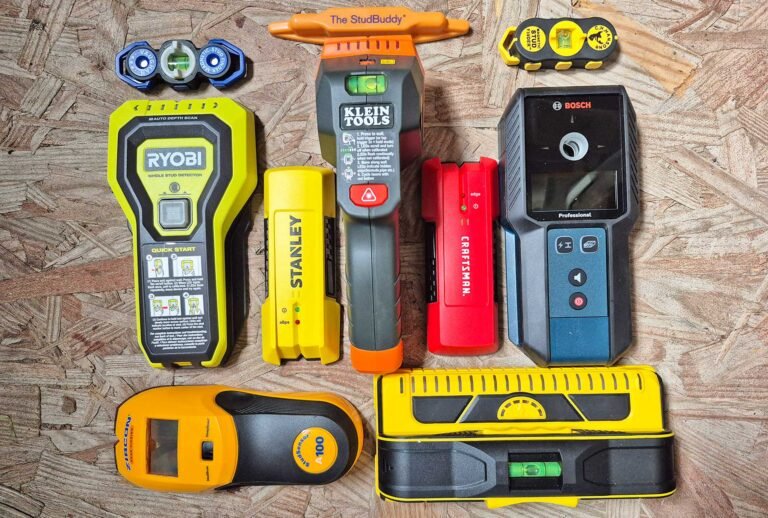
Does Stud Finder Detect Pipes? What It Can and Cannot Find
Yes, a stud finder can sometimes detect pipes, but it depends on the type of stud finder, the pipe material, the wall construction, and how deep the pipe is behind the surface. A basic stud finder may react to a pipe without identifying it as plumbing, while a multi-sensor model with metal detection is much better at locating copper, steel, or other metal pipes. Plastic PVC or PEX pipes are considerably harder to detect reliably.
This distinction matters because a stud finder does not necessarily know what object is behind your drywall. A standard electronic model primarily detects changes in density or other properties behind the surface. A strong reading could therefore come from a wooden stud, metal stud, pipe, electrical wire, drywall fastener, blocking, or another hidden object.
That becomes especially important before drilling into bathroom, kitchen, laundry-room, or utility walls. Finding a “stud” with an electronic scanner does not automatically mean the entire area is safe to penetrate.
In this guide, I’ll explain whether a stud finder can detect pipes, which types of plumbing are easiest and hardest to find, how metal and plastic pipes affect readings, how to tell a pipe from a stud, and what I recommend doing before drilling into any wall that may contain plumbing.
Does Stud Finder Detect Pipes?

A stud finder may detect a pipe, but a standard model cannot always identify that object specifically as a pipe.
Electronic stud finders generally work by sensing differences behind the wall surface. When the sensor passes over something denser or materially different from the surrounding empty wall cavity, the reading changes.
That change can occur when the scanner passes over:
- Wood framing
- Metal framing
- Copper or steel plumbing
- Electrical cables
- Drywall screws or nails
- Blocking
- Metal protection plates
More advanced scanners can separate some of these materials into different detection modes.
For example, a multi-function wall scanner may include one mode for framing, another for metal, and another intended to warn about energized electrical wiring. Metal-pipe detection is therefore much more reliable when the tool actually includes a dedicated metal-scanning function.
The material of the plumbing is one of the biggest factors.
Pipe Detection by Material
| Pipe Material | Can a Stud Finder Detect It? | Typical Reliability |
| Copper pipe | Often with metal-detection mode | Good when within detection depth |
| Steel/iron pipe | Often | Good |
| Galvanized pipe | Often | Good |
| PVC pipe | Sometimes indirectly | Low |
| CPVC pipe | Sometimes indirectly | Low |
| PEX tubing | Sometimes indirectly | Low |
| Metal conduit mistaken for pipe | Often | Good, but object type may be unclear |
A scanner finding metal is useful, but it still cannot always tell whether that metal is plumbing, electrical conduit, a protective plate, or framing.
Key Takeaways:
- Stud finders can detect some pipes, especially metal ones.
- A basic stud finder may detect a pipe as an unexplained dense area rather than identifying it as plumbing.
- PVC, CPVC, and PEX are much harder to locate with conventional stud finders.
- Never assume a stud-finder reading proves an area is safe to drill.
How Does a Stud Finder Detect Something Behind a Wall?
Understanding how the tool works helps explain why pipes can create confusing readings.
Most common electronic stud finders do not directly identify wood.
Instead, they evaluate changes in the material behind the wall.
A typical drywall assembly contains relatively empty cavities between framing members. When the scanner moves from an open cavity toward a wood stud, the amount and type of material behind the drywall changes.
The sensor recognizes that change and signals an edge or center.
A pipe can create a similar change.
That means a basic scanner might react to plumbing even though it was sold primarily as a stud finder.
Density Detection Does Not Equal Object Identification
Suppose your stud finder gives a strong reading approximately 3 feet above the floor in a bathroom.
You might assume you found framing.
However, that location could also contain a vertical supply pipe, drain line, blocking for a fixture, electrical wiring, or several materials close together.
The scanner is giving you information about something behind the wall, not necessarily telling you exactly what that object is.
This is why repeated scans and pattern recognition are so important.
Can a Stud Finder Detect Copper Pipes?
Yes, copper pipes are among the easier plumbing materials to detect with a stud finder that includes metal-scanning capability.
Copper is nonferrous metal, meaning it does not contain iron like steel does, but many electronic metal detectors can still sense it.
How well the scanner performs depends on:
- Pipe depth
- Pipe diameter
- Wall thickness
- Scanner quality
- Metal-detection depth
- Materials between the scanner and pipe
A copper water-supply line close behind standard drywall may produce a strong metal reading.
A smaller copper tube located several inches behind thick plaster may be much harder to detect.
Why Basic Stud Mode Can Still React to Copper
Even without selecting metal mode, a standard stud scanner may notice the change caused by the pipe.
The problem is interpretation.
The scanner may show what appears to be an unusually narrow or inconsistent stud.
If a reading does not behave like normal framing, investigate before drilling.
Can a Stud Finder Detect Steel or Galvanized Pipes?
Usually, yes, particularly if the tool includes metal detection.
Steel and galvanized plumbing contain ferrous metal, making them relatively easy targets for many metal-sensing scanners.
Older houses may contain galvanized water lines, cast-iron drains, or other metal plumbing.
A scanner may produce a particularly strong reading over these materials.
However, a strong metal signal does not prove you found plumbing.
Steel studs, electrical conduit, metal electrical boxes, ductwork, screws, nails, and protective plates can produce similar signals.
The location and shape of the detected object provide additional clues.
Can a Stud Finder Detect PVC Pipe?
A conventional stud finder is not a reliable PVC-pipe detector.
PVC is plastic and therefore will not trigger a normal metal-detection function.
A density-based scanner might react to a large PVC drain pipe because the material changes what the sensor sees behind the wall, but the result can be inconsistent.
This is especially true if:
- The pipe is small
- The pipe is several inches behind the drywall
- Insulation surrounds it
- The wall is thick
- The pipe does not contain water
A large drain stack may be easier to notice than a small plastic supply line, but I would never rely on a basic stud finder alone to clear a wall of PVC plumbing before drilling.
Can a Stud Finder Detect PEX Pipes?
PEX is also difficult to detect with a conventional stud finder.
PEX tubing is plastic, so normal metal mode does not identify the tube itself.
A scanner may occasionally react to:
- Water inside the line
- Metal fittings
- Support brackets
- Protective plates
- Changes in density around the pipe
But that is not the same as reliably detecting PEX.
This is an important limitation in modern homes because PEX is widely used for hot- and cold-water distribution.
A stud finder giving no warning does not mean PEX is absent.
Why Plastic Plumbing Is a Bigger Drilling Concern
Metal pipes may trigger a scanner or magnetic detector.
Plastic plumbing can remain almost invisible to many common tools.
That means safe drilling depends on understanding likely plumbing routes and avoiding unnecessarily deep fasteners, not merely scanning for metal.
Key Takeaways:
- Copper, steel, and galvanized pipes are much easier to detect than plastic plumbing.
- PVC, CPVC, and PEX can be difficult or impossible for a basic stud finder to identify reliably.
- A negative stud-finder scan does not guarantee that no pipe is present.
- Bathrooms, kitchens, and utility walls deserve extra caution even when the scanner shows nothing unusual.
Can a Stud Finder Tell the Difference Between a Pipe and a Stud?
Usually not with complete certainty.
Some advanced wall scanners give more detailed information than a basic stud finder, but the user still needs to interpret the pattern.
The easiest way to distinguish framing from plumbing is to examine how the detected object continues through the wall.
A Stud Usually Follows a Predictable Pattern
Wood wall studs generally run vertically.
In conventional framing, neighboring studs are often positioned approximately 16 or 24 inches on center, although actual construction can vary.
If you detect a vertical object and then find similar objects at regular spacing, you are probably seeing framing.
Pipes Follow Plumbing Routes
Plumbing does not normally repeat at regular framing intervals.
A supply line may run vertically toward a sink, shower valve, toilet, or appliance and then change direction.
Drain pipes may be substantially wider than water-supply lines.
If your reading appears only close to a plumbing fixture and does not repeat at conventional framing spacing, a pipe becomes more plausible.
Scan Higher and Lower
After finding a suspicious object, move the scanner 12 to 24 inches higher or lower.
If the target remains in exactly the same vertical position throughout much of the wall, it could be a stud or a vertical pipe.
Now scan horizontally to find neighboring targets.
If additional vertical targets appear at regular spacing, framing is more likely.
If one isolated target runs toward plumbing equipment, treat the location cautiously.
What Does a Pipe Look Like on a Stud Finder?
There is no universal display pattern because stud finders use different technologies and interfaces.
On a basic edge-finding scanner, a pipe might appear as:
- An unusually narrow “stud”
- A reading that disappears quickly
- A broad dense region
- Multiple unexpected edges
- An inconsistent stud center
On a scanner with metal mode, a pipe may produce a strong metal signal that follows the pipe’s path.
A large metal drain or steel pipe might create a wider signal than a small water line.
The exact apparent width usually should not be treated as the true pipe diameter because sensor response extends beyond the physical object.
Can a Stud Finder Detect Water in Pipes?
Some wall scanners can respond to moisture or to the changes created by water-filled plumbing, but a normal stud finder should not be considered a dependable water-pipe detector.
The presence of water may make some plastic pipes easier for certain sensor technologies to detect, but performance varies too much to make this a safe general rule.
If your real goal is to locate plumbing accurately rather than merely find framing, specialized wall-scanning equipment may be more appropriate.
Professional inspection tools can use technologies designed to evaluate materials at greater depth or distinguish different objects more effectively than an inexpensive stud finder.
Can a Magnetic Stud Finder Detect Pipes?
A magnetic stud finder behaves very differently from an electronic scanner.
It detects ferrous metal rather than wall density.
The magnet is usually intended to locate drywall screws or nails attached to the stud.
It can also react strongly to:
- Steel pipe
- Iron pipe
- Steel studs
- Nail plates
- Screws
- Electrical boxes
- Metal conduit
However, a simple magnet generally will not strongly detect copper, PVC, CPVC, or PEX.
That makes a magnetic finder useful for identifying some metal objects but inadequate as a general plumbing detector.
Why a Strong Magnetic Reading Can Be a Warning
Suppose you move a magnet over a suspected stud and encounter a broad area where the magnet sticks strongly.
That could be more than a drywall screw.
It might be a metal protective plate installed over wiring or plumbing where it passes through framing.
Do not drill through unexplained metal resistance.
That protective plate may be there specifically to stop screws and nails from reaching something hazardous behind it.
What Are Nail Plates and Why Do They Matter?
Builders often install steel protective plates where pipes or electrical cables pass through framing too close to the surface.
These are sometimes called nail plates or stud guards.
Their purpose is straightforward: prevent a nail or screw from accidentally penetrating the concealed utility.
If you try to drill into a location you believe is a wooden stud and unexpectedly hit solid metal, stop drilling.
Do not replace the drill bit with one designed for metal.
The plate may be protecting:
- Water pipe
- Drain or vent pipe
- Electrical cable
- Another vulnerable utility
Trying to defeat that protection can create a water leak, electrical fault, or serious safety hazard.
Important Tip: Unexpected metal resistance inside a wood-framed wall is a reason to stop and investigate, not a reason to drill harder.
Where Are Pipes Most Likely to Be Hidden?
Knowing common plumbing locations can be just as valuable as using a scanner.
Pipes are more likely inside walls around:
- Bathrooms
- Kitchens
- Laundry rooms
- Utility rooms
- Water heaters
- Exterior hose connections
For example, the wall behind a shower valve naturally has water lines.
The wall beneath a kitchen sink contains both supply and drainage plumbing.
The area behind a washing machine may contain hot and cold supply lines plus a drain.
If you are installing something on one of these walls, I recommend assuming concealed plumbing is possible even if a stud finder does not detect it.
Pipes Can Run Through Studs
Another critical point is that plumbing does not always sit in the empty cavity between studs.
Installers may drill holes through framing members and run pipes horizontally through them.
So even if you correctly locate a stud, that does not guarantee that drilling deeply into the stud is safe.
Protective plates should be present when utilities pass close enough to the face of the framing to need protection, but you should still use properly sized fasteners and avoid unnecessary penetration depth.
Can a Stud Finder Detect Electrical Wires and Pipes at the Same Time?
Some multi-sensor stud finders provide separate stud, metal, and live-AC warnings.
In a complicated wall, several signals may overlap.
For example, the area near a bathroom vanity could contain:
- Wooden framing
- Copper water pipe
- Electrical cable
- Metal fasteners
A scanner may therefore produce several warnings in almost the same place.
That does not necessarily mean the tool is malfunctioning.
It can simply mean the wall contains multiple hidden systems.
This is why I prefer tools that display the type of detection rather than units that communicate everything with one generic beep.
Even then, the result should be treated as a clue rather than an X-ray image of the wall.
How to Check for Pipes Before Drilling
No single homeowner method guarantees that a wall contains no plumbing.
The safest approach combines the scanner’s reading with an understanding of the wall and your intended fastener depth.
Start by locating the framing.
Then consider what is on the opposite side of the wall. If there is a shower, sink, toilet, washing machine, water heater, or another plumbing fixture nearby, concealed pipes deserve extra attention.
Scan the area with metal detection if your tool provides it. Check above, below, and beside the proposed hole rather than scanning only one point.
If the scanner produces an unusual metal signal or the stud reading changes unexpectedly, choose a different location or investigate further.
For high-risk locations or expensive installations, professional wall scanning may be worthwhile.
Keep Fastener Depth Appropriate
A mounting screw only needs enough penetration into structural wood to achieve the fastening requirement for the item being installed.
Using an excessively long screw does not automatically make an installation safer.
Extra depth can increase the chance of hitting hidden wiring or plumbing.
Follow the mounting-hardware or equipment manufacturer’s fastening instructions whenever possible.
Is It Safe to Drill Where a Stud Finder Shows a Stud?
Not automatically.
This is probably the most important practical point in this entire topic.
The stud finder tells you where it believes framing exists. It does not certify the complete drilling path.
A wood stud can contain holes carrying plumbing or electrical wiring.
If the area is near a sink, shower, outlet, electrical panel, water heater, or other service, be particularly cautious.
Stop if the Drill Hits Unexpected Resistance
When drilling into ordinary drywall and wood framing, the resistance should feel predictable.
If you suddenly encounter a very hard layer, particularly metal, stop.
Do not force through it.
If the location must be used, determine what the obstruction is first.
Which Type of Stud Finder Is Best for Detecting Pipes?
If detecting hidden plumbing is an important part of the job, I would choose a multi-sensor wall scanner with a dedicated metal-detection mode rather than a basic wood-edge stud finder.
A useful scanner may offer:
| Feature | Why It Helps |
| Stud/wood mode | Locates framing |
| Metal mode | Helps find metal pipes and protective plates |
| Deep scan | Reaches farther into thicker walls |
| Live AC warning | Adds awareness of energized wiring |
| Center detection | Helps locate the center of framing |
Remember that even a sophisticated scanner has depth and material limitations.
A model capable of finding copper pipe does not automatically make it dependable for PEX or PVC.
I Would Not Buy Based on “Pipe Detection” Alone
Marketing terminology can make a wall scanner sound more precise than it really is.
Check what the manufacturer actually says the tool can detect, at what maximum depth, and in which materials.
A good multi-sensor scanner is useful because it gives you more information about hidden objects.
It is not a replacement for understanding the construction.
Key Takeaways:
- A multi-sensor scanner with metal mode is preferable when hidden plumbing is a concern.
- Stud detection alone cannot prove an area is free of pipes.
- Even an accurately located stud can contain plumbing running through drilled holes.
- Use an appropriate fastener length and stop if you encounter unexplained metal.
Why Does My Stud Finder Detect Something Near a Sink or Shower?
It may be detecting exactly what you would expect in a plumbing wall.
Behind a shower, for example, you may have hot and cold supply pipes leading to the mixing valve and a pipe extending toward the showerhead.
Around a sink, the wall may contain water supplies, a drain, vent plumbing, electrical wiring, and framing.
This can make stud-finder readings much more complicated than those on a simple bedroom wall.
A broad or repeated signal does not necessarily mean the entire area is framed.
Use metal mode if available and check whether the detected object follows a logical plumbing route.
Can a Stud Finder Find a Pipe Leak?
Generally, no.
A standard stud finder is not designed as a leak-detection tool.
A moisture-related change might sometimes affect scanner readings, but that would not reliably tell you:
- Whether a leak exists
- Where it originates
- How much water is present
If you suspect a hidden water leak, look for symptoms such as staining, soft drywall, peeling paint, musty odor, unexplained water usage, or moisture.
Moisture meters, thermal imaging under suitable conditions, plumbing diagnostics, and professional leak-detection equipment are more appropriate tools.
Why Does My Stud Finder Keep Beeping Over a Pipe?
If the scanner keeps beeping in a particular area, it may be responding to metal plumbing, multiple nearby materials, or the wall’s changing density.
A continuous vertical metal signal may indicate a pipe, conduit, or metal stud.
A series of small metal signals aligned vertically may simply be drywall fasteners.
Instead of relying on the beeping alone, switch detection modes and rescan from different directions.
The pattern matters more than one isolated alarm.
Common Mistakes When Looking for Pipes With a Stud Finder
The first mistake is assuming that no alert means no plumbing.
That is particularly risky with PEX, PVC, and CPVC.
Another mistake is treating every metal reading as a pipe. Screws, electrical boxes, metal studs, conduit, ductwork, and nail plates can all produce signals.
The third major mistake is drilling through a metal obstruction because you are certain a wooden stud should be there.
If metal is intentionally preventing your drill from entering farther, there may be a very good reason.
I would also avoid assuming that pipes only run vertically. Plumbing can turn and travel horizontally through framing.
Finally, do not rely on stud spacing alone to determine safe drilling locations. A correctly identified stud can still contain utilities.
FAQs about Does Stud Finder Detect Pipes
Will a stud finder detect water pipes?
Sometimes. Metal water pipes such as copper or steel are much more likely to be detected, especially with metal mode. Plastic plumbing is considerably harder to find.
Can a stud finder detect copper pipe?
Yes, many multi-sensor stud finders with metal detection can find copper pipe when it is within the scanner’s detection range.
Can a stud finder detect PVC pipe?
Not reliably. PVC is nonmetallic, so metal detection will not find the pipe itself. Some electronic scanners may react to a large PVC pipe indirectly, but you should not rely on this for drilling safety.
Can a stud finder detect PEX?
Usually not reliably. PEX is plastic and can remain undetected by common stud finders.
The scanner may detect nearby metal fittings or protective plates rather than the tubing itself.
Can a stud finder detect metal pipes?
Yes. Metal pipes are generally much easier for an appropriate wall scanner to detect than plastic ones.
Use the dedicated metal mode if your stud finder provides one.
Will a magnetic stud finder find copper pipes?
Generally, no. Copper is not strongly magnetic.
A magnetic stud finder is more useful for steel or iron objects and drywall fasteners.
Can a stud finder mistake a pipe for a stud?
Yes.
A basic electronic stud finder can react to a pipe or another dense object and produce a reading that resembles framing.
Confirm suspicious readings using scanning patterns, metal mode, or another detection method.
How can I tell if my stud finder is detecting a pipe?
Check whether the object follows normal stud spacing and continues like structural framing.
Then switch to metal mode if available.
A strong isolated metal target near plumbing fixtures deserves additional investigation.
Can I drill into a wall after finding a stud?
Finding a stud does not automatically prove drilling is safe.
Pipes and electrical cables can pass through holes drilled in framing.
Use an appropriate fastener length and stop if you encounter unexpected metal resistance.
What does it mean if I hit metal when drilling into a stud?
Stop drilling.
You may have reached a protective nail plate installed over plumbing or electrical wiring.
Do not attempt to drill through the metal until you know what it is.
Can pipes run horizontally through studs?
Yes.
Plumbers can route water and drainage lines through properly located holes in framing.
That is why correctly identifying a stud does not eliminate the possibility of plumbing behind your proposed fastener.
Are pipes usually behind bathroom walls?
Bathroom walls commonly contain water supply pipes, drains, and vents, particularly around sinks, toilets, tubs, and showers.
Use extra caution when drilling in these areas.
What type of stud finder detects pipes best?
A multi-function wall scanner with metal detection, stud detection, and deep-scan capability provides more information than a basic stud finder.
Even then, plastic pipes may remain difficult to identify.
Can a stud finder detect plumbing through tile?
Sometimes, but tile, backer board, mortar, waterproofing, and wall thickness can reduce detection accuracy.
Metal detection may still locate sufficiently close metal plumbing, but results should be interpreted carefully.
Does live-wire mode detect water pipes?
No. Live-wire detection is intended to warn about energized electrical conductors.
A pipe might influence another scanning function, but an AC warning should not be interpreted as plumbing detection.
Conclusion
If you are asking does stud finder detect pipes, the answer is sometimes, but not reliably enough to assume every hidden pipe will be found. Metal pipes such as copper, steel, and galvanized plumbing are much easier to detect, particularly when your stud finder includes a dedicated metal-scanning mode.
Plastic plumbing is the bigger limitation. PVC, CPVC, and PEX may produce little or no clear response from an ordinary stud finder, which means a wall that appears clear can still contain water lines or drains.
A basic stud finder can also mistake plumbing or other hidden materials for framing. For that reason, I recommend looking at the entire detection pattern rather than trusting a single beep. Confirm normal stud spacing, scan higher and lower, use metal mode when available, and consider nearby plumbing fixtures.
Most importantly, remember that finding a wooden stud does not guarantee the drilling path is free of utilities. Pipes and electrical cables can pass directly through framing. If your drill encounters unexplained metal, stop immediately rather than trying to penetrate it; you may have reached a protective plate covering a pipe or wire.
For ordinary mounting work, a multi-sensor stud finder is useful, but it should be treated as one part of the safety process. Combining the scanner’s readings with knowledge of the wall layout, appropriate fastener depth, and extra caution near kitchens, bathrooms, and utility areas is the better way to avoid accidentally drilling into hidden plumbing.