Will an Impact Wrench Break Bolts? What You Need to Know
Yes, an impact wrench can break a bolt if it applies more torque than the fastener can withstand, especially when the bolt is rusted, seized, weakened, cross-threaded, or already overtightened.
Impact wrenches are designed to deliver repeated rotational impacts that help loosen stubborn nuts and bolts. That makes them extremely useful for automotive and mechanical work, but the same high torque can damage a fastener when used without enough control.
A healthy bolt normally does not snap simply because an impact wrench touches it. Problems are more likely when the fastener is already compromised or when the tool continues hammering after the bolt has stopped moving.
Will an Impact Wrench Break Bolts?
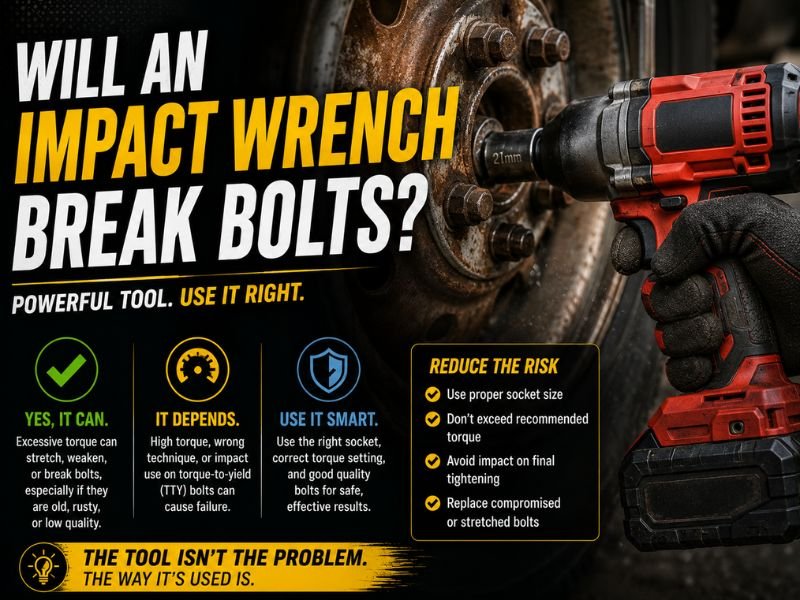
It can.
Whether a bolt breaks depends on several factors:
- Bolt diameter
- Bolt grade and strength
- Corrosion
- Thread condition
- Impact wrench torque
- Power setting
- Impact duration
- Whether you are tightening or loosening
- Condition of the joint
A small, healthy bolt subjected to excessive torque can snap. A heavily rusted bolt may break even before a powerful impact wrench reaches its maximum output.
The safest approach is to use only as much impact force as necessary.
If a bolt refuses to move after several controlled attempts, simply holding the trigger longer is not always the right solution.
Why Can an Impact Wrench Snap a Bolt?
An impact wrench does not apply torque in exactly the same way as a normal hand wrench.
Inside the tool, a hammer mechanism repeatedly strikes an anvil connected to the socket.
These rapid impacts produce high rotational force.
That action is excellent for breaking corrosion and static friction, but it can also repeatedly load the bolt.
If the threads remain stuck, the bolt itself begins absorbing more of that twisting force.
Eventually, several things can happen:
- Threads strip
- Bolt stretches
- Bolt head rounds
- Stud twists
- Bolt shank fractures
The weakest part of the fastener or joint usually fails first.
Can an Impact Wrench Break a Bolt While Removing It?
Yes.
Removal is one of the most common situations where bolts snap.
Imagine a bolt that has been exposed to water, road salt, or years of heat cycles.
The threads may be effectively locked together by corrosion.
When you attach an impact wrench, the tool begins hammering in the loosening direction.
Ideally, the vibration and torque break the threaded connection free.
But if the threads remain locked, the torque begins twisting the bolt itself.
A weakened bolt may snap before the threads move.
This is particularly common with:
- Exhaust hardware
- Suspension fasteners
- Old engine bolts
- Rusty wheel studs
- Outdoor equipment
- Small corroded screws
The fact that the bolt has not moved does not mean you should automatically apply more torque.
Why Do Rusted Bolts Break More Easily?
Corrosion creates two problems at the same time.
First, rust can lock the threads together and increase the amount of torque required to remove the bolt.
Second, corrosion can reduce the strength of the bolt itself.
A heavily rusted bolt may have less usable metal remaining in its shank or threads.
That creates a bad combination:
More torque is required, but the fastener may be weaker than it was when originally installed.
This is why a powerful impact wrench can sometimes turn a difficult removal into a broken-bolt extraction job.
Can an Impact Wrench Break a Bolt While Tightening?
Yes, and tightening can create an even greater risk of accidental damage.
When a bolt becomes snug, an impact wrench does not necessarily stop automatically.
If you continue holding the trigger, the hammer mechanism can keep adding impacts to the joint.
Depending on the fastener and tool, this may:
- Stretch the bolt
- Strip threads
- Crush a gasket
- Damage aluminum threads
- Break a wheel stud
- Distort the clamped component
An impact wrench is excellent for speeding up installation, but that does not mean maximum impact power should be used for final tightening.
For torque-critical fasteners, follow the specified tightening procedure and verify final torque with an appropriate torque wrench.
Can You Overtighten Bolts With an Impact Wrench?
Absolutely.
An impact wrench can produce far more torque than many small fasteners require.
The risk becomes especially high when using a large high-torque wrench on:
- Small bolts
- Wheel studs
- Drain plugs
- Small suspension hardware
- Aluminum components
- Engine fasteners
A powerful impact wrench does not automatically know how much torque the fastener needs.
Some modern tools have lower power settings, auto-stop functions, or tightening-control modes. These can improve control, but they should not be treated as universal replacements for a torque wrench where a precise final torque is required.
Does a More Powerful Impact Wrench Break Bolts More Easily?
Potentially.
A higher-torque wrench gives you more available force.
That is useful when removing stubborn axle nuts or large structural fasteners, but it also means you have more than enough torque to damage smaller hardware.
The best impact wrench is not always the most powerful wrench available.
A compact wrench may offer better control for small and medium fasteners, while a high-torque wrench is more appropriate for larger hardware.
Use the tool that matches the job.
Maximum torque is a capability, not a setting that must be used every time.
Can an Impact Wrench Break Wheel Studs?
Yes.
Wheel studs can break when they are:
- Overtightened
- Corroded
- Cross-threaded
- Previously stretched
- Damaged by repeated improper installation
Impact wrenches are commonly used to remove lug nuts because they make the job fast.
Installation requires more control.
One common mistake is placing the lug nut on the stud and immediately hammering it with a high-torque impact wrench.
If the nut is cross-threaded, the impact can quickly damage both the nut and stud.
Even when properly threaded, excessive impacting can stretch or weaken the stud.
A better procedure is to start the lug nuts correctly, bring them into position in a controlled manner, and complete final tightening according to the vehicle manufacturer’s specified torque procedure.
Breakaway Torque vs. Fastening Torque
Impact-wrench specifications can be confusing because you may see several torque ratings.
Two important terms are:
Fastening Torque
This describes the tool’s tightening capability.
Breakaway or Nut-Busting Torque
This refers to the tool’s ability to loosen an already tightened fastener.
Breakaway torque is often advertised as a larger number.
Neither specification tells you how much torque a specific bolt should receive.
For example, an impact wrench capable of producing several hundred foot-pounds should not be used to tighten every bolt anywhere near that level.
The correct bolt torque comes from the vehicle, equipment, or fastener application—not from the maximum output printed on the impact wrench.
Does Holding the Trigger Longer Increase the Risk?
Yes.
Once an impact wrench starts hammering against a fastener that is no longer moving freely, impact duration becomes important.
Continued hammering means repeated loading.
When tightening, that can increase clamping force until threads or the bolt reach their limit.
When loosening a seized bolt, continued hammering can keep twisting the fastener while the threads remain stationary.
Short, controlled bursts give you a better opportunity to observe what is happening.
If the bolt begins moving, continue cautiously.
If it remains completely stuck, reassess the situation before simply holding the trigger indefinitely.
Signs a Bolt May Be at Risk of Breaking
Inspect suspicious fasteners before applying maximum impact power.
Warning signs include:
- Heavy rust
- Deep corrosion
- Reduced shank diameter
- Damaged threads
- Rounded head
- Previous tool marks
- Visible stretching
- Bent fastener
- Corroded exposed threads
Pay attention to the way the bolt reacts once torque is applied.
If the bolt appears to twist or flex without actually backing out, stop.
That can be a sign that the shank is taking the load instead of the threads turning.
How to Reduce the Risk of Breaking Bolts
Start With a Lower Power Setting
If your impact wrench has multiple modes, start lower.
Move to a higher setting only when necessary.
Use Short Bursts
Avoid immediately holding the trigger continuously.
Short bursts provide more control.
Use the Correct Socket
The socket should fit the fastener properly.
Loose-fitting sockets increase the risk of rounding the head.
Use impact-rated sockets with an impact wrench.
Fully Seat the Socket
Make sure the socket is fully engaged before pulling the trigger.
Address Heavy Corrosion
If accessible corrosion is obvious, treating the fastener before applying extreme torque may improve your chances of successful removal.
A suitable penetrating product may help in some applications.
Stop When the Bolt Is Not Responding
If the wrench is hammering hard but nothing is moving, more torque may not be the safest next step.
Reassess before the bolt snaps.
Should You Tighten Bolts to Final Torque With an Impact Wrench?
For torque-critical fasteners, you generally should not rely on an ordinary impact wrench alone to establish precise final torque.
Impact wrench output can vary with:
- Tool setting
- Battery state
- Air pressure on pneumatic models
- Impact duration
- Fastener friction
- Thread condition
- Lubrication
- Socket and extension setup
Use the impact wrench for speed where appropriate, then follow the specified final tightening procedure.
A torque wrench provides much better control when a manufacturer specifies an exact final torque.
Do Auto-Stop and Torque-Control Modes Prevent Broken Bolts?
They can reduce the risk, but they are not foolproof.
Modern impact wrenches may include modes designed to:
- Stop or reduce power during tightening
- Limit unnecessary hammering
- Slow down after a fastener breaks loose
- Reduce fastener run-off
These features are useful because they give the operator more control.
However, they cannot determine the condition of every fastener.
A badly corroded or weakened bolt can still fail.
For critical tightening, use the required torque procedure even when the impact wrench has electronic control modes.
Is a Breaker Bar Safer for a Stuck Bolt?
A breaker bar provides a different type of control.
Instead of repeated impacts, it applies relatively smooth torque through a long handle.
This can give you better tactile feedback.
You may feel:
- Fastener beginning to move
- Bolt twisting
- Tool flex
- Sudden thread movement
An impact wrench can sometimes loosen corrosion more effectively because its rapid impacts help shock the joint.
Neither tool guarantees that a seized bolt will survive.
A sufficiently long breaker bar can also snap a weak bolt.
The key advantage is that manual torque can make it easier to feel what the fastener is doing.
What Should You Do If the Impact Wrench Won’t Remove the Bolt?
Do not automatically keep increasing power.
Check the basics first:
- Confirm the wrench is turning in reverse
- Verify the socket is correct
- Make sure the socket is fully seated
- Inspect the bolt for corrosion
- Check whether exposed threads are damaged
- Consider whether additional preparation is appropriate
For some mechanical work, controlled heat can help with seized fasteners, but it is not appropriate around every component. Fuel, wiring, rubber parts, coatings, bearings, and other nearby materials can make heat unsafe.
If breaking the fastener would create an expensive repair, stopping early may be the better choice.
What Happens If the Bolt Breaks?
The repair depends on where the bolt fractures.
Bolt Breaks Above the Surface
You may still have enough material to grip.
Bolt Breaks Flush
Removal becomes more difficult because there is nothing protruding.
Bolt Breaks Below the Surface
Extraction can require drilling or specialized repair methods.
Thread condition, component material, and accessibility all affect the next step.
This is why preventing the break is usually far easier than extracting the remaining bolt afterward.
Common Mistakes to Avoid
Avoid these habits when using an impact wrench:
- Starting every job at maximum power
- Holding the trigger indefinitely
- Using the wrong socket
- Using non-impact sockets
- Tightening critical fasteners entirely with impact power
- Ignoring severe corrosion
- Continuing after a bolt begins twisting
- Impacting a cross-threaded fastener
- Assuming more advertised torque is always better
- Treating breakaway torque as the correct tightening torque
Frequently Asked Questions
Will an Impact Wrench Break Bolts?
Yes. Excessive torque can snap a bolt, particularly when the fastener is rusty, damaged, seized, cross-threaded, or already weakened.
Can an Impact Wrench Snap a Rusted Bolt?
Yes. Rust can both lock the threads and weaken the fastener, increasing the chance of breakage during removal.
Can an Impact Wrench Break Wheel Studs?
Yes. Excessive tightening, corrosion, cross-threading, or continued hammering can damage or break wheel studs.
Can You Overtighten Bolts With an Impact Wrench?
Yes. An impact wrench may continue tightening after the fastener is already snug.
Should You Tighten Lug Nuts With an Impact Wrench?
An impact can be used carefully during installation, but final tightening should follow the vehicle manufacturer’s specified torque procedure.
Does Holding an Impact Wrench Longer Increase Torque?
Continued impacting can continue loading the fastener, increasing the risk of overtightening or failure.
Is a High-Torque Impact Wrench More Likely to Break Bolts?
It can be if its available torque is excessive for the fastener or if maximum power is used unnecessarily.
Can an Impact Wrench Strip Threads?
Yes. Excessive torque, cross-threading, or damaged threads can result in stripped internal or external threads.
Should I Use Maximum Torque on a Stuck Bolt?
Not automatically. If the bolt is seized or weakened, maximum torque may snap it instead of loosening it.
Is a Breaker Bar Safer Than an Impact Wrench?
A breaker bar can provide better tactile feedback, but either tool can break a severely seized or weakened bolt if enough torque is applied.
Conclusion
If you’re asking “will impact wrench break bolts,” the answer is yes—an impact wrench can snap a bolt when the applied torque exceeds what the fastener can withstand, particularly when the bolt is seized, corroded, damaged, or repeatedly impacted.
Impact wrenches are valuable because their hammering action can loosen fasteners that would otherwise require substantial manual force. But more torque is not always better.
A rusted bolt may require more torque to turn at the same time that corrosion has made the bolt weaker. In that situation, simply moving to maximum impact power can break the fastener before the threads come loose.
Use lower settings when possible, apply short controlled bursts, make sure the correct impact socket is fully seated, and pay attention to signs that the bolt is twisting instead of turning.
During installation, be even more careful. An impact wrench can quickly overtighten a fastener, stretch a bolt, strip threads, or damage a wheel stud. For torque-critical fasteners, use the specified final tightening procedure rather than treating impact-wrench output as a precise torque measurement.
Use an impact wrench to help free stubborn hardware—not as a reason to apply unlimited torque. If the bolt refuses to move and begins twisting, stop before a stuck bolt becomes a broken bolt.