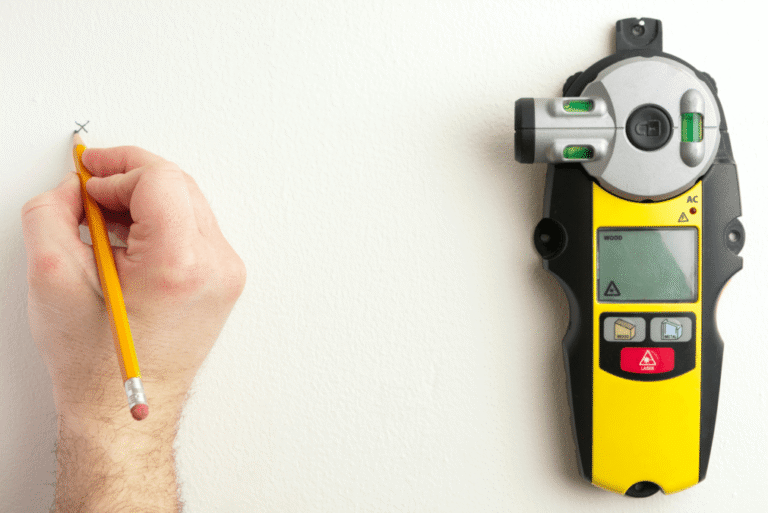
Will a Stud Finder Find Pipes? Metal vs. Plastic Pipes Explained
Yes, some stud finders can detect pipes, especially metal pipes when the tool has a dedicated Metal Scan mode, but a basic stud finder may only produce an ambiguous reading and usually cannot reliably identify a plastic pipe.
The key is understanding what your stud finder is actually designed to detect. A basic electronic stud finder primarily looks for framing behind drywall. A multi-mode model may also detect metal, while more advanced wall scanners can identify a wider range of hidden objects, including some plastic pipes.
Even when a scanner detects something behind the wall, it may not tell you exactly what the object is. A metal response could come from a steel stud, copper pipe, electrical conduit, nail plate, screw, or another hidden component. For that reason, a stud finder is useful for investigating a wall, but one reading should not be treated as proof that you have found a pipe.
Will a Stud Finder Find Pipes?
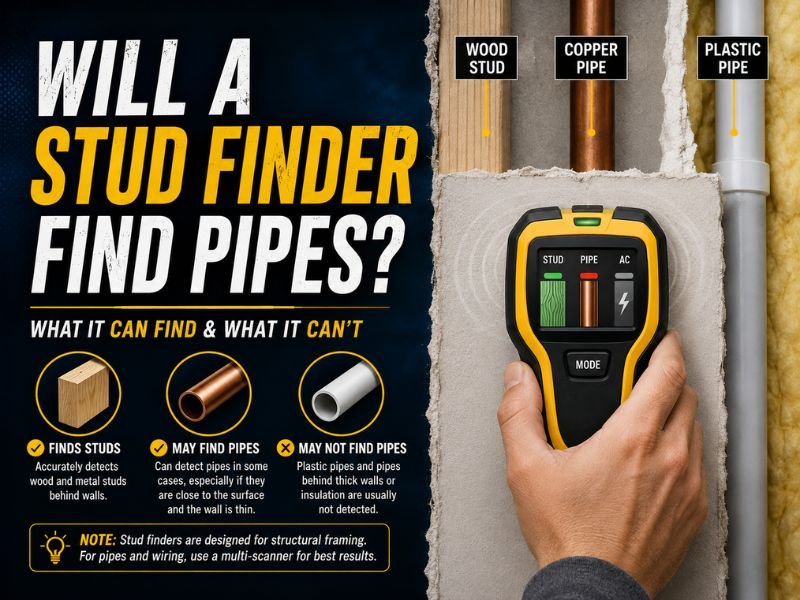
A stud finder can sometimes find pipes, but the answer depends heavily on the type of pipe and the type of finder.
Metal pipes are generally easier to detect because many multi-mode stud finders include a dedicated metal-scanning function. Steel and copper plumbing can create a clear metal signal when they are within the tool’s rated detection depth.
Plastic pipes are much more difficult.
PVC and PEX do not contain enough metal for a conventional metal detector to recognize them directly. Some advanced scanners can detect changes caused by plastic pipes or water-filled plumbing, but a basic stud finder should not be expected to reliably locate them.
A simple way to think about it is:
- Steel pipe: commonly detectable with Metal Scan
- Copper pipe: commonly detectable with Metal Scan
- Metal conduit: commonly detectable with Metal Scan
- PVC pipe: unreliable with a basic stud finder
- PEX tubing: unreliable with a basic stud finder
- Advanced wall scanner: may detect both metal and some plastic pipes
How Does a Stud Finder Detect Objects Behind a Wall?
Different stud finders use different sensing methods.
Understanding those differences helps explain why one model may locate a pipe while another does not.
Basic Electronic Stud Finders
A traditional electronic stud finder is mainly designed to locate framing.
It senses changes behind the wall surface and looks for patterns consistent with a wood or metal stud.
This means the tool may also react to other objects.
A pipe, conduit, blocking, dense material, or another object behind the drywall can sometimes create a reading that resembles a stud.
The tool may therefore tell you that something is there without correctly identifying what that object is.
Metal-Scanning Stud Finders
A multi-mode stud finder may include a dedicated Metal Scan.
This mode can respond to metallic objects such as:
- Steel pipe
- Copper pipe
- Metal conduit
- Steel studs
- Nails
- Screws
- Protective metal plates
- Rebar
Metal Scan is much more useful for investigating suspected plumbing than ordinary Stud Scan.
However, it still does not automatically tell you what the metal object is.
Advanced Wall Scanners
More sophisticated wall scanners may use radar or other advanced sensing systems.
Depending on the model, these tools may detect:
- Wood framing
- Metal framing
- Copper pipes
- Steel pipes
- Plastic pipes
- Electrical cables
- Rebar
- Other hidden objects
These scanners are more appropriate when identifying hidden plumbing is important rather than simply finding a stud for hanging a shelf.
Can a Regular Stud Finder Detect a Pipe?
Sometimes.
A regular stud finder can react to a pipe because the pipe changes what the sensor sees behind the wall.
But that is not the same as recognizing the object as plumbing.
For example, a normal Stud Scan might produce a strong reading between two expected stud positions. That reading could come from:
- A pipe
- Blocking
- Electrical conduit
- A metal plate
- Another structural component
This is one reason you should not assume every positive stud-finder reading represents framing.
If your finder has a separate Metal Scan mode, rescanning the location can provide more information.
Can a Stud Finder Find Copper Pipes?
Yes, a stud finder with a dedicated metal-detection mode can often locate copper pipes.
Copper is a non-ferrous metal, so it does not behave exactly like steel, but many electronic metal scanners are designed to detect both ferrous and non-ferrous materials.
Detection depends on several factors:
- Pipe diameter
- Pipe depth
- Wall thickness
- Scanner sensitivity
- Scan mode
- Other nearby materials
A copper pipe directly behind standard drywall may be easier to detect than a small copper line buried behind tile, backer board, and multiple wall layers.
A metal reading also does not prove that the object is copper plumbing. The signal could come from electrical conduit or another metallic component.
Can a Stud Finder Find Steel Pipes?
Yes, steel pipes are generally among the easier plumbing materials for a metal-capable wall scanner to detect.
Steel is ferrous, meaning it strongly interacts with magnetic and metal-detection systems.
A steel pipe may create a strong, continuous signal.
The challenge is distinguishing it from other steel objects.
For example, a strong vertical metal reading could be:
- Steel plumbing
- Metal framing
- Electrical conduit
Looking at the direction, width, and surrounding wall pattern can help you determine what is most likely.
Can a Stud Finder Find PVC Pipe?
A normal stud finder usually cannot reliably identify PVC plumbing.
PVC is plastic, so a metal-scanning function has nothing metallic to detect.
A density-based stud finder might occasionally react to the pipe or the surrounding wall cavity, but that response is not reliable enough to use as proof that you have found PVC.
Advanced wall scanners may detect plastic pipes using different sensing technology.
Even then, performance can depend on:
- Whether the pipe contains water
- Pipe diameter
- Wall construction
- Scan depth
- Scanner technology
If locating hidden PVC is important, use a tool specifically designed to detect non-metallic objects rather than relying on a standard stud finder.
Can a Stud Finder Find PEX Pipe?
PEX presents similar problems to PVC.
PEX tubing is plastic and generally does not create the kind of metal signal that a standard metal-scanning stud finder needs.
A basic electronic finder may sometimes detect a change in the wall, but it cannot reliably identify that change as PEX.
An advanced scanner designed for plastic plumbing is a better option.
Be especially cautious around bathrooms, kitchens, utility rooms, and laundry areas where PEX lines may run through wall cavities.
What Types of Pipes Can a Stud Finder Detect?
| Pipe Type | Basic Stud Scan | Metal Scan | Advanced Wall Scanner |
| Steel pipe | May trigger | Usually detectable | Usually detectable |
| Copper pipe | May trigger | Usually detectable | Usually detectable |
| Cast-iron pipe | May trigger | Usually detectable | Usually detectable |
| Metal conduit | May trigger | Usually detectable | Usually detectable |
| PVC pipe | Unreliable | No direct detection | Some models can |
| PEX tubing | Unreliable | No direct detection | Some models can |
These are general capabilities rather than guarantees. Detection performance varies with the scanner and wall construction.
Stud Finder vs. Wall Scanner for Finding Pipes
A standard stud finder and an advanced wall scanner are built for different purposes.
Stud Finder
Best for:
- Locating wood studs
- Locating metal studs
- Basic mounting projects
- Finding framing behind drywall
Multi-Mode Stud Finder
Better for:
- Studs
- Metal pipes
- Metal conduit
- Fasteners
- Basic live-wire warnings
Advanced Wall Scanner
Better for:
- Plumbing investigation
- Plastic pipes
- Complex wall cavities
- Deeper objects
- Multiple hidden materials
- More detailed object location
If you simply need to locate a stud for hanging a small shelf, a standard finder may be sufficient.
If you are trying to determine where plumbing runs before drilling into a wall, a more capable scanner provides much more useful information.
How to Use a Stud Finder to Look for Pipes
1. Identify the Available Scan Modes
Check whether your finder includes:
- Stud Scan
- Deep Scan
- Metal Scan
- AC detection
- Object detection
If Metal Scan is available, it is generally more useful for locating copper or steel plumbing than ordinary Stud Scan.
2. Map the Studs First
Scan the wall in normal Stud mode.
Mark likely framing locations.
Understanding the framing pattern gives you context for interpreting other signals.
3. Switch to Metal Mode
Rescan the area using Metal Scan.
Mark significant signals.
4. Scan Horizontally and Vertically
This is particularly useful when trying to identify plumbing.
A stud normally runs vertically.
A pipe may run:
- Vertically
- Horizontally
- Around corners
- Between framing members
Mapping the direction can help distinguish plumbing from framing.
5. Scan From Both Directions
Move across the suspected object from left to right and then right to left.
Compare the readings.
Repeated readings are more useful than one isolated indication.
6. Follow the Signal
Scan farther along the object’s apparent route.
If the metal signal continues horizontally across several framing spaces, you probably are not looking at a stud.
7. Do Not Treat the Reading as Proof
A scanner helps you investigate the wall.
It does not necessarily tell you the exact function of every hidden object.
How to Tell a Pipe From a Stud
One of the most useful clues is the object’s pattern.
Studs Usually:
- Run vertically
- Extend through much of the wall height
- Repeat across the wall
- Have a relatively consistent width
Pipes May:
- Run vertically or horizontally
- Turn within the wall
- Branch
- Appear between studs
- Stop or change direction
- Produce a narrower or different signal
If you detect something that runs horizontally across multiple stud bays, plumbing or conduit is more likely than a stud.
However, vertical plumbing is common too, especially near bathrooms and kitchens.
Use multiple clues rather than orientation alone.
Metal Pipe vs. Metal Stud
| Feature | Metal Stud | Metal Pipe |
| Typical direction | Usually vertical | Vertical or horizontal |
| Repeating wall pattern | Often | Usually not |
| Metal Scan | Yes | Yes |
| Stud Scan | Usually | May trigger |
| Width | Framing-like | Often narrower |
| Identity confirmed by one scan? | No | No |
A metal detector recognizes the presence of metal. It does not automatically determine whether that metal is structural framing or plumbing.
Can a Stud Finder Mistake a Pipe for a Stud?
Yes, a stud finder can mistake a pipe or another hidden object for a stud.
This can happen because conventional electronic stud finders respond to changes behind the wall rather than visually seeing the framing.
If the reading seems unusual, check:
- Whether it continues vertically
- Whether similar studs appear nearby
- Whether Metal Scan responds
- Whether the target runs horizontally
- Whether you are near plumbing fixtures
An isolated signal between otherwise regular studs deserves more investigation.
Can a Stud Finder Detect Water Pipes?
Metal water pipes are often detectable with Metal Scan.
This includes:
- Copper water lines
- Steel plumbing
Plastic water lines are more difficult.
PVC and PEX require more advanced sensing technology if you want to detect the pipe itself.
A water-filled plastic line may sometimes be easier for certain advanced scanners to detect than an empty plastic pipe, but this capability varies greatly by model.
Can a Stud Finder Detect Plumbing Behind Drywall?
Yes, especially when the plumbing is metallic.
Standard drywall is relatively scanner-friendly because it is thin and uniform compared with many other wall surfaces.
Conditions that improve detection include:
- Thin drywall
- Large metal pipe
- Pipe close to wall surface
- Dedicated Metal Scan
- Minimal interference
Detection becomes more difficult with:
- Double drywall
- Thick plaster
- Insulation
- Tile
- Cement backer board
- Deeply recessed plumbing
Can a Stud Finder Find Pipes Behind Plaster?
It may, but plaster walls are more challenging.
Traditional plaster may be installed over:
- Wood lath
- Metal lath
Wood lath creates many changes in density that can confuse a basic stud finder.
Metal lath is even more difficult for Metal Scan because the scanner may detect metal across most of the wall.
If the wall contains widespread metal lath, isolating a single metal pipe can become very difficult.
A deeper, more advanced wall scanner is often the better choice for these walls.
Can a Stud Finder Find Pipes Behind Tile?
Possibly.
Tile installations can contain several layers:
- Tile
- Adhesive or thinset
- Backer board
- Waterproofing
- Drywall
- Framing
Each additional layer increases the distance between the scanner and the hidden pipe.
A basic stud finder designed for drywall may struggle.
If locating plumbing behind a tiled shower or bathroom wall is important, use a scanner designed for deeper or more complex wall assemblies.
How Deep Can a Stud Finder Detect a Pipe?
There is no universal maximum depth.
Detection range depends on:
- Scanner technology
- Pipe material
- Pipe diameter
- Wall material
- Scan mode
- Object orientation
A large steel pipe is often easier to detect at depth than a small copper line.
Metal Scan also commonly reaches deeper than standard Stud Scan because the two modes are looking for different things.
Always treat a manufacturer’s maximum depth as an ideal-condition specification rather than a guarantee through every wall.
Why Is My Stud Finder Detecting Something Between Studs?
A signal between known studs does not automatically mean your stud finder is malfunctioning.
The target could be:
- Plumbing
- Electrical wiring
- Conduit
- Blocking
- Fire blocking
- Ductwork
- Metal plate
- Fastener
- Another hidden structural component
Scan above, below, and to both sides.
The way the signal continues through the wall may help you determine what it represents.
Why Does My Stud Finder Show Something Everywhere?
Widespread or confusing readings can occur because of:
- Metal lath
- Foil-backed insulation
- Thick walls
- Moisture
- Dense wall material
- Multiple hidden objects
- Incorrect calibration
- Uneven wall surfaces
If the finder produces nearly continuous signals, it may not be able to isolate individual objects in that wall assembly.
Trying a different scanning mode may help.
Pipe vs. Electrical Conduit
This distinction can be difficult.
Both plumbing and electrical conduit may:
- Be metallic
- Run vertically
- Run horizontally
- Produce strong Metal Scan signals
A metal-scanning stud finder may not reliably distinguish between the two.
Some scanners include live-wire detection, but the absence of a live-wire warning does not prove that the object is plumbing.
Electrical detection can be affected by:
- Wire depth
- Shielding
- Whether the cable is energized
- Wall material
- Nearby metal
Treat unidentified metal conservatively.
Can a Magnetic Stud Finder Find Pipes?
It depends on the pipe material.
Steel Pipe
A strong magnet may respond to steel plumbing if it is close enough to the surface.
Copper Pipe
Copper is not ferromagnetic, so a normal magnet will not directly locate it.
PVC or PEX
A magnet will not detect plastic pipe.
A magnet may also react to nails, screws, corner bead, metal studs, or protective plates.
For that reason, magnetic attraction alone does not identify a pipe.
What Does a Metal Plate Behind Drywall Mean?
If you are drilling and encounter unexpected metal, do not automatically assume it is a metal stud.
Builders commonly install protective metal plates where plumbing or electrical cables pass through framing in vulnerable locations.
The plate is there specifically to resist penetration from screws or nails.
If you encounter unexpected metal where you expected empty wall or wood framing, stop rather than drilling aggressively through it.
Investigate what is behind the area before continuing.
Is a Stud Finder Enough Before Drilling?
A stud finder is useful, but it should not be treated as a guarantee that the wall is clear.
No detection tool is perfect in every wall assembly.
A negative reading does not necessarily prove there are no:
- Pipes
- Electrical wires
- Conduit
- Other hidden objects
This is particularly important when drilling near:
- Faucets
- Toilets
- Showers
- Sinks
- Washing machines
- Water heaters
- Electrical panels
- Outlets
- Switches
Consider the likely route of plumbing and electrical services before drilling.
Which Type of Stud Finder Works Best for Pipes?
| Tool Type | Metal Pipes | Plastic Pipes | Studs | Best Use |
| Basic electronic finder | Unreliable | Unreliable | Yes | Finding framing |
| Magnetic finder | Steel only | No | Through fasteners | Simple confirmation |
| Multi-mode finder | Good | Usually limited | Yes | DIY wall scanning |
| Advanced wall scanner | Good | Some models | Yes | Complex hidden-object detection |
If the primary goal is finding metal plumbing, a multi-mode scanner with dedicated metal detection is usually more suitable than a basic stud finder.
If locating plastic plumbing is important, look for an advanced scanner specifically designed for non-metallic pipes.
Common Mistakes When Looking for Pipes
Assuming Every Positive Reading Is a Stud
Pipes and other hidden objects can trigger stud finders.
Assuming Metal Scan Means Pipe
A metal signal might be framing, conduit, a screw, or a protective plate.
Expecting Metal Mode to Detect PVC
Plastic pipe does not provide a normal metal target.
Scanning in Only One Direction
Horizontal and vertical scanning provides more information about the object’s path.
Ignoring Detection Depth
A pipe may simply be outside the scanner’s useful range.
Trusting One Reading
Repeat scans before drawing conclusions.
Drilling Through Unexpected Metal
Stop and investigate it first.
Assuming No Signal Means No Pipe
Every scanner has limitations.
Frequently Asked Questions
Will a Stud Finder Find Pipes?
Some will. Metal-capable stud finders can often detect copper and steel pipes, while plastic pipes generally require more advanced scanning technology.
Can a Stud Finder Detect Copper Pipes?
Yes, many multi-mode stud finders with a dedicated metal setting can detect copper pipes when they are within the scanner’s rated depth.
Can a Stud Finder Detect Steel Pipes?
Yes. Steel pipes are generally well suited to metal detection, although the scanner may not automatically distinguish them from steel studs or conduit.
Can a Stud Finder Find PVC Pipe?
A basic stud finder generally cannot reliably identify PVC pipe. Some advanced wall scanners are designed to detect plastic plumbing.
Can a Stud Finder Detect PEX?
Ordinary stud and metal modes are not reliable for PEX because it is plastic. Advanced scanners may perform better.
Can a Stud Finder Mistake a Pipe for a Stud?
Yes. A pipe, conduit, or another dense object can sometimes produce a reading that resembles framing.
How Do You Tell a Pipe From a Stud?
Map the target’s direction and compare it with surrounding framing. Studs normally continue vertically and repeat across the wall, while pipes may run horizontally, turn, or appear between studs.
Will a Stud Finder Find Water Pipes?
Metal water lines are often detectable with Metal Scan. Plastic water pipes are more difficult and may require an advanced scanner.
Can a Stud Finder Find Pipes Behind Drywall?
Yes, especially metal pipes located reasonably close behind standard drywall.
Can a Stud Finder Find Pipes Behind Tile?
Some deeper-scanning models may, but tile, adhesive, and backer board can reduce detection performance.
How Deep Can a Stud Finder Detect a Pipe?
It varies by scanner, pipe material, pipe size, wall thickness, and scan mode. There is no universal detection depth.
Can a Stud Finder Detect Electrical Conduit?
A metal-capable scanner can often detect metal conduit, which is why a metal signal should not automatically be interpreted as plumbing.
Is It Safe to Drill Where a Stud Finder Shows Nothing?
A negative scan does not guarantee that the wall is free of plumbing or wiring. Consider the wall layout and nearby utilities before drilling.
Conclusion
If you’re wondering “will stud finder find pipes,” metal pipes such as copper and steel can often be detected with a stud finder that has a dedicated Metal Scan mode, while plastic pipes usually require more advanced sensing technology.
A conventional stud finder may still react to plumbing, but it may interpret the pipe only as an unusual dense object rather than correctly identifying it. That is why an unexplained positive reading should not automatically be labeled as a stud.
When investigating the wall, first map the framing. Then use Metal Scan if available and follow suspicious signals horizontally and vertically. A continuous vertical target that repeats with other framing is more likely to be a stud, while an object traveling between studs or changing direction may be plumbing, conduit, or another hidden component.
Metal detection also has an important limitation: it detects metal, not the purpose of the metal. A copper pipe, steel stud, electrical conduit, protective plate, and fastener can all generate readings.
For plastic plumbing such as PVC or PEX, a basic stud finder is much less useful. If finding those pipes is important, an advanced wall scanner designed for non-metallic objects is the better approach.
The safest principle is simple: use a stud finder to gather information about what may be behind a wall, but never assume one positive or negative reading proves exactly what is—or is not—inside the wall.