When To Use an Impact Driver VS Drill: Complete Guide
When To Use an Impact Driver VS Drill comes down to the type of work: use an impact driver when you need high fastening force for long screws, lag bolts, and repetitive driving, and use a drill when you need clean, controlled holes or precise screw driving. A drill is the more versatile drilling tool, while an impact driver is optimized for demanding fastening. Bosch describes impact drivers as primarily fastening tools and standard drills as better suited to general drilling and lighter-duty fastening.
Both tools may look similar, but they transfer power differently. A drill applies smooth rotational force through a chuck, while an impact driver adds rapid rotational impacts when resistance increases. That difference affects torque, control, compatible bits, noise, and the jobs each tool handles best.
For many homeowners, woodworkers, remodelers, and contractors, the best setup is not choosing one permanently over the other. A drill and impact driver complement each other: drill the pilot hole with the drill, then drive the fastener with the impact driver.
Impact Driver vs Drill: Quick Answer
Use an impact driver for:
- Long screws
- Structural screws
- Lag bolts
- Deck screws
- Repetitive fastening
- Dense lumber
- Fasteners that resist driving
- Jobs where a compact fastening tool is useful
Use a drill for:
- Drilling clean holes
- Pilot holes
- Wood, metal, and plastic drilling
- Large selection of drill-bit shanks
- Small or delicate screws
- Controlled fastening
- Countersinking
- Applications where precision matters more than impact force
Impact drivers commonly use a 1/4-inch hex collet, while drills typically use an adjustable multi-jaw chuck that can accept a much wider variety of round- and hex-shank bits.
What Is an Impact Driver?
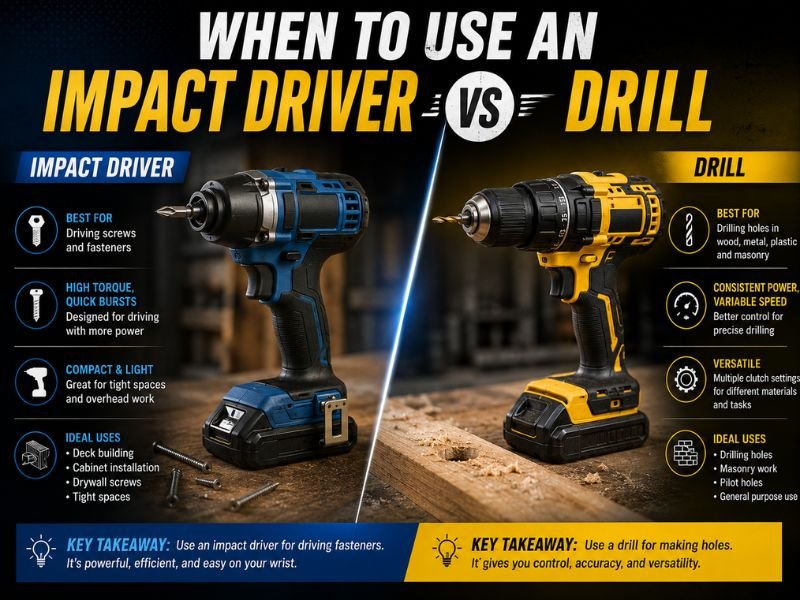
An impact driver is a compact power tool designed primarily for driving fasteners.
It rotates like a drill during light work. When resistance increases, an internal hammer-and-anvil mechanism delivers repeated rotational impacts. These short twisting blows allow the tool to continue driving stubborn fasteners without relying solely on continuous rotational force.
Most cordless impact drivers use a 1/4-inch hex quick-change collet instead of a conventional drill chuck. This makes changing driver bits, nut setters, and compatible hex-shank accessories fast.
Impact drivers are especially effective when a screw becomes difficult to turn as it penetrates deeper into wood or another resistant material.
What Is a Drill?
A drill/driver is a general-purpose rotary power tool designed for both drilling holes and driving fasteners.
Most cordless drills use a three-jaw chuck that can tighten around drill bits and accessories with different shank sizes. This gives the drill substantially greater bit versatility than a conventional 1/4-inch hex impact driver.
Many drill/drivers also provide:
- Multiple speed ranges
- Variable-speed triggers
- Adjustable clutch settings
- Drill-only mode
For example, Bosch drill/drivers use multi-speed gearing for controlled high-torque driving or faster drilling, while some models provide numerous clutch settings for precise screw driving.
That level of control is one reason a drill remains the better choice for precision work.
Impact Driver vs Drill: Main Differences
| Feature | Impact Driver | Drill/Driver |
| Main purpose | Driving fasteners | Drilling and controlled driving |
| Bit holder | Usually 1/4-inch hex collet | Adjustable chuck |
| Power delivery | Rotation plus rotational impacts | Smooth continuous rotation |
| Long screws | Excellent | Good, depending on tool and fastener |
| Precision drilling | Limited | Excellent |
| Delicate screws | Less ideal | Better |
| Bit compatibility | Mostly hex-shank | Wide range of bit shanks |
| Repetitive fastening | Excellent | Good |
| Noise | Generally louder under impact | Usually quieter |
| Clutch control | Model-dependent | Common on drill/drivers |
Bosch specifically notes that impact drivers use a hammer-and-anvil mechanism for high-force fastening and generally accept 1/4-inch hex-shank bits, while drills are more versatile for general-purpose drilling and lighter fastening.
When To Use an Impact Driver
An impact driver makes the most sense when the job is primarily about fastening rather than producing precise holes.
Driving Long Screws
Long screws create increasing resistance as they enter the material.
An impact driver’s rotational impact mechanism helps maintain driving force as resistance rises. This makes it particularly useful for framing screws, deck screws, and other long fasteners used in construction and remodeling. Bosch lists long screws and structural-style fasteners among appropriate impact-driver applications.
Driving Lag Bolts and Heavy Fasteners
An impact driver can be useful for appropriately sized lag bolts and similar heavy fasteners, particularly in wood construction.
Its repeated rotational impacts provide greater fastening capability than relying on smooth drill rotation alone.
For large automotive lug nuts and heavy mechanical fasteners, however, an impact wrench is a different tool and is generally more appropriate. Impact drivers commonly use 1/4-inch hex drive systems, while impact wrenches use larger square drives and are intended for heavier nuts and bolts.
Building a Deck
Deck construction is a classic impact-driver job because it can involve driving hundreds of screws.
The tool’s compact body, quick bit changes, and high fastening force are useful when installing decking, blocking, rail components, and other screwed connections.
A drill is still valuable on the same project for pilot holes and other drilling operations.
Framing and Construction
An impact driver is useful when assembling framing or other construction components with structural screws and similar fasteners.
Bosch specifically identifies framing and other repetitive, high-force fastening work among common impact-driver applications.
Working in Tight Spaces
Impact drivers are often designed with compact heads, which can make them convenient between studs, inside cabinets, or around framing where a longer tool becomes awkward.
Compact size is one of the advantages manufacturers emphasize in current impact-driver designs.
Repetitive Screw Driving
If your project involves driving fastener after fastener, an impact driver can reduce how much effort is required to keep the bit turning under heavy resistance.
The rotational impact action also produces less continuous reaction torque than applying the same type of high load through uninterrupted rotation.
When To Use a Drill Instead
A drill is usually the better tool when hole quality, bit compatibility, or fine control is more important than aggressive fastening.
Drilling Pilot Holes
Use a drill for clean, accurately positioned pilot holes.
You can choose from standard twist bits, brad-point bits, countersink bits, and many other bit styles without being restricted to a 1/4-inch hex shank.
Drilling Holes in Wood
For normal holes in lumber, plywood, cabinetry, or furniture components, a drill is usually the first choice.
The conventional chuck accepts common woodworking drill bits, and the smooth rotation gives you better control when starting and finishing the hole.
Drilling Metal
A drill is generally more appropriate for controlled hole drilling in metal.
Drill speed, pressure, bit selection, and lubrication where applicable can be managed more predictably with smooth rotary action than with an impact mechanism.
An impact driver can technically drill with certain compatible hex-shank bits, but Bosch describes impact drivers as primarily fastening tools rather than tools intended for precision hole drilling.
Driving Small Screws
For cabinet hardware, hinges, electronics enclosures, furniture, and other small fasteners, a drill/driver often provides better control.
Its clutch can limit how much torque reaches the screw. This helps reduce the chance of sinking the fastener too deeply or damaging the workpiece.
Bosch offers drill/drivers with multiple clutch settings specifically for controlled screw driving.
Countersinking Screws
If you need the screw head to stop at a very specific depth, a drill/driver’s clutch and smoother torque delivery are generally easier to control.
An impact driver can drive quickly, but speed and impact force are not always desirable when the finish matters.
Can You Use an Impact Driver as a Drill?
Yes, but with limitations.
An impact driver can drill holes when you use compatible hex-shank drill bits or an appropriate accessory. DEWALT states that an impact driver can be used for drilling with impact-ready bits and also describes chuck-adapter options for certain uses.
However, using an impact driver for drilling does not make it a complete replacement for a drill.
A conventional impact driver generally:
- Accepts 1/4-inch hex accessories
- Has less bit compatibility
- Is optimized for fastening
- Is less suitable for precision drilling
Bosch specifically advises that impact drivers generally do not accept ordinary round-shank drill bits and are not intended as precision hole-drilling tools.
So if you occasionally need a quick hole and have the correct hex-shank bit, the impact driver can work. If drilling holes is a major part of the project, use a drill.
Can You Use a Drill as an Impact Driver?
A drill can drive many of the same screws, but it does not become an impact driver.
With the correct bit, a drill/driver can handle:
- Wood screws
- Machine screws
- Small lag screws
- General hardware
- Light construction fasteners
The difference appears as resistance increases.
A drill continues applying smooth rotational force. An impact driver begins adding rapid rotational blows to help turn the fastener.
For occasional household screw driving, a drill may be all you need. For long or repetitive fasteners, the impact driver becomes much more useful.
Impact Driver vs Drill for Woodworking
For fine woodworking, the drill usually gets more use.
Use the drill for:
- Pilot holes
- Doweling holes
- Countersinking
- Cabinet hardware
- Controlled screw depth
- Precise boring
Use the impact driver for:
- Shop construction
- Workbench assembly
- Large structural screws
- Heavy jigs
- Long screws where appearance is less sensitive
For finished furniture, aggressive impact driving can be unnecessary. Control is usually more valuable than maximum fastening force.
Impact Driver vs Drill for Deck Screws
For deck screws, an impact driver is normally the more efficient fastening tool.
The repetitive nature of deck construction plays directly to its strengths: high-force driving, compact size, and quick bit changes.
Use the drill alongside it to make pilot holes where needed. Keeping a drill bit in the drill and a driver bit in the impact driver also eliminates repeated bit changes.
Impact Driver vs Drill for Lag Screws
For many wood lag screws, the impact driver has the advantage because of its rotational impacts.
However, fastener size matters.
Very large lag bolts, nuts, and automotive fasteners can exceed what a typical 1/4-inch hex impact driver is intended to handle. A proper impact wrench or another correctly sized tool may be required. DEWALT distinguishes impact drivers from impact wrenches on exactly this basis: impact drivers are aimed at smaller screw-type fastening, while impact wrenches are built around larger square drives for heavier nuts and bolts.
Impact Driver vs Hammer Drill
These tools are frequently confused.
An impact driver produces rotational impacts primarily to drive fasteners.
A hammer drill adds a hammering action intended to help drill into masonry-type materials.
A standard drill/driver provides smooth rotation for drilling and controlled fastening.
Therefore, choosing an impact driver because you need to drill concrete or masonry is usually a category mistake. Use the drilling tool and bit system specified for the masonry application instead.
Do Impact Drivers Strip Screws?
They can, especially when excessive power, poor bit fit, or incorrect technique is involved.
However, the rotational impact mechanism can also help maintain fastener movement under load without requiring the operator to fight as much continuous reaction torque. DEWALT notes that this impact action can reduce reaction torque and help with difficult screw driving.
To reduce screw-head damage:
- Use the correct bit type and size.
- Keep the bit aligned with the fastener.
- Apply sufficient forward pressure.
- Use a lower speed or drive mode when available.
- Stop as the fastener reaches the intended depth.
- Use accessories suitable for impact-driver loads.
Should Impact-Rated Bits Be Used?
For impact driving, use bits and accessories designed for the loads generated by impact tools.
DEWALT specifically recommends impact-ready bits when using an impact driver for drilling-type applications, while Bosch specifies compatible 1/4-inch hex-shank accessories for its impact drivers.
Standard bits may fit physically, but compatibility alone does not mean they are designed for repeated impact loading.
Which Tool Should a Beginner Buy First?
If you can buy only one tool for general household use, a cordless drill/driver is usually the more versatile first purchase.
It can drill holes and drive most everyday screws, and its adjustable chuck accepts a wide variety of accessories.
An impact driver becomes especially valuable once your projects regularly involve:
- Deck building
- Framing
- Long screws
- Structural fasteners
- Repetitive assembly
- Dense lumber
- High-resistance fastening
For serious DIY work, remodeling, or construction, owning both is often more efficient than trying to make either tool perform every task.
Frequently Asked Questions
When Should I Use an Impact Driver Instead of a Drill?
Use an impact driver when driving long screws, structural fasteners, lag bolts, or many fasteners repeatedly. Its rotational impact mechanism is designed for high-force fastening.
Is an Impact Driver Better Than a Drill?
Neither is universally better. An impact driver is better for demanding fastening, while a drill is better for versatile and precise hole drilling. Bosch describes this same division between high-force fastening and general-purpose drilling.
Can an Impact Driver Drill Holes?
Yes, with compatible hex-shank or impact-ready drill bits. However, impact drivers are primarily fastening tools and generally offer less drilling versatility than drills.
Can I Use an Impact Driver for Regular Screws?
Yes. An impact driver can drive ordinary screws, but its extra fastening force may be unnecessary for small or delicate hardware. A drill/driver with clutch control can provide more precise screw-depth control.
Do I Need Both a Drill and an Impact Driver?
Not for every project, but the combination is convenient. The drill can stay fitted with a drill bit for pilot holes while the impact driver stays fitted with a driver bit for screws.
What Is the Main Difference Between an Impact Driver and a Drill?
The main difference is power delivery and bit holding. A drill uses smooth rotational force through an adjustable chuck, while an impact driver adds rotational impacts and commonly uses a 1/4-inch hex collet.
Is an Impact Driver the Same as an Impact Wrench?
No. Impact drivers typically use a 1/4-inch hex drive for screw-type fasteners. Impact wrenches generally use larger square drives and are intended for heavier nuts and bolts.
Is an Impact Driver Good for Woodworking?
It is useful for large fasteners, jigs, workbenches, and shop construction. For precise pilot holes, countersinking, small screws, and finished furniture, a drill/driver generally provides better control.
Conclusion
Knowing When To Use an Impact Driver VS Drill is mainly about separating high-force fastening from controlled drilling. Choose the impact driver for long screws, structural fasteners, lag screws, repetitive fastening, and jobs where resistance makes a normal drill harder to manage. Choose the drill for pilot holes, precision drilling, small screws, countersinking, and projects requiring broad bit compatibility or fine control.
A drill is usually the more versatile single tool, while an impact driver becomes highly valuable when fastening gets heavier or more repetitive. For many DIYers and professionals, the most efficient approach is to own both: drill the hole with the drill, then drive the fastener with the impact driver.