Will a Pancake Compressor Run an Impact Wrench?
Yes, a pancake compressor can run some pneumatic impact wrenches for short bursts, but many small pancake compressors cannot supply enough continuous airflow to keep a full-size impact wrench working at maximum performance.
The important specification is not simply the compressor’s tank size or maximum PSI. You need to compare the compressor’s SCFM at the impact wrench’s required operating pressure with the wrench’s air consumption. A small 6-gallon pancake compressor may have enough stored air to loosen a few fasteners, but the tool can quickly use air faster than the compressor pump replaces it.
That distinction explains why a pancake compressor may seem perfectly capable during the first few trigger pulls yet begin losing performance during repeated or sustained impact work.
Will a Pancake Compressor Run an Impact Wrench?
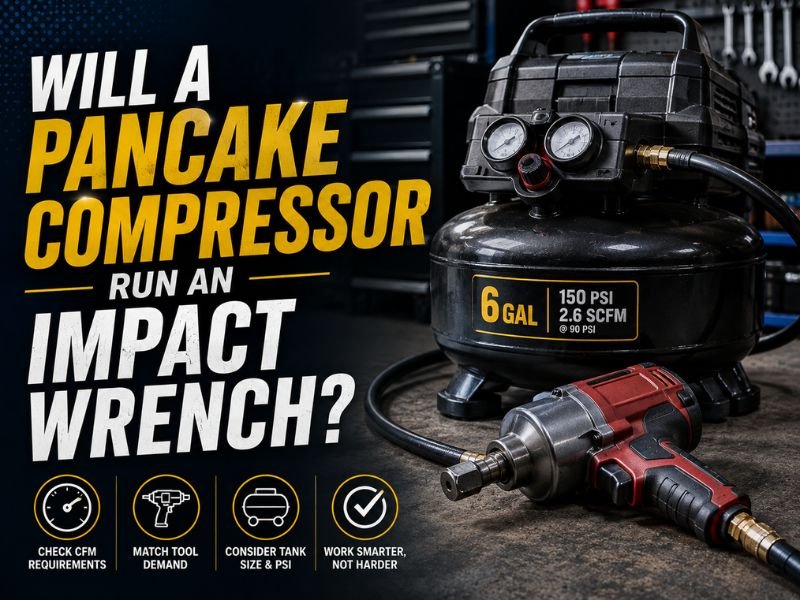
In many cases, yes—but with limitations.
A pancake compressor is most practical with an impact wrench when the job involves:
- Short trigger bursts
- Occasional fastener removal
- A relatively low-air-consumption wrench
- Plenty of recovery time between uses
- Proper hose and fittings
It becomes a poor match when you need:
- Long periods of continuous impacting
- Repeated automotive work
- High-output 1/2-inch impact wrenches
- Large 3/4-inch pneumatic impacts
- Rapid removal of many stubborn fasteners
A small compressor can store compressed air in its tank, so the impact wrench may initially receive considerably more airflow than the compressor pump could supply continuously. Once that reserve begins running down, however, the compressor must keep up with the tool’s demand.
If it cannot, performance falls.
Why PSI Alone Does Not Tell You Enough
One of the most common mistakes is looking at a compressor labeled 150 PSI and assuming it must be powerful enough for an impact wrench.
That number describes maximum tank pressure.
It does not describe how much air the compressor can continuously deliver.
Two compressors can both reach 150 PSI but have very different airflow capacities.
For an impact wrench, you need to pay attention to two separate specifications:
PSI
PSI is air pressure.
Many pneumatic impact wrenches are designed to operate around a specified working pressure, commonly near 90 PSI.
CFM or SCFM
CFM describes airflow volume.
SCFM is airflow referenced to standardized conditions and is commonly used on compressor specifications.
An impact wrench needs sufficient pressure and sufficient airflow.
A compressor that reaches the correct PSI but cannot deliver enough SCFM may still leave the wrench underpowered during sustained use.
How Much Air Does an Impact Wrench Need?
There is no single CFM requirement for every impact wrench.
Air consumption depends on:
- Wrench size
- Internal motor design
- Impact mechanism
- Tool efficiency
- Operating pressure
- How long the trigger is held
- Whether the tool is free-spinning or impacting against a load
A compact 3/8-inch pneumatic wrench may require considerably less air than a heavy-duty 1/2-inch or 3/4-inch wrench.
Even among 1/2-inch impact wrenches, requirements can differ significantly.
This is why you should always check the air-consumption specification for the exact wrench rather than relying solely on drive size.
Average CFM vs. Air Consumption Under Load
Impact wrench specifications can sometimes be confusing because manufacturers may provide more than one airflow number.
You may see:
- Average air consumption
- Air consumption at load
- Free-air consumption
These are not necessarily interchangeable.
Average Air Consumption
This typically estimates airflow based on intermittent tool operation.
An impact wrench is usually not running continuously for an entire minute. You pull the trigger for a few seconds, release it, reposition the tool, and continue.
Because of that intermittent usage pattern, average consumption may appear relatively modest.
Air Consumption at Load
This represents how much air the tool can consume while actually operating under demanding conditions.
That number can be much higher.
This is important when a stubborn lug nut requires the wrench to hammer continuously for several seconds.
A small pancake compressor may support the tool’s average intermittent demand reasonably well while still struggling badly during sustained impacting.
How Much Air Does a Pancake Compressor Produce?
Many portable pancake compressors prioritize:
- Compact size
- Low weight
- Portability
- Nail-gun compatibility
- Easy household use
They are not generally designed as high-airflow shop compressors.
A common small pancake compressor may deliver only a few SCFM at 90 PSI.
That is adequate for many pneumatic nailers because nail guns use small bursts of air rather than continuous airflow.
An impact wrench is different.
When its trigger is held, it can consume a large amount of air continuously.
This is why a compressor that performs perfectly with a brad nailer can feel inadequate with an impact wrench.
Why Tank Size Matters
Tank size still matters—it just is not the entire story.
Think of the tank as an air reservoir.
Before you begin working, the compressor fills the tank with compressed air.
When you pull the impact wrench trigger:
- Air leaves the tank.
- The tool uses that air.
- Tank pressure begins dropping.
- The compressor pump starts replacing the used air.
- If tool demand exceeds pump output, tank pressure continues to fall.
A larger tank gives you a larger reserve.
A smaller tank empties more quickly.
But once either tank begins running low, the compressor pump’s airflow becomes the limiting factor.
That is why adding tank capacity does not increase the compressor’s actual SCFM.
Why a 6-Gallon Pancake Compressor Can Still Run an Impact Wrench
This is where many people become confused.
Suppose the compressor cannot continuously produce as much air as the impact wrench wants.
Why does the wrench work at all?
Because the tank stores compressed air.
When fully charged, the tank acts as a temporary supply.
For the first few seconds, the wrench may perform quite well.
Then, as the tank pressure drops:
- Tool speed may decrease
- Impacts may become weaker
- Compressor motor starts running
- Recovery time becomes necessary
Once you release the trigger, the compressor can rebuild pressure.
This makes a pancake compressor usable for intermittent impact work, even when it is technically undersized for continuous operation.
Will a 6-Gallon Pancake Compressor Run a 1/2-Inch Impact Wrench?
A 6-gallon pancake compressor can often operate a 1/2-inch impact wrench for brief bursts, but it is usually not an ideal combination for sustained work.
It may be practical when:
- You remove only a few fasteners
- Fasteners break loose quickly
- Wrench air consumption is relatively low
- Tank starts fully charged
- Hose and fittings are properly sized
- You allow recovery time
It becomes frustrating when:
- Lug nuts are heavily rusted
- Fasteners require prolonged impacting
- You need to remove many fasteners quickly
- The impact wrench has high airflow demand
- You use a restrictive hose
- Compressor recovery is slow
For occasional home-garage work, the setup may be acceptable.
For repeated professional automotive work, a higher-SCFM compressor is usually a better match.
Can a Pancake Compressor Remove Lug Nuts?
Possibly.
The compressor itself does not loosen the lug nut—the impact wrench does.
The compressor simply has to supply enough air for the wrench to produce its intended performance.
Whether the lug nut comes loose depends on:
- Impact wrench output
- Available airflow
- Actual pressure at the wrench
- Hose restriction
- Fastener condition
- Corrosion
- How tightly the fastener was installed
A pancake compressor may handle several properly torqued lug nuts if the wrench only needs short bursts.
A seized or over-tightened lug nut may require longer impacting, causing the small tank to drain rapidly.
Therefore, it is inaccurate to say that every 6-gallon compressor will—or will not—remove lug nuts.
The combination of compressor, wrench, hose, and fastener matters.
Can a Pancake Compressor Run a 3/8-Inch Impact Wrench?
Often, a compact 3/8-inch impact wrench can be a better match for a pancake compressor than a high-output 1/2-inch or 3/4-inch wrench.
However, drive size alone does not determine air consumption.
Some compact tools are very efficient, while others still demand substantial airflow.
Always compare:
Impact wrench air requirement vs. compressor SCFM at the required pressure.
Do not assume that every 3/8-inch wrench will automatically work well with a small compressor.
Can a Pancake Compressor Run a 3/4-Inch Impact Wrench?
A small pancake compressor is generally a poor match for a heavy-duty 3/4-inch pneumatic impact wrench.
Large impact wrenches are commonly designed for demanding applications such as:
- Heavy trucks
- Large suspension components
- Industrial equipment
- Construction machinery
These tools may consume considerably more air than a portable pancake compressor can continuously supply.
A fully charged small tank might power one briefly, but runtime can be extremely short.
For sustained use of a large pneumatic impact, compressor airflow should be matched much more closely to the tool.
Is 150 PSI Enough for an Impact Wrench?
Having a compressor capable of 150 PSI does not automatically make it suitable.
If the wrench is designed to operate at a lower regulated pressure, you normally set the compressor regulator accordingly.
The more important question becomes:
How much airflow can the compressor supply at that working pressure?
Maximum tank PSI primarily affects how much compressed air can be stored in the tank and the compressor’s operating range.
It does not mean you should supply the wrench with maximum tank pressure.
Operate pneumatic tools according to their specified pressure requirements.
Can You Increase PSI to Compensate for Low CFM?
No.
Increasing pressure beyond the impact wrench’s rated operating pressure is not a proper solution for inadequate airflow.
It can:
- Increase tool wear
- Damage internal components
- Stress fittings and hoses
- Create unsafe operating conditions
If the tool is not receiving enough airflow, correct the airflow problem.
That may involve:
- Larger compressor
- Larger hose
- Less restrictive couplers
- Shorter hose
- Repairing leaks
Do not simply increase pressure beyond the manufacturer’s limit.
Does Air Hose Size Matter?
Yes, considerably.
An impact wrench can be sensitive to airflow restrictions.
A long, narrow hose may create enough pressure drop to noticeably reduce performance.
Factors include:
- Hose inside diameter
- Hose length
- Coupler size
- Fitting design
- Regulator capacity
Many full-size pneumatic impact wrenches are better served by a 3/8-inch air hose than a narrow 1/4-inch hose.
However, use the hose size specified for your exact tool.
A small compressor paired with an undersized hose has two limitations at once:
- Limited airflow from the compressor
- Additional airflow restriction from the hose
That can make the wrench feel much weaker than expected.
Do Quick-Connect Fittings Affect Impact Wrench Power?
They can.
Every fitting creates some resistance to airflow.
Cheap or unusually narrow quick-connect couplers can restrict the amount of air reaching the wrench.
This matters more with high-consumption pneumatic tools than with small nailers.
If the compressor should theoretically be close to adequate but the wrench still feels weak, inspect the entire air path:
- Compressor outlet
- Regulator
- Coupler
- Hose
- Tool connector
A large hose cannot compensate for a severely restrictive fitting.
Why Does My Impact Wrench Start Strong and Then Get Weak?
This is a classic sign that tank reserve is being used faster than the compressor can replace it.
Initially:
- Tank is full
- Pressure is high
- Airflow is strong
After several seconds:
- Tank pressure falls
- Compressor starts
- Pump cannot match tool consumption
- Available airflow decreases
The wrench then loses speed or impact strength.
Release the trigger and allow the tank to recover.
If performance returns after recovery, compressor capacity is likely part of the issue.
Other Reasons an Air Impact Wrench Feels Weak
The compressor is not always the problem.
Check for:
Low Regulator Setting
The tank may be full while outlet pressure is set too low.
Small Hose
An undersized hose can restrict airflow.
Long Hose
Longer hose runs increase pressure loss.
Restrictive Couplers
Small passages reduce usable airflow.
Air Leaks
Leaks waste compressor capacity before air reaches the wrench.
Poor Tool Maintenance
Some pneumatic impact wrenches require regular lubrication.
Worn Impact Mechanism
An old or damaged wrench may produce weak impacts even with adequate air.
Fastener Condition
A heavily corroded bolt may simply exceed what the tool can remove.
Signs Your Pancake Compressor Is Too Small
You may need more compressor capacity if:
- Wrench works well only for the first few seconds
- Tank pressure drops rapidly
- Compressor runs almost constantly
- You must pause after every fastener
- Tool speed falls while the trigger is held
- Impact strength improves only after tank recovery
- Removing several lug nuts becomes frustratingly slow
These symptoms do not necessarily mean the compressor is defective.
They may simply show that the pneumatic tool requires more air than the pump can continuously provide.
How to Get Better Performance From a Pancake Compressor
If you already own a pancake compressor, several practical steps can help you get the best possible performance.
Start With a Full Tank
Allow the compressor to reach full cut-out pressure before beginning.
Set the Correct Regulated Pressure
Use the impact wrench manufacturer’s recommended operating pressure.
Use the Correct Hose Diameter
Avoid unnecessarily restrictive hoses.
Keep Hose Length Reasonable
Do not use a very long hose when a shorter one will reach comfortably.
Check Fittings
Use fittings with adequate internal flow.
Repair Leaks
Listen for escaping air around:
- Couplers
- Hose ends
- Regulator
- Tool inlet
Use Short Bursts
Short trigger pulls make better use of a small tank than holding the trigger continuously.
Allow Recovery
Give the compressor time to refill the tank between demanding fasteners.
Maintain the Wrench
Follow the tool’s lubrication and service instructions.
Will Adding a Bigger Air Tank Help?
It can improve short-term runtime.
An auxiliary tank adds more stored compressed air.
That means the impact wrench can run longer before the system pressure falls significantly.
But there is an important limitation:
A larger tank does not increase compressor SCFM.
If the compressor pump produces less air than the wrench consumes, the system will still eventually fall behind.
A larger tank simply delays that moment.
It may also take longer for a small compressor to refill the expanded air capacity.
So an auxiliary tank can improve burst performance, but it does not transform a small compressor into a high-output shop compressor.
What Size Compressor Is Better for an Impact Wrench?
Do not choose a compressor only by gallons.
Instead:
- Find the wrench’s required operating pressure.
- Find its air-consumption specification.
- Check compressor SCFM at that pressure.
- Consider how long you will use the tool at a time.
- Choose enough tank capacity for the desired runtime.
For occasional short bursts, a smaller compressor may be practical.
For repeated automotive work, higher SCFM and more storage generally provide a better experience.
For continuous professional pneumatic-tool use, prioritize a compressor capable of supplying the tool’s required airflow without relying mainly on stored tank air.
Pancake Compressor vs. Larger Compressor
| Feature | Pancake Compressor | Larger Compressor |
| Portability | Excellent | Usually lower |
| Air storage | Limited | Greater |
| Continuous airflow | Usually lower | Often higher |
| Short impact bursts | Often workable | Easy |
| Repeated lug work | Limited | Better |
| Long impact cycles | Poor match | Better suited |
| Recovery pauses | Frequent | Usually less frequent |
Tank size alone does not guarantee performance, but larger compressors designed for pneumatic tools commonly provide higher airflow as well as greater storage.
Pancake Compressor vs. Cordless Impact Wrench
If your only compressor is a small pancake model, a cordless impact wrench can avoid the airflow and recovery limitations of pneumatic tools.
A cordless model does not require:
- Air hose
- Compressor recovery
- Pneumatic couplers
- Compressor SCFM matching
That does not automatically make cordless better for every application.
Pneumatic impact wrenches remain useful in shops with properly sized compressed-air systems.
But for occasional home-garage use, a cordless wrench can be simpler when the existing compressor is undersized.
Common Mistakes When Matching a Compressor and Impact Wrench
Looking Only at Tank Gallons
Tank capacity tells you storage, not continuous airflow.
Looking Only at Maximum PSI
Pressure alone does not tell you how much air reaches the tool.
Ignoring SCFM at Working Pressure
This is one of the most important matching specifications.
Comparing Different CFM Ratings Incorrectly
Average and loaded air consumption can represent different operating conditions.
Using a Small Hose
Airflow restrictions can make an otherwise workable setup perform poorly.
Increasing Pressure Too Far
Higher pressure is not a substitute for adequate airflow.
Assuming a Bigger Tank Increases SCFM
It increases reserve air, not pump output.
Judging Compatibility From One Trigger Pull
A small compressor may power the wrench strongly for a few seconds but fail to sustain it.
Quick Compatibility Checklist
Before using a pancake compressor with an impact wrench, check:
- Required tool PSI
- Impact wrench CFM or SCFM
- Compressor SCFM at that pressure
- Tank capacity
- Hose inside diameter
- Hose length
- Coupler restriction
- Regulator setting
- Air leaks
- Whether use will be intermittent or continuous
If the compressor’s continuous airflow is lower than the tool’s demand, expect reduced runtime and additional recovery pauses.
Frequently Asked Questions
Will a Pancake Compressor Run an Impact Wrench?
Yes, a pancake compressor can run many pneumatic impact wrenches for short bursts, but small models may not supply enough continuous airflow for sustained use.
Can a 6-Gallon Pancake Compressor Run a 1/2-Inch Impact Wrench?
Often for intermittent work. Whether it performs well depends on compressor SCFM, wrench air consumption, hose size, and how long the trigger is held.
Is a 6-Gallon Compressor Big Enough for Lug Nuts?
It may be adequate for occasional lug-nut removal if the wrench breaks the fasteners loose quickly. Repeated or stubborn lug work can exhaust the available air rapidly.
How Many CFM Does an Impact Wrench Need?
It varies by model. Check the manufacturer’s air-consumption specification for the exact wrench rather than assuming all tools of the same drive size use the same amount of air.
Is 2.6 SCFM Enough for an Impact Wrench?
It may support brief intermittent use of some impact wrenches, but it is below the continuous airflow demand of many full-size pneumatic impacts.
Is 150 PSI Enough for an Impact Wrench?
Maximum compressor PSI is not the main compatibility measurement. The compressor must also provide adequate airflow at the wrench’s specified operating pressure.
Does Tank Size Matter for an Impact Wrench?
Yes. A larger tank provides more stored air and longer burst runtime. It does not increase the compressor pump’s SCFM output.
Can a Pancake Compressor Run a 3/8-Inch Impact Wrench?
Often, depending on the specific wrench’s airflow requirement. A compact 3/8-inch tool can be easier to supply than a high-demand impact, but specifications still need to be compared.
Can a Pancake Compressor Run a 3/4-Inch Impact Wrench?
A small pancake compressor is generally poorly suited to sustained operation of a high-demand 3/4-inch pneumatic impact wrench.
Why Does My Impact Wrench Lose Power?
Possible causes include falling tank pressure, insufficient compressor SCFM, low regulator pressure, undersized hose, restrictive fittings, leaks, or tool maintenance problems.
Does a 3/8-Inch Air Hose Help an Impact Wrench?
A properly sized hose can improve airflow compared with an undersized hose. Use the minimum hose diameter recommended for your particular wrench.
Will a Bigger Air Tank Make My Impact Wrench Work Better?
It can extend the amount of time you can use the wrench before pressure drops, but it does not increase the compressor’s continuous airflow capacity.
What Size Compressor Do I Need for a Pneumatic Impact Wrench?
Choose based primarily on the wrench’s required airflow at its specified working pressure, then select enough tank capacity for the amount of continuous runtime you need.
Conclusion
If you’re asking “will a pancake compressor run an impact wrench,” the answer is yes for many short, intermittent jobs, but a small pancake compressor may not supply enough continuous airflow to keep a full-size pneumatic impact wrench operating at maximum performance.
The reason is simple: the compressor tank stores air, allowing the wrench to operate strongly for a short period even when the pump itself cannot continuously replace air as fast as the wrench consumes it. Once that reserve falls, the tool may begin losing speed and impact strength until the compressor recovers.
That is why compressor selection should not be based only on tank gallons or maximum PSI.
Pay closer attention to:
- Compressor SCFM at working pressure
- Impact wrench air consumption
- Hose diameter
- Fitting restrictions
- Tank size
- Intended duty cycle
A 6-gallon pancake compressor can be perfectly usable for a few short impact-wrench bursts around a home garage. It becomes much less convenient when removing many lug nuts, working on stubborn fasteners, or running a high-air-demand wrench continuously.
A larger tank can extend your burst runtime, but it cannot increase the pump’s SCFM. Likewise, increasing pressure beyond the wrench’s rating is not a proper solution for low airflow.
For occasional impact-wrench use, a pancake compressor can work. For repeated or sustained pneumatic impact work, choose a compressor whose continuous SCFM is properly matched to the wrench rather than relying on stored tank air alone.