How Many Decibels Is an Impact Wrench: Full Guide and Key Facts
An impact wrench commonly produces about 85 to 105 decibels A-weighted (dBA) during operation, although some pneumatic and high-torque models can approach or exceed 110 dBA under load. The exact reading depends on the tool, power source, operating speed, load, and distance from the listener.
That range is useful, but it is not a universal rating. A manufacturer may measure sound at a specified test position, while a phone app may measure it beside the operator’s ear, near the exhaust, or in a reflective garage. Those different conditions can produce noticeably different numbers, even when the same wrench is running.
This guide explains how impact-wrench noise is measured, why cordless, pneumatic, and electric models differ, and how distance and surrounding surfaces change what you hear. It also covers hearing protection, practical comparisons with other tools, measurement limitations, and the point at which repeated exposure becomes a safety concern. By the end, you can interpret a published sound rating, make a reasonable estimate for an unlisted tool, and decide what protection and test method are appropriate.
Typical Decibel Range for an Impact Wrench
Most impact wrenches fall somewhere between 85 and 110 dBA while fastening or removing hardware. A compact cordless wrench used briefly on light-duty work may be near the lower end, while a high-torque pneumatic wrench operating continuously in a shop can be much louder.
Typical operating ranges are useful as general estimates, not as guaranteed specifications:
- Cordless impact wrenches: approximately 85–100 dBA, depending on speed, torque mode, and load.
- Corded electric models: approximately 90–105 dBA, with motor and impact-mechanism noise contributing to the total.
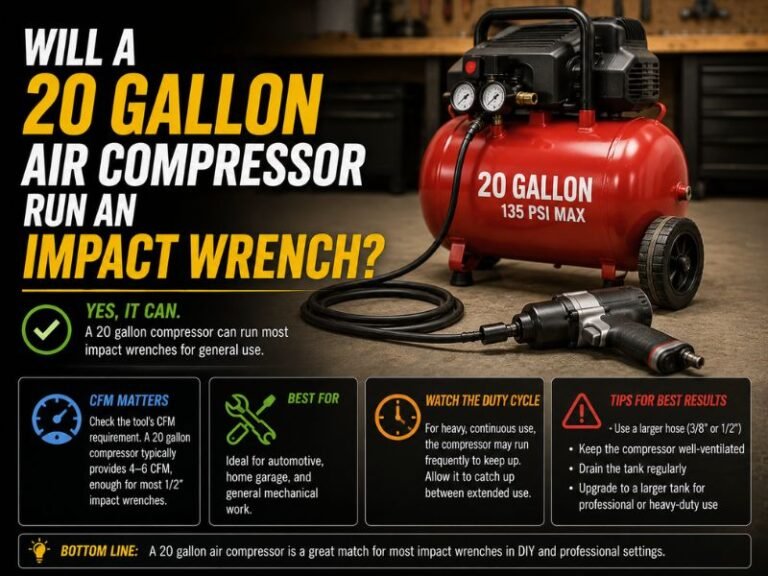
- Pneumatic impact wrenches: approximately 95–110 dBA, especially when compressed-air exhaust is prominent.
- High-torque or industrial tools: potentially above 105 dBA in demanding applications or close-range measurements.
The characteristic sharp hammering sound is often more important than the average number alone. Impact mechanisms create repeated transients, and a tool that averages 95 dBA may still produce brief peaks that feel substantially louder.
Why Impact Wrench Noise Varies
An impact wrench does not make one fixed sound. Its noise changes as the motor accelerates, the hammer mechanism strikes, the fastener resists rotation, and the tool reaches its torque limit.
Load and torque demand
A wrench usually becomes louder when it is working against significant resistance. Free-spinning produces motor, gear, and airflow noise, but tightening a stubborn lug nut adds repeated hammer impacts and vibration through the socket and fastener.
When the fastener is already loose, the wrench may sound less aggressive. When a rusted bolt refuses to move, the hammering may continue for several seconds, increasing both the perceived loudness and the operator’s exposure time.
Tool design and power source
Cordless models often avoid the continuous air blast associated with pneumatic tools, which can make them quieter in some situations. However, a powerful battery tool can still generate substantial mechanical impact noise, and a compact design does not automatically mean a safe sound level.
Pneumatic wrenches have two major sound sources: the impact mechanism and compressed-air exhaust. The exhaust can create a steady hiss or blast that raises the overall sound pressure, particularly when the tool is used close to a wall or inside a vehicle wheel well.
Socket, fastener, and work surface
The attached socket and the material being worked can alter the sound. A loose socket, thin metal panel, wheel assembly, or hollow frame may resonate and amplify the hammering, while a heavier assembly may absorb more vibration.
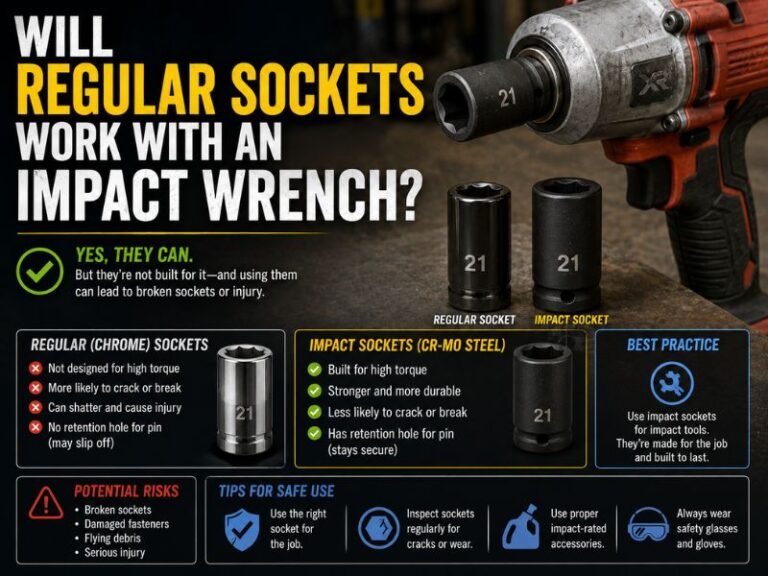
Accessories also matter. Extensions, adapters, worn sockets, and poorly fitting attachments can vibrate or rattle. Besides adding noise, they can create a mechanical hazard if they fail under torque.
Distance Changes the Decibel Reading
Sound level drops as you move away from the source. Under ideal free-field conditions, sound pressure decreases by roughly 6 dB each time the distance from the source doubles. A reading taken 1 foot away can therefore be much higher than one taken several feet away.
This rule is only an approximation for real workplaces. Walls, floors, ceilings, vehicles, tool cabinets, and concrete surfaces reflect sound, so a garage or shop may remain loud even after you step away from the wrench.
The operator is often exposed to a particularly unfavorable position because the tool is held at arm’s length near the head. A person standing several feet away may record a lower level than the person actively using the wrench.
For a meaningful comparison, note all of the following:
- The distance between the microphone and the tool.
- Whether the wrench was free-spinning or under load.
- The tool’s operating mode and speed setting.
- Whether the measurement was indoors, outdoors, or inside a vehicle area.
- Whether the value was an average, maximum, or peak reading.
dB, dBA, and Peak Sound Levels
Decibels describe a ratio, not a simple linear unit. An increase of 10 dB represents ten times the sound intensity, although people commonly perceive it as roughly twice as loud under comparable conditions.
Most workplace and consumer sound discussions use dBA, meaning the measurement is A-weighted. The A-weighting curve roughly reflects the sensitivity of human hearing at moderate sound levels and reduces the influence of frequencies to which the ear is less sensitive.
Some tools list sound power level rather than sound pressure level. These are not interchangeable numbers. Sound pressure level describes what a microphone detects at a particular location, while sound power level describes the acoustic energy emitted by the tool under a defined test method.
A sound-power figure can be higher than a sound-pressure figure without indicating a contradiction. Always check the unit, weighting, test distance, and measurement standard before comparing two specifications.
Peak or maximum readings are also different from average exposure. An impact wrench may produce short, sharp hammer strikes that are captured by a peak setting but diluted in a longer average measurement. Both values can be useful, but they answer different questions.
How Loud Is an Impact Wrench Compared With Other Tools?
An impact wrench is generally louder than a typical household drill or screwdriver, especially when it is loaded. Its repeated hammer blows make it more comparable to other high-noise shop tools than to a small electric driver.
Approximate comparisons can help establish context:
- Quiet conversation: about 50–60 dBA.
- Vacuum cleaner: commonly around 70–80 dBA.
- Small drill under load: often around 80–95 dBA.
- Impact wrench: commonly around 85–110 dBA.
- Many powered saws and grinders: often around 95–110 dBA or higher.
These are broad ranges, not fixed ratings. A poorly maintained drill can be louder than a well-designed impact wrench, and a small wrench working against a seized fastener may exceed the sound level of a larger tool used lightly.
Does an Impact Wrench Require Hearing Protection?
Hearing protection is a sensible precaution whenever an impact wrench sounds loud, is used repeatedly, or operates in an enclosed space. The need becomes more compelling when conversation is difficult at arm’s length, your ears ring afterward, or you must raise your voice to be heard.
Disposable foam earplugs can reduce exposure when inserted correctly. Earmuffs are convenient and can be easier to use consistently, while wearing earplugs and earmuffs together provides additional protection for especially loud or extended work.
Protection should not be treated as permission to ignore the source. Use the lowest practical torque setting, avoid unnecessary hammering, maintain the tool, and move away from reflective surfaces when possible. Limit the time spent operating the wrench continuously rather than allowing repeated long bursts.
In a professional workplace, noise exposure should be evaluated using an appropriate sound-level meter or personal dosimeter rather than relying only on a phone application. Workplace requirements can depend on the measured exposure over time, not simply the loudest instant.
Signs that exposure may be excessive
Temporary muffled hearing, ringing, a feeling of fullness in the ears, or difficulty understanding speech after tool use are warning signs. They indicate that the ears have experienced more sound than they comfortably handled, even if the symptoms later disappear.
Persistent ringing, hearing loss, pain, or one-sided symptoms warrant medical attention. Stop using the tool and seek professional advice if symptoms do not resolve promptly or recur after every work session.
How to Measure an Impact Wrench Accurately
A smartphone sound-meter app can provide a rough indication, but its microphone, calibration, automatic gain control, and case design may limit accuracy. It is useful for spotting obvious differences between tools, not for certifying an occupational exposure level.
For a practical comparison, use a calibrated sound-level meter and keep the test conditions consistent. Place the microphone at a defined distance and height, record both the average and maximum values, and repeat the test while the wrench is free-spinning and under a representative load.
- Choose a clear test area with no unrelated machinery running.
- Set the meter to A-weighting for a general hearing-risk comparison.
- Keep the microphone at the same distance for every tool.
- Record the tool at idle or free-spin and during actual impact operation.
- Repeat the measurement and note unusual reflections or rattling.
- Compare readings only when the test distance and conditions match.
Do not hold a phone or meter directly against the tool, socket, or exhaust outlet. That position does not represent normal operator exposure and may produce an unstable or misleading result.
Ways to Reduce Impact-Wrench Noise
Noise reduction begins with correct tool selection. A smaller wrench may be adequate for the fastener and may produce less impact energy than a high-torque model, but it should never be forced beyond its intended capacity.
Keep the wrench lubricated and maintained according to its instructions. In pneumatic equipment, damaged air fittings, excessive pressure, clogged mufflers, or a leaking exhaust can increase noise and reduce performance.
- Use the correct socket and replace damaged or loose accessories.
- Choose a lower speed or torque mode when the job allows it.
- Avoid repeated impact after the fastener has stopped moving.
- Use barriers or distance to separate other people from the work area.
- Keep doors or openings available when ventilation and safety conditions permit.
- Wear hearing protection during operation, especially indoors.
Never modify an impact wrench with improvised mufflers, blocked vents, or attachments that interfere with cooling or exhaust. Reducing the sound at the expense of overheating, pressure buildup, or tool control can create a greater hazard.
Frequently Asked Questions About Impact-Wrench Decibels
How many decibels is an impact wrench at the operator’s
An operator may experience roughly 90–110 dBA, depending on the model and workload. The actual level changes with the tool’s position, the fastener, nearby surfaces, and whether the wrench is pneumatic or battery powered.
Are cordless impact wrenches quieter than air impact wrenches?
Cordless models are often quieter than pneumatic models, but not always. Cordless tools usually lack the continuous compressed-air exhaust, while their hammer mechanism can still create loud peaks under heavy torque.
Is 100 dB from an impact wrench dangerous?
Repeated or extended exposure to 100 dBA can damage hearing without effective protection. Risk depends on exposure duration and repetition, so hearing protection and shorter operating periods are appropriate at that level.
Why does an impact wrench sound louder inside a garage?
Hard walls and floors reflect sound and increase reverberation. The reflected energy can make the tool seem louder and can keep the sound level elevated around the operator and nearby workers.
Can a phone measure the decibels of an impact wrench?
A phone can estimate the level, but it may not be accurate enough for safety decisions. Microphone limitations, app calibration, distance, and peak-holding behavior can all affect the displayed number.
What is the loudest part of an impact wrench?
The hammer mechanism and, on pneumatic models, the air exhaust are usually the dominant sources. The socket, fastener, and surrounding metal can add vibration and resonance that make the impact sound sharper.
Should hearing protection be worn for short use?
Yes, especially when the wrench is used indoors or under heavy load. Short use is not automatically harmless, and foam plugs or earmuffs are a simple way to reduce avoidable exposure.
Conclusion: Estimate the Level and Protect Your Hearing
Most impact wrenches operate around 85–110 dBA, with the highest readings typically occurring during heavy load, close-range use, or pneumatic operation in reflective spaces. The major limitation is that no single decibel figure applies to every tool or situation.
Check the manufacturer’s measurement conditions, test the wrench at a consistent distance when needed, and wear suitable hearing protection during use. If the tool causes ringing or muffled hearing, stop the exposure, reduce operating time, and arrange a professional assessment for ongoing symptoms.