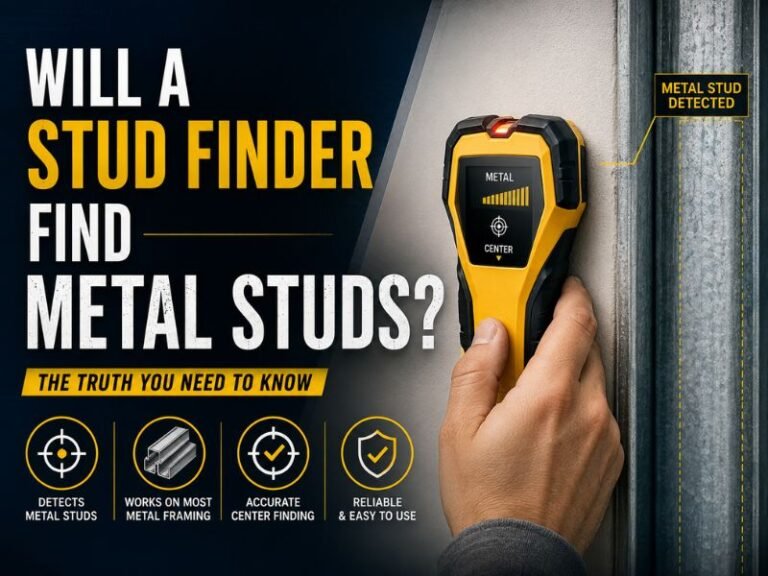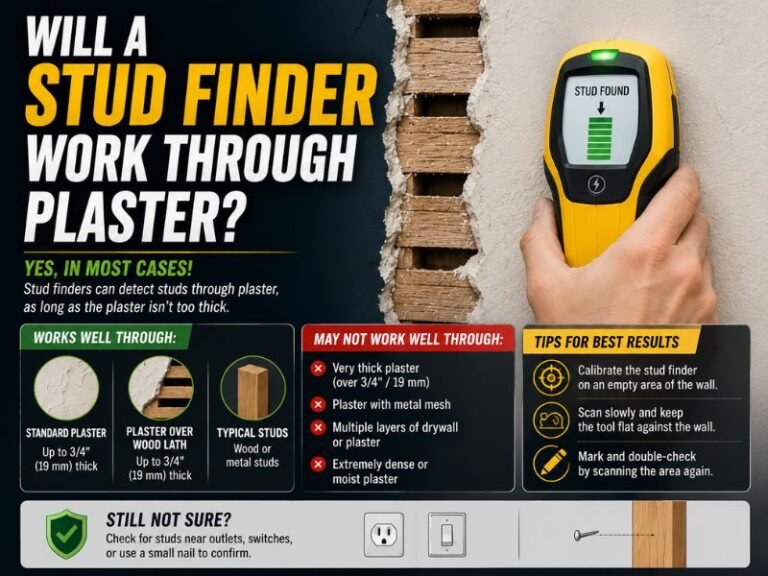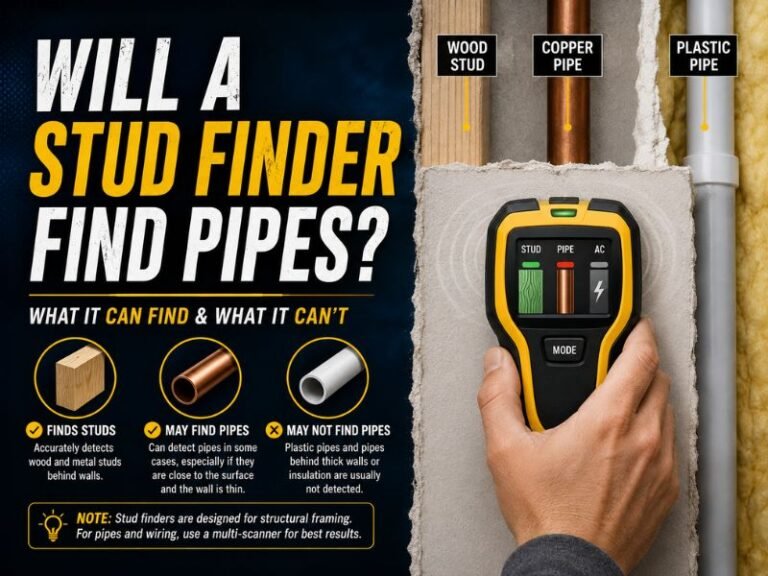
Will a Stud Finder Work Through Vinyl Siding: Explained Clearly
Yes, a stud finder can sometimes detect framing through vinyl siding, but the result is often less reliable than finding the same stud from inside the house. Vinyl is thin, yet the tool may also have to sense through an air gap, housewrap, wood or composite sheathing, insulation, and textured siding. The farther the framing sits behind the siding, the weaker and less consistent the reading becomes.
The counterintuitive detail is that the vinyl itself is usually not the main problem. The bigger issue is the layered wall assembly and the fact that vinyl siding is designed to move slightly, leaving a surface that may flex or sit unevenly under the tool. An electronic finder can mistake changes in thickness or density for a stud, while a magnetic finder may detect siding nails rather than the structural framing behind them.
This article explains which stud finders have the best chance of working, why exterior readings can be misleading, and how to confirm a location before drilling. You will learn when to use an interior reference, how to account for siding seams and fasteners, what changes with insulated vinyl siding, and which precautions matter when attaching something to an exterior wall.
Why Vinyl Siding Makes Stud Detection Difficult
Vinyl siding is a relatively thin cladding material, so it does not automatically block a stud finder. However, the tool does not simply “see through” the siding; it responds to changes in density, capacitance, or magnetic material depending on its design.
A typical exterior wall may contain vinyl panels, a drainage or ventilation space, housewrap, sheathing, wall framing, and insulation. Some homes also have foam-backed or insulated vinyl siding. Each added layer increases the distance between the sensor and the stud and can weaken the reading.
The surface itself can also interfere. Vinyl panels overlap, have ribs or grooves, and may bow slightly between attachment points. If a stud finder is pressed firmly against a flexible panel, the panel can move as the tool passes over it.
That movement changes the sensor’s distance from the wall and can create inconsistent results.
Detection depth is the central limitation. A tool may advertise a maximum scanning depth under ideal conditions, but that does not guarantee reliable results through a particular siding and wall combination. Maximum depth is affected by the type of wall, the sensor, calibration, moisture, insulation, and nearby wiring or metal.
Which Type of Stud Finder Works Best?
Electronic stud finders are generally the most useful option for trying to locate framing behind vinyl siding. They detect changes in material density or electrical capacitance and may identify a wider area than a simple magnet.
Still, electronic models are normally designed for relatively flat interior surfaces. Their calibration assumes that the tool is held steadily against drywall or another consistent material. Vinyl siding creates a less predictable starting surface, so the finder may need several passes and careful confirmation.
Magnetic stud finders can be useful, but they do not detect wood studs directly. They locate ferrous fasteners, such as steel nails or screws. If the siding is attached with metal fasteners near a wall stud, the magnet may reveal a vertical line of attachment points.
That method has an important weakness: a siding fastener is not always a stud marker. Vinyl siding is commonly installed over sheathing, and the panels may be fastened at locations that do not correspond with the center of a framing member. Even when a nail hits framing, the visible fastener pattern may be difficult to distinguish from other attachment points.
Some advanced scanners use multiple modes or deeper scanning technology. These may improve the odds, but no exterior scanner should be treated as proof of a safe structural attachment point without additional verification.
How to Try Scanning Through Vinyl Siding
If an exterior scan is necessary, use a methodical process rather than trusting the first beep. Choose a relatively flat section of siding away from corners, trim, utility fixtures, and obvious overlaps.
- Inspect the area for siding seams, vertical channels, bulges, and loose panels.
- Clean dust or grit from the surface so the tool can move smoothly without scratching the finish.
- Read the finder’s instructions for calibration and maximum sensing depth.
- Calibrate in a clear area according to the manufacturer’s procedure, without starting directly over a suspected stud.
- Move the tool slowly in both directions across the area.
- Mark the center of a repeated signal rather than the first point where the tool reacts.
- Repeat the scan several inches higher or lower to see whether the signal stays vertically aligned.
A genuine framing location should usually produce a reasonably consistent vertical path. A single short beep near a siding edge is less meaningful because the overlap or change in panel shape may be causing the response.
Do not press hard enough to flatten the panel. Excessive pressure can change the sensor’s distance from the wall and can also deform or damage the siding. Holding the tool lightly and keeping it at a consistent angle produces more useful comparisons.
How to Confirm a Suspected Stud Location
Confirmation is more important outdoors than indoors because a false reading can lead to a hole in the siding, a damaged water-resistive barrier, or an attachment that fails under load. Use more than one indication before drilling.
First, measure from a known framing reference. Exterior wall studs are often installed at regular spacing, commonly 16 or 24 inches on center, although older homes, additions, garages, and unusual wall layouts may differ. A corner, window opening, door opening, or visible structural post can provide a starting point, but trim does not always reveal the exact center of the framing.
Next, compare the suspected location with interior measurements if access is available. Locate the stud from inside the room, measure to a corner or opening, and transfer that measurement to the exterior while accounting for the wall’s geometry. This is often more dependable than relying on a sensor through the siding.
A small exploratory hole may confirm the material behind the siding, but drilling through the exterior should be treated as a last verification step rather than a casual test. If the hole is unavoidable, select a location that will be concealed by the final mounting hardware and use a method that does not leave an unprotected path for water.
Do not use the fastener’s resistance alone as proof of a stud. A screw may feel tight in sheathing, blocking, foam, or another solid layer without reaching structural framing. Conversely, a drill can pass through a hollow section before meeting a stud at a different depth.
Why a Reading May Be Wrong
Several conditions can cause false positives or false negatives when scanning from the outside. Understanding them helps distinguish a useful pattern from an isolated signal.
- Metal fasteners: Nails, screws, corner bead, flashing, and utility hardware can trigger electronic or magnetic sensors.
- Siding seams: Overlapping panels change the thickness and shape of the surface, which may create a false edge.
- Insulated siding: Foam backing adds distance and may produce a broad, weak, or uneven response.
- Moisture: Wet materials can alter the electrical characteristics sensed by some electronic finders.
- Wiring and plumbing: Metal pipes, electrical boxes, and cables may be detected or may distort a reading.
- Sheathing variation: Plywood, oriented strand board, fiberboard, and masonry-backed walls do not present the same scanning conditions.
- Loose siding: A panel that flexes or rattles can make it difficult to maintain a consistent sensor distance.
Corner posts and trim are especially troublesome because they may contain metal or several overlapping materials. Avoid using a scan immediately beside them as the only evidence for a stud location.
Can You Find Siding Nails Instead?
In some installations, a strong magnet can reveal the pattern of nails or screws holding vinyl siding. When several attachment points line up vertically, they may indicate the approximate location of a stud or another structural support.
That approach is most useful as a mapping aid, not as a substitute for locating framing. Vinyl siding panels can be fastened through sheathing, and installation practices vary. Fasteners must also be driven loosely enough for the siding to expand and contract, so the visible pattern may not be perfectly centered or obvious.
Run the magnet slowly over a broad area and mark repeated points. If the points form a straight vertical line that agrees with interior measurements or regular stud spacing, confidence increases. If the pattern conflicts with those references, do not assume the magnet is correct.
Best Method for Mounting to a Vinyl-Sided Wall
The correct method depends on the item’s weight, shape, exposure to wind, and whether it needs a watertight connection. A lightweight decoration may need only a siding-compatible hook, while a light fixture, mailbox, camera, or heavy bracket may require a structural attachment.
For many exterior installations, a mounting block designed for vinyl siding is preferable to drilling directly through a panel. The block is shaped or flashed to fit the siding profile and provides a stable surface for the fixture. It can also reduce pressure on the panel and help preserve the siding’s ability to move.
When a screw must enter a stud, locate the framing first and use an attachment method suitable for the wall assembly. The fastener should be long enough to achieve the required embedment in solid framing after passing through the mounting material and siding, but it should not be selected by guesswork.
Do not tightly clamp a screw through vinyl siding. Vinyl expands and contracts with temperature changes, and a rigidly clamped panel can buckle, crack, or develop a distorted hole. The siding should remain able to move as intended around the penetration.
Water management matters as much as structural strength. Seal or flash penetrations according to the fixture and siding system, avoid blocking drainage paths, and do not cover weep openings. If the installation involves a junction box, electrical cable, gas equipment, or a large load, follow applicable electrical and building requirements and consider professional installation.
When an Interior Scan Is the Better Choice
If the wall is accessible from inside, locating the stud indoors is usually the most reliable approach. Drywall presents a more uniform surface, and the distance to the framing is typically shorter and more predictable than from the exterior.
Find the stud from inside, mark its center, and transfer the location outside using fixed references such as a corner, window edge, or door opening. Measure carefully because exterior trim can extend beyond the actual opening, and the interior and exterior reference points may not align perfectly.
For a project where exact placement matters, access inside the wall may be even better. An unfinished basement, attic, garage, crawl space, or removable interior trim can expose framing without requiring a questionable exterior scan.
Interior confirmation is especially important for heavy or safety-critical items. Exterior siding detection is not sufficient by itself for a deck-related attachment, large awning, handrail, satellite equipment, heavy sign, or anything that could injure someone if it pulls loose.
Safety Checks Before Drilling
Finding a stud does not tell you what else is inside that stud bay. Electrical wiring and plumbing can run through or near framing, particularly around outlets, switches, fixtures, bathrooms, kitchens, and mechanical equipment.
Before drilling, identify nearby interior fixtures and shut off power when working near electrical components. A stud finder with wire detection may help, but its warning should be treated as an indication to investigate, not as a guarantee that the area is clear.
- Do not drill near a gas line, electrical service, hose bib, vent, or plumbing fixture without understanding its route.
- Use the correct bit and fastener for the siding, sheathing, framing, and load.
- Wear eye protection when drilling overhead or through brittle trim.
- Do not use a siding panel as the sole support for a heavy object.
- Stop if the wall feels unexpectedly hollow, wet, damaged, or unstable.
Call a qualified contractor, electrician, or plumber when the location is uncertain or the project affects wiring, plumbing, structural framing, or weatherproofing. Professional help is also sensible when removing siding is necessary and the correct reinstallation method is not clear.
Frequently Asked Questions
Will a stud finder work through vinyl siding?
It may work, but exterior readings are less dependable than interior readings. Thin vinyl is not usually the main obstacle; the air space, sheathing, insulation, siding movement, and wall depth can weaken or distort the signal. Confirm a suspected stud with measurements or another reliable reference before drilling.
What is the best stud finder for vinyl siding?
An electronic deep-scanning finder generally offers the best chance of detecting framing. A magnetic finder can help identify metal siding fasteners, but it detects steel hardware rather than wood. The most suitable tool still depends on the total wall thickness and siding construction.
Can a magnet find studs behind vinyl siding?
A magnet can sometimes trace nails or screws that align with framing. It cannot detect the wood stud itself, and siding fasteners may be attached only to sheathing. Treat a vertical fastener pattern as supporting evidence, not final proof.
Does insulated vinyl siding affect stud finder accuracy?
Yes, foam-backed siding usually makes detection more difficult. The additional material increases the distance to the framing and may broaden or weaken the tool’s response. An interior scan or transferred measurement is usually more trustworthy.
Should a heavy item be attached directly to vinyl siding?
No, heavy items should be supported by framing or an appropriate structural mounting system. Vinyl siding is cladding, not a structural substrate. Use a siding-compatible mounting block or another method that supports the load while preserving drainage and allowing normal panel movement.
How can a suspected stud be confirmed without removing siding?
Compare repeated sensor readings with interior measurements, corners, openings, and expected framing spacing. A consistent vertical signal that agrees with several independent references is more credible than one isolated beep. Avoid drilling until the location and the intended fastener depth are understood.
Can drilling through vinyl siding cause water damage?
Yes, an unsealed or poorly placed penetration can compromise the wall’s water management. A hole may damage the panel, housewrap, flashing, or drainage path. Use the mounting hardware and sealing approach suited to the siding system, and seek professional help when weatherproofing is uncertain.
Practical Takeaway
A stud finder can sometimes work through vinyl siding, but it should be treated as a preliminary locator rather than definitive proof. The major limitations are the layered wall assembly, flexible siding, insulated backing, hidden metal, and the risk of drilling into wiring or compromising water protection.
For the most dependable result, locate the framing from inside and transfer the measurement outside. If that is not possible, scan slowly, compare repeated readings with structural references, and use a siding-compatible mounting solution before making any penetration.