How Does an Impact Wrench Work? Mechanism, Torque, and Uses
If you have seen a mechanic remove a stubborn lug nut in seconds, you have likely seen an impact wrench at work. The tool looks much like a heavy drill, but its internal action is very different. Instead of sending smooth torque straight to the socket, it builds motion and releases it in fast impacts.
Understanding how does impact wrench work makes the tool much easier to use well. The key parts are the motor, hammer mechanism, anvil, drive socket, and control system. Together, they turn motor power into short, strong torque pulses that help break loose tight fasteners.
A simple way to picture it is to imagine turning a stuck bolt with a wrench while tapping the wrench with a hammer. The impact wrench creates a similar effect inside the tool, but it does so many times each second. That repeated action is why an impact wrench can handle fasteners that a normal drill or hand wrench may struggle to move.
What Is an Impact Wrench?
An impact wrench is a power tool made to tighten and loosen nuts and bolts. It uses a motor to create rotation and an impact mechanism to deliver that rotation as repeated blows. This lets the tool produce high torque without needing a long handle or constant force from the user.
The tool is also called an impact gun, especially in automotive shops. You will find impact wrenches in tire shops, repair garages, construction work, equipment service, and home workshops. Common tasks include removing wheel lug nuts, working on suspension parts, and loosening large machine bolts.
The main difference between an impact wrench and a regular drill is the way torque reaches the fastener. A drill normally gives smooth rotation. An impact wrench adds short impact pulses when the fastener resists turning.

- ✦ Motor
The motor supplies the spinning motion that drives the internal mechanism.
- ✦ Hammer mechanism
The hammer stores rotational energy and releases it as repeated impacts.
- ✦ Anvil
The anvil receives the hammer strikes and transfers the force to the socket.
- ✦ Square drive
The square drive holds the impact socket that fits over the nut or bolt.
- ✦ Trigger and controls
The trigger controls speed, while some models also offer power or direction settings.
Why Does an Impact Wrench Hit Instead of Just Spin?
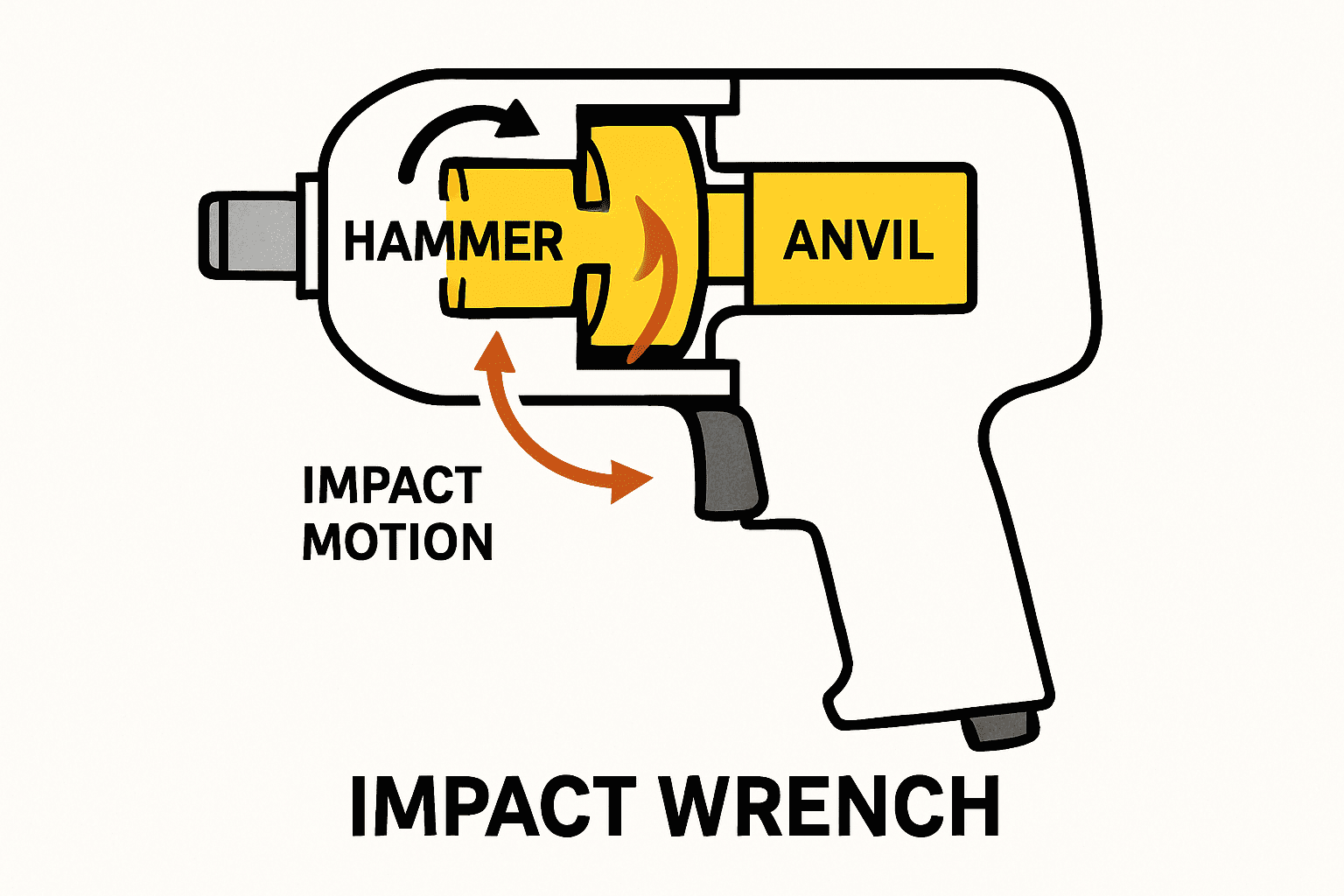
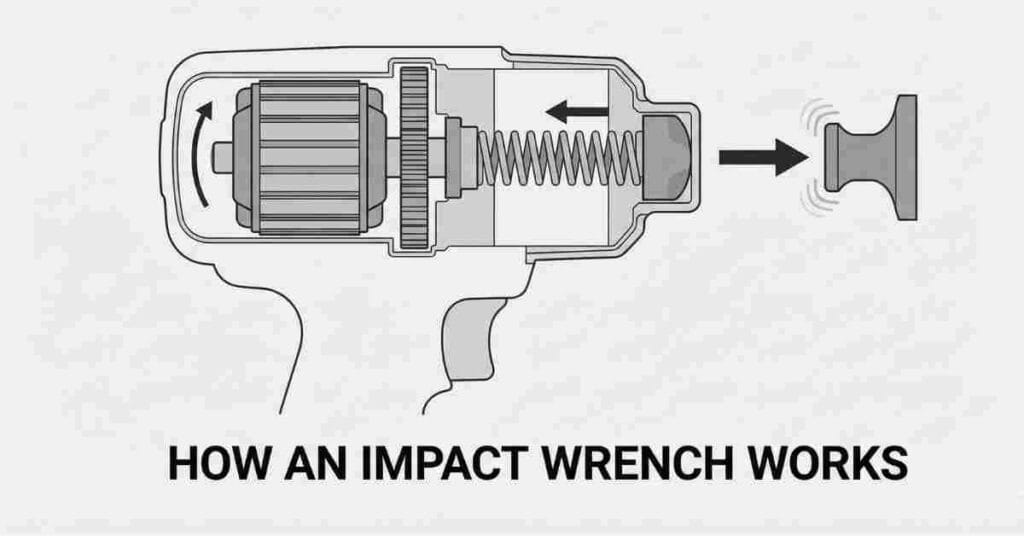
A tight fastener creates resistance. When resistance rises, the hammer mechanism can disengage from the anvil, speed up, and then strike it. That strike transfers a short burst of energy into the fastener.
This cycle repeats very quickly. The motor keeps driving the mechanism while the hammer repeatedly catches and strikes the anvil. That is the basic answer to how does impact wrench work when a bolt becomes hard to turn.
- ✦ Smooth rotation
The motor turns the internal drive parts while the fastener offers little resistance.
- ✦ Resistance rises
As the nut or bolt gets harder to turn, the hammer mechanism begins its impact cycle.
- ✦ Impact occurs
The hammer strikes the anvil and sends a strong pulse of torque into the socket.
How Does an Impact Wrench Work Step by Step?
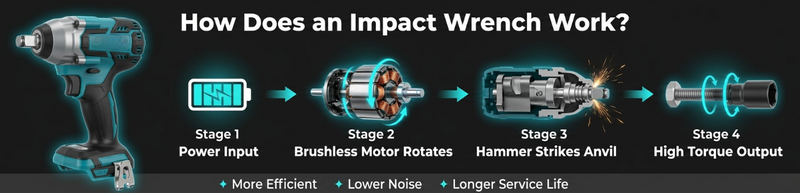
To understand how does impact wrench work, it helps to follow the power from the source to the fastener. The process starts with electricity or compressed air. That power turns a motor, which drives the hammer system inside the tool.
At first, the hammer and anvil can rotate together. When the socket meets enough resistance, the hammer pulls away from the anvil for a short moment. It then accelerates and strikes the anvil, sending energy through the square drive and socket.
The hammer repeats this action over and over. Each impact adds another burst of torque. This is why the tool can keep working against a stubborn fastener even though the motor itself may not produce the same peak torque in a smooth, continuous way.

- ✦ 1. Power enters the tool
A battery, electric outlet, or air compressor supplies energy to the impact wrench.
- ✦ 2. The motor spins
The motor converts the supplied energy into rotational motion.
- ✦ 3. The hammer gains speed
Internal gears and drive parts move the hammer mechanism and build rotational energy.
- ✦ 4. The hammer strikes
When resistance rises, the hammer strikes the anvil and transfers a torque pulse.
- ✦ 5. The socket turns
The anvil passes the impact through the square drive and socket to the fastener.
- ✦ 6. The cycle repeats
The hammer resets, accelerates, strikes again, and continues until the trigger is released or the fastener moves freely.
The Role of the Hammer and Anvil
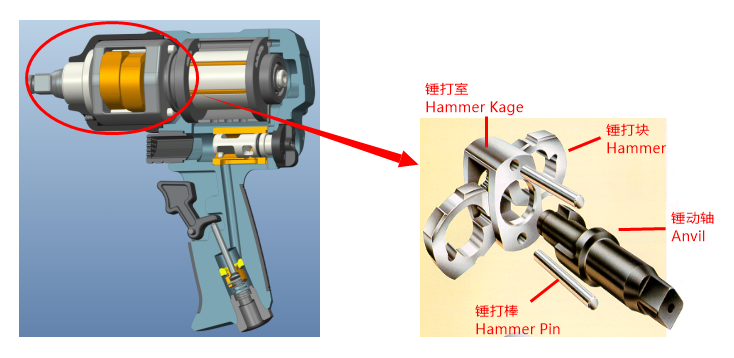
The hammer is the moving part that creates the impact. The anvil is the part connected to the output drive. Their shape and movement vary by design, but their job stays the same: build rotational energy and release it in short pulses.
Different tools use different impact systems. Twin-hammer, pin-clutch, rocking-dog, and other designs can change the feel, speed, vibration, durability, and service needs of an impact wrench.
- ✦ Hammer
Builds and releases rotational energy during each impact cycle.
- ✦ Anvil
Receives the hammer strike and transfers the force to the output shaft.
- ✦ Impact cycle
The hammer separates, accelerates, strikes, and resets before the next impact.
How Does an Impact Wrench Create So Much Torque?
The important idea is energy transfer. The motor supplies continuous rotational energy, but the hammer mechanism gathers that energy and releases it in short bursts. These bursts can create very high instantaneous torque at the output.
Torque is the twisting force that turns a fastener. A longer hand wrench can create more torque because it gives you a longer lever. An impact wrench takes a different path by using motor speed, mechanical motion, and repeated impacts to deliver force to the fastener.
This also explains why an impact wrench can feel less punishing than a large manual breaker bar during repeated work. The tool handles most of the motion. However, the socket and fastener still receive strong forces, so the correct impact-rated accessories matter.
- ✦ Rotational energy
The motor keeps moving the internal mechanism and provides energy for each impact.
- ✦ Short impact pulses
The hammer releases energy quickly instead of applying all torque as one smooth force.
- ✦ Mechanical advantage
The internal drive system helps convert motor motion into useful output torque.
- ✦ Repeated strikes
Many impacts can gradually overcome resistance from tight threads, rust, dirt, or clamping force.
Torque, Breakaway Torque, and Tightening Torque
Tool makers may list several torque figures, and these numbers can be easy to confuse. Breakaway torque describes the force available for loosening under a stated test method. Tightening torque describes the force available while driving a fastener.
These numbers do not mean the tool will apply that exact torque to every bolt. Fastener size, thread condition, socket fit, battery or air supply, joint stiffness, and impact time all affect the result. For critical fasteners, use a calibrated torque wrench to verify final torque.
- ✦ Breakaway torque
A measure related to the tool’s ability to loosen a fastener under a defined test condition.
- ✦ Fastening torque
A measure related to the tool’s ability to tighten a fastener.
- ✦ Actual joint torque
The torque reached on a real fastener can vary with the joint, hardware, tool, and operating conditions.
How Do Cordless, Pneumatic, and Electric Impact Wrenches Work?
The basic impact process stays the same across most impact wrench types. The main difference is how the tool gets power. A cordless model uses a battery, a pneumatic model uses compressed air, and a corded electric model uses power from an outlet.
Cordless impact wrenches are common for home garages and mobile work because they need no air hose or wall outlet. Pneumatic impact wrenches remain common in professional shops because a good air system can provide steady power for repeated work.
Corded electric models can work well where an outlet is close by. They are less common than cordless models for general automotive use, but they can still be useful for shop and maintenance tasks.
- ✦ Cordless impact wrench
A rechargeable battery powers an electric motor. It offers strong mobility and avoids the need for an air hose.
- ✦ Pneumatic impact wrench
Compressed air drives an air motor. The tool depends on the compressor, hose, fittings, and available airflow.
- ✦ Corded electric impact wrench
Electric power from an outlet drives the motor. It can provide consistent operation without battery charging.
Does the Power Source Change How the Impact Mechanism Works?
The power source changes how the motor receives energy, but the core impact idea remains similar. The motor turns the drive system, and the hammer and anvil create the impact pulses that reach the socket.
In practice, the power source affects portability, run time, air requirements, noise, maintenance, and sustained performance. A cordless tool may be ideal for roadside work, while a pneumatic model can fit a busy repair shop with a suitable compressor.
- ✦ Portability
Cordless tools offer the most freedom of movement because they do not need a hose or power cord.
- ✦ Shop use
Pneumatic tools can suit high-use shop work when the air system is sized correctly.
- ✦ Fixed work areas
Corded electric tools can make sense when reliable outlet power is close to the job.
What Is an Impact Wrench Used For?
Now that the mechanism is clear, the next question is where an impact wrench helps most. The tool is especially useful when a fastener needs high torque or when many fasteners must be removed quickly.
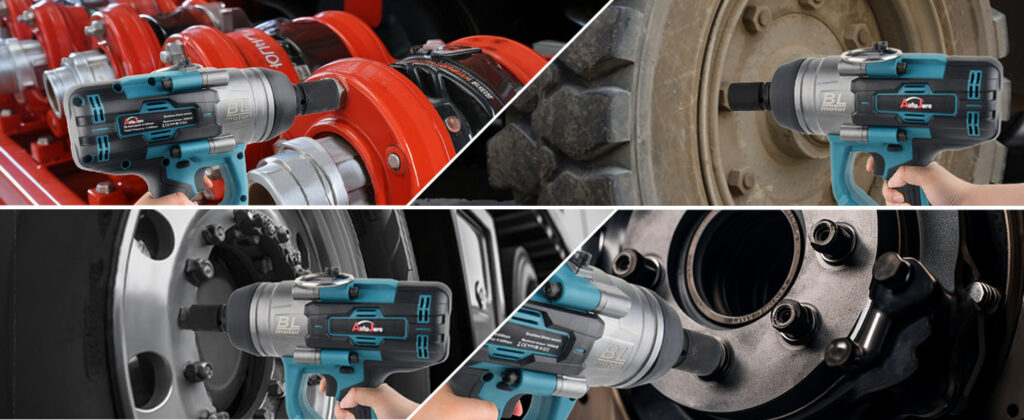
In the United States, one of the most familiar uses is changing vehicle wheels. An impact wrench can remove lug nuts fast and can save time during tire service. It is also useful for suspension work, engine repairs, trailer maintenance, equipment repair, and construction tasks.
The tool is not a replacement for every wrench. Small fasteners can be damaged by too much force, and sensitive assemblies may need careful manual control. Use the impact wrench for the work it suits, then use the correct hand tool when precision matters.
- ✦ Removing lug nuts
Impact wrenches can quickly remove vehicle wheel fasteners when used with the correct impact socket.
- ✦ Loosening rusty bolts
Repeated impact pulses can help break loose fasteners that resist smooth turning.
- ✦ Automotive repair
The tool can save time on suspension, steering, drivetrain, and other repair jobs.
- ✦ Construction
Higher-power models can drive and remove large fasteners used in heavy construction and structural work.
- ✦ Equipment maintenance
The tool can speed work on machinery, trailers, agricultural equipment, and other large assemblies.
When Should You Not Use an Impact Wrench?
Avoid using an impact wrench as the final torque tool when a manufacturer gives a specific torque value for a critical fastener. An impact wrench can stop at different torque levels depending on the tool, joint, socket, battery, air pressure, and impact time.
For wheel lug nuts, for example, many manufacturers specify a final torque value. A practical method is to use the impact wrench for removal and initial installation, then check final torque with a properly set torque wrench when the vehicle maker requires it.
- ✦ Precision fasteners
Use controlled hand tools or a torque wrench when the exact final torque matters.
- ✦ Small hardware
Small bolts and screws can strip, break, or become damaged if the tool applies too much force.
- ✦ Delicate assemblies
Sensitive parts may need slow, controlled tightening rather than repeated impacts.
Impact Wrench vs. Impact Driver: What Is the Difference?
An impact wrench and an impact driver both use impact action, but they are built for different jobs. An impact wrench normally uses a square drive for sockets and is designed for nuts and bolts. An impact driver commonly uses a hex chuck for driver bits and smaller fasteners.
The size of the tool and its output also differ. Impact wrenches are usually the better fit for automotive lug nuts, large bolts, and heavy hardware. Impact drivers are often more convenient for screws, wood fasteners, and smaller construction work.
This distinction matters when choosing a tool. If your main goal is vehicle repair, an impact wrench with the correct socket size is usually the tool category to consider. If you mainly drive screws and construction fasteners, an impact driver may fit that work better.
- ✦ Drive type
Impact wrenches commonly use a square drive for sockets, while impact drivers commonly use a quick-change hex chuck.
- ✦ Typical work
Impact wrenches suit nuts and bolts, while impact drivers are often used for screws and smaller fasteners.
- ✦ Tool size
Impact wrenches are often larger and heavier because they are built for higher-load fastening tasks.
- ✦ Sockets and bits
Use impact-rated sockets with impact wrenches and bits designed for impact drivers with impact drivers.
Can You Use Regular Sockets on an Impact Wrench?
It is safer to use sockets marked for impact use with an impact wrench. Impact-rated sockets are designed to handle repeated shock loads and are usually made from tougher materials and construction than standard chrome sockets.
Regular hand-tool sockets can crack or fail under impact use. The safest practice is to match the socket, adapter, extension, and drive size to the impact tool and the job.
- ✦ Use impact sockets
Choose sockets specifically rated for impact tools.
- ✦ Check fit
A loose socket or worn drive connection can increase the risk of damage or failure.
- ✦ Inspect accessories
Replace damaged, cracked, or badly worn impact accessories before use.
How to Use an Impact Wrench Safely and Effectively
Knowing how does impact wrench work is only part of using one well. Good technique matters because the tool can apply high force very quickly. Before starting, select the correct socket, inspect the tool, and make sure the fastener is properly aligned.
Keep the socket square on the fastener. Let the tool do the work instead of forcing it sideways. If a fastener does not move, stop and check for rust, cross-threading, damage, or another mechanical problem rather than holding the trigger longer without a plan.
For tightening, use the impact wrench as a controlled installation tool when appropriate, but do not assume its maximum rating equals the required fastener torque. For critical joints, finish with a torque wrench set to the manufacturer’s specification.

- ✦ Wear eye protection
Eye protection helps guard against flying debris, damaged hardware, and broken accessories.
- ✦ Use the correct socket
Use an impact-rated socket that matches the fastener and drive size.
- ✦ Keep the tool straight
Hold the socket square to the fastener to reduce slipping and uneven loading.
- ✦ Start threads by hand
For threaded fasteners, start the nut or bolt by hand to reduce the risk of cross-threading.
- ✦ Control tightening
Use short trigger pulls when approaching the desired tightness instead of holding full power continuously.
- ✦ Verify critical torque
Use a suitable torque wrench when the fastener has a specified final torque requirement.
- ✦ Inspect before use
Check the tool, battery or air line, socket, drive, and fastener for damage before starting work.
Why Impact Wrench Technique Matters
An impact wrench can remove a fastener quickly, but speed is not the same as precision. A careful user knows when to use full power, when to reduce trigger time, and when to stop and switch to a torque wrench.
A common mistake is to use maximum power for every fastener. That can damage threads, break small hardware, or make later service harder. Use the lowest practical power and the shortest practical impact time for the task.
- ✦ Start gently
Begin with low trigger pressure when tightening so you can watch how the fastener seats.
- ✦ Avoid side loading
Keep the socket aligned with the fastener to reduce stress on the socket and drive.
- ✦ Know when to stop
Stop impacting when the fastener reaches the intended installation stage or when a torque wrench is needed.