
Will Regular Sockets Work With an Impact Wrench?
Regular sockets may physically fit an impact wrench, but they are generally not designed for the repeated shock loads produced by impact tools. Impact-rated sockets are the correct and safer choice.
This is an easy point to misunderstand because a standard socket and an impact socket may have the same square-drive size and fit the same fastener. A 1/2-inch regular socket can slide onto a 1/2-inch impact wrench just fine, but physical fit does not mean the socket is suitable for repeated hammering.
Impact wrenches deliver rapid rotational blows through the anvil. That repeated shock loading is different from the smoother torque applied by a hand ratchet or breaker bar, and impact sockets are specifically engineered for that kind of use.
Will Regular Sockets Work With an Impact Wrench?
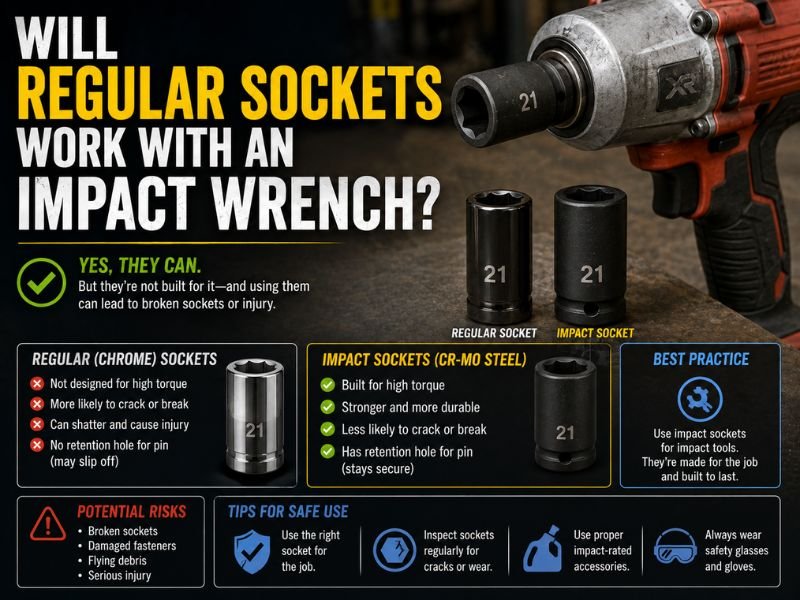
They may work temporarily, but that does not make them the right choice.
A regular socket may:
- Fit the impact wrench
- Turn the fastener
- Survive a few uses
- Appear completely normal afterward
The problem is that repeated impact loading can damage a socket over time.
Possible results include:
- Cracking
- Drive-end deformation
- Split socket walls
- Rounded internal corners
- Sudden socket failure
The proper rule is simple:
If the socket is not specifically rated for impact use, do not treat it as an impact socket.
Why Regular Sockets and Impact Sockets Are Different
Regular sockets and impact sockets are designed for different types of loading.
Regular Hand Sockets
Standard sockets are mainly intended for:
- Ratchets
- Breaker bars
- Hand wrenches
- Torque wrenches where appropriate
They are designed around relatively smooth manual torque.
Many regular sockets also have a polished chrome finish and may use a different material or heat-treatment strategy from impact-rated tools.
Impact Sockets
Impact sockets are designed for:
- Cordless impact wrenches
- Pneumatic impact wrenches
- Corded impact wrenches
- Repeated high-torque shock loading
Their material, heat treatment, wall design, and drive-end construction are selected for impact service.
The important difference is not simply that one socket is “stronger.” It is that the impact socket is engineered to tolerate repeated shock without becoming dangerously brittle.
What Happens If You Use a Regular Socket on an Impact Wrench?
Several things can happen.
Nothing Happens at First
This is why people sometimes assume regular sockets are fine.
A socket may survive:
- One lug nut
- A few bolts
- Several short impact cycles
That still does not prove long-term compatibility.
The Socket Can Develop Cracks
Repeated impacts can create fatigue damage.
Small cracks may not be obvious at first.
The Drive End Can Deform
The square-drive opening can become worn or distorted from repeated hammering.
The Socket Can Split
Under enough shock or torque, the socket body may fail.
Fasteners Can Be Damaged
A worn or distorted socket may fit the fastener poorly and contribute to rounded corners.
The biggest mistake is assuming:
“It worked last time, so it must be safe.”
Impact damage can accumulate.
Can a Regular Socket Shatter on an Impact Wrench?
It is possible for a non-impact socket to fail suddenly under heavy impact loading.
That does not mean every chrome socket will instantly explode the first time you use it.
The more accurate point is that regular sockets are not designed for the same repeated shock environment, so failure risk increases when they are used outside their intended application.
The risk becomes greater with:
- High-torque impact wrenches
- Rusted fasteners
- Long impact duration
- Worn sockets
- Loose socket fit
- Stubborn suspension or automotive hardware
If a socket already has visible cracks or deformation, do not use it with any high-load tool.
Why Are Impact Sockets Usually Black?
Many impact sockets have a black or dark finish.
This often makes them easy to distinguish from polished chrome hand sockets.
However, color is not a reliable safety rating.
A black socket is not automatically impact-rated.
Likewise, appearance alone does not tell you enough about:
- Material
- Heat treatment
- Manufacturing process
- Testing
- Intended application
Look for clear impact identification from the manufacturer.
Common markings may include wording such as:
- Impact
- Impact Rated
- Impact Duty
- Impact Ready
When in doubt, check the exact socket model.
Are Impact Sockets Stronger Than Regular Sockets?
It is better to say that impact sockets are engineered differently for impact loading.
Impact tools expose sockets to rapid shock rather than only smooth torque.
Impact sockets are designed to tolerate that environment through choices involving:
- Steel composition
- Heat treatment
- Wall geometry
- Drive-end design
- Overall toughness
A regular socket may be very hard and durable for hand-tool use while still not being appropriate for impact service.
Hardness and impact toughness are not exactly the same design goal.
Are Impact Sockets Thicker?
Often, but not always.
Many impact sockets have thicker walls than conventional hand sockets because additional material can improve durability.
However, this is not a universal rule.
Some impact-rated sockets are deliberately designed with thinner walls to reach fasteners in tight spaces.
Therefore, you should not identify an impact socket based solely on:
- Wall thickness
- Weight
- Black finish
- Overall appearance
The manufacturer’s impact rating is the important information.
Can You Use Chrome Sockets With an Impact Wrench?
Conventional chrome hand sockets should generally be treated as non-impact sockets unless the manufacturer specifically states otherwise.
A chrome socket may physically fit and may even survive occasional use.
That does not mean it was designed for the hammering action of an impact wrench.
Use chrome hand sockets primarily with:
- Ratchets
- Breaker bars
- Other manual tools
Use impact-rated sockets with the impact wrench.
Can You Use Regular Sockets on a Cordless Impact Wrench?
The same rule applies.
A cordless impact wrench still produces repeated rotational impacts.
The fact that the tool runs on a battery does not make the shock loading gentler or change the socket requirement.
This applies to:
- Compact cordless impact wrenches
- Mid-torque models
- High-torque models
Even a relatively compact impact wrench should be used with compatible impact-rated accessories.
There is no reliable universal torque threshold below which every hand socket suddenly becomes safe for impact use.
Can You Use Regular Sockets on a Pneumatic Impact Wrench?
Again, use impact-rated sockets.
Pneumatic impact wrenches can generate substantial repeated hammering.
In many automotive and shop applications, they are used on:
- Lug nuts
- Suspension fasteners
- Axle hardware
- Large bolts
Those are exactly the situations where socket failure is especially undesirable.
The socket’s drive size may match perfectly while its construction remains unsuitable for impact service.
Can You Use Impact Sockets With a Regular Ratchet?
Generally, yes.
This is one reason impact sockets are versatile.
You can normally use an appropriate impact socket with:
- Standard ratchet
- Breaker bar
- Hand wrench system
- Torque wrench when suitable for the specific procedure
The main disadvantages are practical rather than safety-related.
Impact sockets may be:
- Heavier
- Larger
- Thicker
- Harder to fit into very tight areas
But they can usually perform normal hand-tool work without a problem.
This makes the compatibility direction important:
Impact socket on hand tool: generally fine.
Regular hand socket on impact wrench: generally not recommended.
Do You Need Impact Sockets for a Small Impact Wrench?
Yes, use impact-rated sockets even with a compact or lower-torque impact wrench.
A small wrench still uses an impact mechanism.
The tool’s lower maximum torque does not change the fact that the socket receives repeated shock loads.
Avoid creating your own rule such as:
“Regular sockets are safe below 200 ft-lbs.”
There is no universal threshold like that.
Socket compatibility should come from the manufacturer’s intended use.
6-Point vs. 12-Point Impact Sockets
Point count is another feature users often confuse with impact compatibility.
6-Point Sockets
Six-point sockets are common in high-torque applications.
They provide broad contact with the flats of a standard hex fastener.
For many automotive jobs, they are a practical choice.
12-Point Sockets
Impact-rated 12-point sockets also exist.
They may be needed for specific 12-point fasteners or certain access situations.
The important point is:
6-point does not automatically mean impact-rated, and 12-point does not automatically mean unsuitable.
Check the actual socket rating.
Can You Use Regular Extensions With an Impact Wrench?
The same impact-rating principle applies to more than just sockets.
Accessories in the drive path may include:
- Extensions
- Adapters
- Reducers
- Universal joints
- Swivel adapters
If you are building an impact-tool setup, use accessories designed for impact service.
An impact-rated socket attached through a non-impact adapter still leaves a weak link in the system.
That component can receive the same repeated hammering.
Can You Use a Drive Adapter With an Impact Wrench?
Yes, if the adapter is designed for impact use and appropriately sized for the application.
For example, someone might use:
- 1/2-inch drive wrench
- 1/2-to-3/8-inch adapter
- 3/8-inch socket
The adapter becomes part of the torque path.
A smaller adapter may also become the limiting component when a high-torque wrench is involved.
Do not assume that because the socket is impact-rated, every adapter between it and the wrench is automatically suitable.
How Can You Tell If a Socket Is Impact Rated?
Use several checks.
Look for Manufacturer Markings
The socket may include impact-related identification.
Check the Packaging
Sets are usually clearly labeled for impact service.
Look Up the Exact Part Number
This is one of the best methods when the socket’s appearance is ambiguous.
Do Not Rely Only on Color
Black finish is common but not proof.
Do Not Rely Only on Thickness
Impact sockets come in different wall designs.
If you cannot confirm that an old or unmarked socket is impact-rated, the safer choice is to use a known impact socket instead.
When Should You Replace an Impact Socket?
Impact sockets are durable, but they do not last forever.
Inspect them regularly.
Replace a socket if you notice:
- Visible cracks
- Split wall
- Distorted square drive
- Severe internal rounding
- Heavy deformation
- Significant damage around retention holes
- Excessive wear
Do not continue using a damaged socket simply because it still stays on the anvil.
A high-torque impact wrench can make existing damage worse very quickly.
Regular Socket vs. Impact Socket
| Feature | Regular Socket | Impact Socket |
| Primary use | Hand tools | Impact and hand tools |
| Impact wrench use | Generally not recommended | Designed for it |
| Repeated shock loading | Not primary design purpose | Yes |
| Ratchet use | Yes | Yes |
| Common finish | Polished chrome | Often dark finish |
| High-torque impact work | Poor choice | Appropriate choice |
The table highlights the real difference: intended application.
Does Using a Regular Socket Reduce Impact Wrench Power?
The bigger concern is not usually power loss—it is socket durability and safety.
However, a damaged or poorly fitting socket can contribute to:
- Sloppy engagement
- Rounded fasteners
- Drive wear
- Less effective torque transfer
Using the correct socket also helps ensure the tool and fastener fit properly.
Can the Wrong Socket Damage the Impact Wrench?
A failed or poorly fitting socket can potentially create problems for the entire setup.
For example:
- Damaged drive opening can fit the anvil poorly
- Loose socket can hammer against the anvil
- Cracked socket can fail during operation
The immediate concern is usually the socket and fastener, but using the right accessory also protects the overall tool system.
Common Mistakes to Avoid
Assuming Same Drive Size Means Safe
A 1/2-inch socket fitting a 1/2-inch anvil tells you size compatibility, not impact compatibility.
Using Chrome Sockets Because They Worked Before
Previous survival does not prove future safety.
Using an Impact Socket With a Regular Adapter
Every component in the impact path should be suitable.
Identifying Sockets Only by Color
Black finish is not a certification.
Continuing to Use Cracked Sockets
Visible damage is a reason to replace the socket.
Using the Wrong Fastener Size
An oversized socket can round the fastener even if it is impact-rated.
Failing to Seat the Socket Fully
Proper engagement matters.
Using Worn Sockets on High-Torque Tools
Wear and impact loading are a poor combination.
Frequently Asked Questions
Will Regular Sockets Work With an Impact Wrench?
They may physically fit and turn a fastener, but regular hand sockets are generally not designed for repeated impact-wrench loads. Use impact-rated sockets instead.
Can Regular Sockets Break on an Impact Wrench?
Yes. A non-impact socket can crack, deform, split, or otherwise fail under repeated impact loading.
Can Chrome Sockets Be Used With an Impact Wrench?
Conventional chrome hand sockets should not be used for normal impact-wrench work unless the manufacturer specifically rates them for impact use.
Why Shouldn’t You Use Regular Sockets on an Impact Wrench?
Impact wrenches create repeated shock loads that regular hand sockets are generally not designed to withstand.
What Is the Difference Between Impact and Regular Sockets?
Impact sockets use materials, heat treatment, and designs intended for repeated high-torque shock loads, while regular sockets are mainly designed for manual tools.
Why Are Impact Sockets Black?
Many use dark protective finishes, which also makes them easy to distinguish from polished chrome sockets. Color alone does not prove impact compatibility.
Are Impact Sockets Stronger Than Regular Sockets?
They are better described as being engineered for impact loading. Their toughness and construction are selected for repeated hammering.
Can You Use Impact Sockets With a Normal Ratchet?
Yes, impact sockets can generally be used with normal hand ratchets and breaker bars.
Do I Need Impact Sockets for a Cordless Impact Wrench?
Yes. Cordless impact wrenches still create repeated shock loading, so impact-rated sockets are the appropriate choice.
Can You Use Regular Extensions With an Impact Wrench?
You should use impact-rated extensions and adapters in an impact setup rather than introducing a non-impact accessory into the torque path.
How Can I Tell If a Socket Is Impact Rated?
Check the manufacturer’s markings, packaging, product description, or exact part number. Do not identify it only by color.
Are 12-Point Impact Sockets Safe for Impact Wrenches?
Yes, if the socket is specifically impact-rated and appropriate for the fastener. Impact rating matters more than point count alone.
Conclusion
If you’re asking “will regular sockets work with an impact wrench,” they may physically fit and even turn a fastener, but regular hand sockets are generally not designed for the repeated shock loads produced by an impact wrench.
That is the difference that matters.
A socket fitting the square drive only confirms its drive size. It does not confirm that the material, heat treatment, or construction is suitable for repeated impact loading.
A regular socket may seem to work perfectly for a few jobs, which can create false confidence. Repeated hammering can still contribute to cracking, deformation, or eventual failure.
Impact sockets are engineered specifically for this type of service. The same rule should also be applied to extensions, reducers, adapters, and other accessories positioned between the wrench and fastener.
Do not rely only on black color, chrome finish, wall thickness, or appearance to identify an impact socket. Check the manufacturer’s rating whenever there is uncertainty.
Impact sockets can generally be used with manual ratchets and breaker bars as well, making them a versatile option when you need one socket for both hand and impact work.
Use regular sockets with hand tools and impact-rated sockets with impact wrenches. A standard socket may fit, but the correct impact-rated accessory is designed to handle the repeated hammering the tool produces.
