Are Earthquake Impact Wrenches Any Good: Key Facts and Guidance
Yes, Earthquake impact wrenches can be good tools, especially for home mechanics, tire work, suspension repairs, and other jobs where strong breakaway torque matters more than premium fit and finish. Their value depends heavily on the specific model, power source, air supply, battery condition, and whether the tool is used for removal or final tightening.
The small detail that often changes the decision is not the advertised maximum torque. It is the wrench’s ability to deliver useful torque repeatedly while remaining controllable, comfortable, and serviceable. A powerful impact can remove stubborn fasteners yet still be a poor choice if it is too bulky, drains batteries quickly, struggles with an undersized compressor, or encourages over-tightening during assembly.
This article separates ordinary limitations from genuine warning signs. You will learn how Earthquake tools compare in practical performance, where pneumatic and cordless versions fit, what affects durability and accuracy, which jobs suit them, and what to check before buying or relying on one for vehicle work.
What makes Earthquake impact wrenches appealing
Earthquake is a tool brand associated with Harbor Freight’s automotive and mechanical equipment range. Its impact wrenches are generally aimed at buyers who want substantial performance without paying the price of a top-tier professional tool line.
The main attraction is usable removal power. An impact wrench applies rapid hammering force rather than relying only on a person’s arm strength, making it much faster than a hand ratchet for lug nuts, frame bolts, suspension hardware, and other threaded fasteners.
Many Earthquake models also offer features that matter in a garage environment, such as a compact head, a friction ring or pin-style socket retention system, variable trigger control, and multiple power settings. The exact design varies by model, so the product’s individual specifications matter more than the brand name alone.
For occasional users, the lower purchase price can be especially attractive. A homeowner who changes wheels seasonally or repairs a personal vehicle may not need the longest duty cycle, the lightest magnesium housing, or the extensive battery ecosystem associated with a premium professional platform.
How well do Earthquake impact wrenches perform?
Performance is usually best judged in two separate categories: breakaway torque and controlled fastening. Breakaway torque describes how effectively the tool loosens a fastener that is already tight, corroded, or stuck. Tightening performance concerns speed, control, and the ability to avoid damaging the fastener or component.
An Earthquake impact wrench can be very effective for removing ordinary automotive lug nuts and many stubborn bolts. Its success depends on the fastener, socket quality, battery charge or air pressure, extension length, rust, thread condition, and how long the joint has been tightened.
Torque claims should not be treated as an exact promise for every job. Manufacturers may list different values for fastening torque, loosening torque, nut-busting torque, or maximum torque under specific test conditions. These figures are useful for comparing models, but they do not guarantee that a wrench will remove every bolt showing the same torque rating.
A pneumatic model also depends on the compressor and air system. A small compressor with a restrictive hose, undersized fittings, or a long duty cycle may not supply enough air volume for the tool to maintain hammering force. The wrench may sound active while gradually losing effectiveness.
Cordless performance changes as the battery discharges. A worn battery, cold temperature, poor-quality replacement pack, or long period of continuous use can reduce output. A freshly charged battery can make the same wrench feel much stronger than it does near the end of a work session.
Pneumatic versus cordless Earthquake models
Pneumatic Earthquake impact wrenches can be a strong choice for a garage that already has a suitable compressor. They are often lighter than comparable cordless tools and can run for extended periods without waiting for a battery to recharge, provided the air system can keep up.
The tradeoff is reduced portability. A hose, compressor, fittings, and adequate air capacity are necessary, and poor air delivery can make a high-torque wrench perform below expectations. Moisture and inadequate lubrication can also shorten the life of an air tool.
Cordless models are more convenient for driveway repairs, roadside work, and locations without a compressor. They start immediately, eliminate the air hose, and can be easier to move around a vehicle. Their practical limits are battery runtime, charging time, tool weight, and the cost of additional battery packs.
A cordless wrench may also feel less consistent during a long repair. As the battery loses charge, the tool can slow down or deliver less impact energy. That does not necessarily indicate a defective wrench, but it does mean that battery condition should be part of any performance assessment.
Neither power source automatically makes an impact wrench better. Choose pneumatic if the compressor is already capable and the tool will see sustained use. Choose cordless when mobility and convenience are more important than uninterrupted operation.
Are they durable enough for regular use?
Earthquake impact wrenches can provide good service for home garages and moderate mechanical work, but durability depends on workload and maintenance. A tool used occasionally on passenger vehicles faces a very different demand from one used every day in a busy repair shop.
Common wear points include the hammer mechanism, motor or air vane components, trigger, bearings, battery, anvil, and socket-retention parts. Repeated impacts, contamination, overheating, drops, and excessive side loading can accelerate wear in any brand of impact wrench.
For pneumatic tools, clean and dry air is important. Follow the model’s maintenance instructions, use the specified air-tool lubricant when required, and avoid operating the wrench with a damaged hose or leaking fitting. A tool that receives contaminated air may lose power or develop internal wear sooner.
Cordless tools need sensible battery care. Use the correct charger and battery system, keep battery contacts clean, and do not store packs in extreme heat. If the tool becomes unusually hot, emits a burning odor, or behaves erratically, stop using it until the cause is understood.
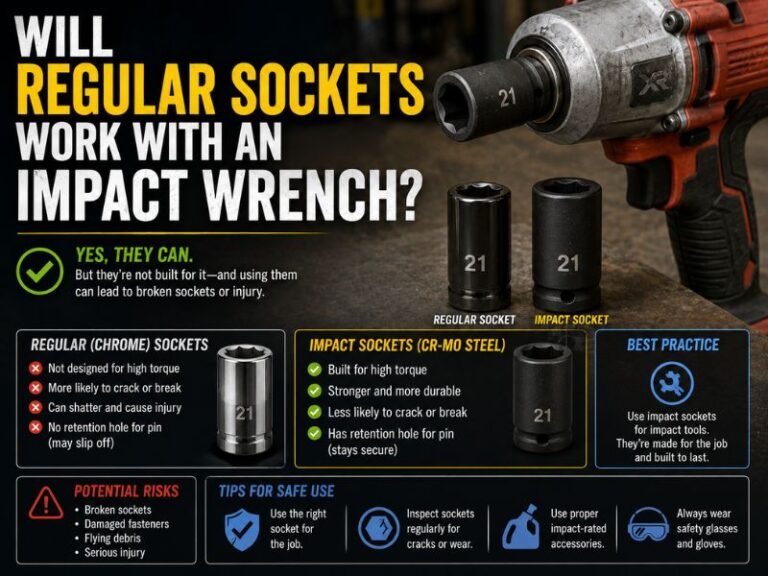
Durability is also affected by socket choice. Impact-rated sockets are designed for the repeated shock loads produced by impact tools. Standard chrome hand-tool sockets can crack or shatter, creating a safety hazard and potentially damaging the fastener or anvil.
Important limits of impact-wrench torque
An impact wrench is excellent for loosening and quickly running down fasteners, but it is not a precision torque instrument. Even a low setting does not reliably produce one exact torque value because joint friction, impact duration, lubrication, thread condition, and battery or air pressure all vary.
This matters most on wheel lug nuts, cylinder-head fasteners, suspension components, brake hardware, and other parts with a specified tightening value. Over-tightening can stretch studs, distort brake rotors, damage threads, or make future removal difficult.
The safe workflow is to use the impact wrench only for removal or initial snugging when appropriate, then finish with a calibrated torque wrench. Tighten in the manufacturer’s specified sequence and torque range rather than relying on the sound or feel of the impact mechanism.
Some models include low-power settings intended for controlled fastening, but those settings should not be assumed to equal a particular torque value. They can reduce the risk of over-tightening, but verification with a torque wrench remains the dependable final step.
When an Earthquake impact wrench is a good choice
An Earthquake wrench makes sense when the main goal is practical mechanical assistance at a reasonable cost. It can be a sensible purchase for people who maintain their own vehicles, work on trailers, repair equipment, or need faster removal of frequently serviced fasteners.
It is particularly useful for:
- Removing and installing wheel lug nuts before final hand torqueing.
- Suspension, steering, and exhaust repairs where fasteners are difficult to loosen.
- Automotive maintenance in a home garage or driveway.
- Trailer, lawn-equipment, and general mechanical repairs.
- Users who need strong performance but do not require a premium commercial tool platform.
It may not be the best choice for continuous professional use, highly controlled assembly, or work that demands the lightest possible tool. In those settings, higher-end alternatives may offer better thermal management, longer service support, smoother control, or more consistent performance under heavy daily workloads.
That does not make Earthquake tools unsuitable for professionals. It means the purchase should be matched to the duty cycle. A model that performs well for a few vehicle repairs each month may not provide the same value when used for hundreds of fastening cycles every day.
Signs that the wrench is underperforming
A weak impact wrench does not always have a failed motor or hammer. Start with the conditions around the tool before assuming the tool itself is defective.
For a pneumatic model, check the compressor’s delivered air capacity, regulator setting, hose inside diameter, fittings, leaks, and moisture. A long, narrow hose or restrictive coupler can reduce airflow enough to make the wrench appear weak. Confirm that the tool is lubricated according to its instructions.
For a cordless model, test with a fully charged, correctly matched battery. Inspect the battery for damage and compare performance with another known-good pack if available. Excessive heat, an unusual grinding sound, intermittent operation, or a slipping anvil suggests a mechanical or electrical problem rather than a simple low-charge condition.
Other warning signs include:
- The tool stalls or stops under loads it previously handled easily.
- The hammer mechanism produces a sharp, irregular, or unusually loud noise.
- The anvil wobbles or the socket does not seat securely.
- The housing becomes dangerously hot during ordinary intermittent use.
- The trigger sticks, sparks, leaks air, or fails to modulate speed.
- The tool requires excessive impact time on fasteners it should reasonably handle.
Stop using a tool with damaged electrical insulation, a cracked housing, a loose anvil, or a suspected internal failure. Repair or replacement is safer than compensating with a cheater bar or repeatedly hammering a fastener until the tool overheats.
How to buy the right Earthquake impact wrench
Start with the fasteners and working conditions, not the largest torque number. A compact wrench may be easier to use inside an engine bay, while a larger model may be more suitable for truck, trailer, or heavy suspension hardware.
Check the drive size, weight, overall length, grip shape, speed controls, direction switch, and socket-retention design. A half-inch model is a common general-purpose choice for automotive work, but drive size alone does not determine performance.
For pneumatic models, compare the tool’s air requirements with the compressor’s actual output. Tank size is not the whole story; the compressor must deliver enough air volume at the pressure required by the wrench. Confirm that the hose and couplers are not the bottleneck.
For cordless models, consider whether the battery and charger are included, how many packs are needed for a typical job, and whether replacement batteries remain available. The total ownership cost can be substantially higher than the bare-tool price.
Also review the warranty terms, return policy, replacement-part availability, and local service options before purchase. These details can matter more than a modest difference in advertised torque, particularly when the tool will be used regularly.
Safe operating practices
Wear eye protection and keep hands clear of the socket and rotating hardware. Secure the vehicle properly with wheel chocks and jack stands; never depend on a hydraulic jack alone while working underneath a vehicle.
Use the correct impact socket, keep the socket fully seated, and avoid extensions unless necessary. A universal joint or long extension can change how force reaches the fastener and may reduce effective performance. Never hold a socket by hand while the tool is running.
Before loosening a fastener, confirm the direction switch and make sure the socket size is correct. For tightening, run the fastener down gently and stop before relying on the impact wrench as the final torque method.
Do not use an impact wrench to force a damaged nut, cross-threaded bolt, or visibly weakened stud. Correct the underlying problem first. If a fastener will not move, penetrating lubricant, controlled heat where safe, a breaker bar, or professional assistance may be more appropriate than prolonged impact use.
Frequently asked questions about Earthquake impact wrenches
Are Earthquake impact wrenches any good for changing tires?
Yes, they are generally suitable for removing and initially installing tire lug nuts. Use an impact-rated socket, avoid fully tightening the lugs with the tool, and finish with a torque wrench set to the vehicle manufacturer’s specification.
Can an Earthquake impact wrench remove rusted bolts?
It can remove many stubborn bolts, but no impact wrench is guaranteed to free severely seized hardware. Rust, thread damage, joint design, air or battery performance, and the fastener’s size all affect the result. Penetrating lubricant, heat, or a breaker bar may still be needed.
Are pneumatic Earthquake impact wrenches better than cordless versions?
Neither is universally better. Pneumatic models can be lighter and consistent with a capable compressor, while cordless models provide easier movement and do not depend on an air system. The better option depends on whether portability or sustained shop operation matters more.
Can an Earthquake impact wrench replace a torque wrench?
No, an impact wrench should not replace a calibrated torque wrench for final tightening. Impact settings are not precise torque values, and joint conditions can produce different results from one fastener to another.
Why does my Earthquake cordless impact wrench seem weak?
Check the battery charge, battery condition, socket, fastener, and tool temperature first. A depleted or aging battery can reduce output, while a damaged socket, excessive extension, or seized fastener can make a normally functioning tool appear weak.
Are Earthquake impact wrenches suitable for professional mechanics?
Some may handle professional use, but the correct model and duty cycle are decisive. A busy shop should evaluate heat management, service support, battery availability, ergonomics, and long-term reliability rather than choosing solely by purchase price or maximum torque.
Practical verdict on Earthquake impact wrenches
Earthquake impact wrenches can be a good value for home mechanics and moderate automotive work, offering useful removal power at a generally accessible price. Their main limitations are model-to-model variation, dependence on adequate air or battery power, and the lack of precision for final torque.
Choose a model that matches the fastener sizes and working environment, use impact-rated sockets, and treat torque claims as performance guidance rather than exact tightening instructions. The most useful next step is to compare the specific wrench’s air or battery requirements, weight, warranty, and intended duty cycle before buying, then keep a torque wrench available for every critical fastener.