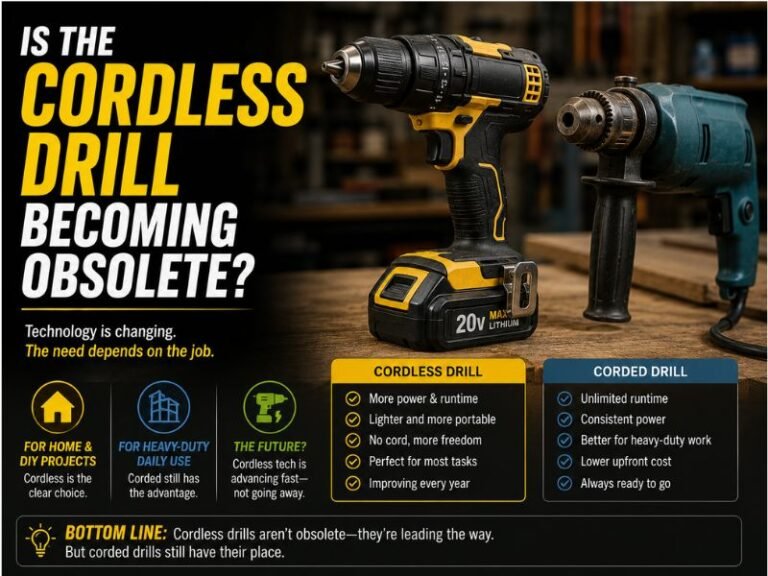
How Many Amps Does a Cordless Drill Draw: Key Facts and Guidance
A cordless drill does not draw one fixed number of amps. Depending on its voltage, motor design, battery condition, and workload, it may use roughly 1–3 amps while spinning freely, 5–15 amps during ordinary drilling, and more than 20 amps under heavy load or near stall.
That range matters because estimating current too low can cause overheating, weak performance, unexpected battery shutdowns, or damage to a power source. Estimating it too high, however, may lead you to buy an unnecessarily large battery, fuse, power supply, or wiring setup for a tool that normally uses far less.
The practical answer depends on whether you mean current at the battery, the charger’s input, or the drill’s brief peak draw. This article explains how voltage, torque, bit size, material, battery capacity, and motor type affect current; how to measure the actual draw; which ratings are commonly misunderstood; and when high current indicates normal hard work versus a mechanical or electrical problem.
Why a cordless drill has no single amp
A corded drill is often labeled by its input current because it operates from a fixed-voltage household circuit. A cordless drill is different: manufacturers usually identify it by battery voltage, such as 12V, 18V, or 20V maximum, rather than by a continuous amp rating.
The current changes constantly as the motor works. A drill may draw little current when the chuck is turning without a bit, more current when drilling wood, and substantially more when driving a large fastener or binding in dense material.
Battery voltage also affects the current needed for a given amount of power. The basic relationship is:
Power in watts = voltage in volts × current in amps
For example, a tool producing approximately 300 watts from an 18-volt battery would draw about 16.7 amps before accounting for motor and electronic losses. A similar 300-watt load on a 12-volt battery would require about 25 amps.
This does not mean every 18V drill continuously draws 16.7 amps. It means that current is the result of the momentary power demand, and that demand changes with the task. Electronic controls, motor efficiency, gearing, battery voltage under load, and temperature also affect the real figure.
Typical current ranges for cordless drills
Exact numbers vary widely, but general ranges help establish what is normal. The following figures describe approximate battery-side current, not the current drawn from a wall outlet by the charger.
- No-load operation: About 0.5–3 amps for many drills, depending on speed and electronics.
- Light drilling or screwdriving: Commonly about 2–8 amps.
- Moderate drilling: Often around 5–15 amps when the bit is cutting steadily.
- Heavy drilling or high-torque driving: Approximately 10–30 amps may occur briefly or intermittently.
- Near-stall or sudden binding: The current can rise above 30 amps and may reach much higher short-duration peaks on powerful tools.
Compact 12V drills usually operate toward the lower end of these ranges, although a small drill can still demand high current when its bit stops. Larger 18V and 20V brushless models may draw more power during demanding work but can also deliver more useful output because their higher voltage reduces the current required for the same wattage.
These are not universal specifications. A manufacturer’s service documentation, a suitable current meter, or a battery analyzer is more reliable than a generic range when the exact draw matters.
What changes the drill’s amp draw?
Battery voltage and tool size
A higher-voltage drill is not automatically a higher-amp drill. For comparable power, an 18V tool generally needs less current than a 12V tool, which can reduce wiring and heat losses inside the tool.
Voltage families also use different battery packs and electronic protection systems. A 20V maximum battery is commonly marketed at its fully charged voltage, while its nominal operating voltage is lower; the label alone does not reveal the drill’s operating current.
Material and bit size
Drilling soft pine with a small bit places relatively little resistance on the motor. Drilling hardwood, metal, masonry, or thick material requires more torque, so the drill draws more current.
A larger bit generally increases the cutting load. Dull bits, incorrect drill speed, inadequate lubrication when drilling metal, and forcing the tool can raise the load further. A hole saw or large auger bit may demand several times the current of a small twist bit.
Gear selection and speed
The low-speed gear provides greater torque at the chuck and is often used for large bits or driving screws. It may draw substantial current during slow, demanding work even though the chuck is turning at a modest speed.
High gear is intended for faster, lighter work. Using high speed with a large bit can overload the motor because the tool may struggle to maintain speed, heat up quickly, or enter a protection shutdown.
Brushed versus brushless motors
A brushless motor is often more efficient and better controlled than a brushed motor, but brushless construction does not create a fixed current level. The electronic controller still adjusts power according to trigger position, speed, torque demand, and protection limits.
Brushed drills can have greater friction and wear at the brushes and commutator. That may reduce efficiency and increase heat, particularly in an older tool, although the actual current depends on the specific design and condition.
Battery condition and temperature
A battery with a high amp-hour rating does not force the drill to draw more current. The amp-hour figure describes estimated capacity over time, while the battery’s discharge capability determines how well it can provide high current.
A worn, damaged, cold, or nearly empty lithium-ion pack may experience a larger voltage drop under load. The drill may then feel weak, shut down, or make the battery-management system disconnect even when the tool itself is functioning normally.
Amps, amp-hours, and peak current are different
Amps measure current at a particular moment. If a drill draws 10 amps while operating, that is an instantaneous electrical demand; it does not mean the drill will use 10 amps continuously for the entire job.
Amp-hours (Ah) measure battery capacity rather than the drill’s required current. In simplified terms, a 2Ah pack could provide 2 amps for about one hour under specified test conditions, or 10 amps for a much shorter period, although real-world output is affected by efficiency, temperature, discharge rate, and the battery’s cutoff system.
Peak current is the brief maximum demand that can occur during startup, sudden resistance, or near-stall conditions. It may be much higher than the average current during ordinary drilling, so a meter that records only a slow average can miss it.
Battery labels may also show a discharge rating or maximum current, but that rating is not necessarily the drill’s normal draw. It indicates what the pack and its protection circuitry can deliver safely under defined conditions.
How to estimate power from current
If you know the approximate current and battery voltage, multiplying them gives a rough electrical input power. For example, an 18V drill drawing 8 amps is using about 144 watts at that moment.
Actual mechanical output will be lower because some energy becomes heat, electrical resistance, sound, and friction. The estimate is still useful for comparing operating conditions or determining whether a portable power source is large enough.
Battery voltage also falls while current flows. An 18V nominal pack may measure higher when freshly charged and lower under load, so the calculation is an approximation rather than a precise performance measurement.
How to measure a cordless drill’s current
The safest method is to use a current-capable battery analyzer or a properly rated inline DC ammeter designed for the battery voltage and expected load. The instrument must be able to tolerate the drill’s startup and stall current, not merely its average operating draw.
Do not place an ordinary multimeter across the battery terminals while the drill is connected. In current mode, many meters create a low-resistance path through an internal fuse; connecting the probes directly across the battery can cause a short circuit, damage the meter, produce sparks, or damage the battery.
A clamp meter can measure current without opening the circuit, but it must be designed for the type and magnitude of DC current involved. Many basic clamp meters measure AC only or are inaccurate at the low currents found during no-load operation.
A practical measurement sequence is:
- Check the meter’s DC-current range, voltage rating, fuse rating, and maximum peak capability.
- Use a fully charged, undamaged battery and secure the drill so the chuck and bit cannot contact people or loose objects.
- Record no-load current at low and high speeds, then test a normal operation using the correct bit and material.
- Watch for peak readings during startup or resistance, but do not intentionally hold the trigger until the drill stalls.
- Stop if the battery, wires, meter, or tool becomes unusually hot, smells burnt, swells, or behaves erratically.
For most household decisions, direct measurement is unnecessary. The drill’s manufacturer specifies compatible batteries and chargers, and those approved components already account for expected current and protection requirements.
What high current means during drilling
A temporary rise in current is usually normal when the bit enters a harder section, the drill starts, or the trigger is pressed under load. The current should generally fall when the bit cuts smoothly or the trigger is released.
High current that continues during easy work is more concerning. Possible causes include a dull or damaged bit, a binding chuck, blocked ventilation, worn bearings, damaged gears, a failing motor, or a battery with abnormal internal resistance.
Common warning signs include:
- Rapid battery heating during light drilling.
- Burning odor, smoke, visible arcing, or unusual motor noise.
- Repeated electronic shutdowns with a known-good battery.
- Very short runtime compared with the tool’s normal behavior.
- Current that remains high even when the bit is removed and the chuck runs freely.
Release the trigger immediately if the bit binds. A stalled drill can transfer significant twisting force to the operator, heat the motor and battery rapidly, and create a high-current condition in a fraction of a second.
Using a cordless drill with an external power source
Replacing a battery with a homemade power supply requires more than matching the labeled voltage. The source must provide sufficient continuous and peak current, tolerate motor-start surges, maintain proper voltage under load, and include suitable overcurrent protection.
Long, thin wires can cause voltage drop and heat. Improvised adapters can also bypass the battery pack’s temperature sensing, communication, or protection features, depending on the tool platform.
For that reason, use the manufacturer’s battery system whenever possible. Do not connect a car battery, bench supply, or other source simply because its voltage appears similar; a wiring error or uncontrolled high-current source can cause fire, tool damage, or battery injury.
Lithium-ion packs should not be opened, bypassed, crushed, exposed to excessive heat, or charged with an incompatible charger. A swollen, leaking, punctured, or unusually hot battery should be removed from service and handled according to local battery-recycling or hazardous-material guidance.
Frequently asked questions about cordless drill current
How many amps does a cordless drill draw while idle?
An unloaded cordless drill often draws about 0.5–3 amps. The exact amount depends on the motor, speed setting, trigger position, display, work light, and electronic controller, so idle current is not a useful substitute for the drill’s loaded current.
Does an 18V cordless drill draw more amps than
Not necessarily. For the same power output, the 12V drill generally requires more current than an 18V drill, although a larger 18V model may be designed to produce substantially more power and therefore may draw more amps during heavy work.
Does a higher Ah battery make a drill draw more
No, a higher Ah battery does not force higher current draw. It normally provides more capacity and may support longer runtime, while the drill takes current according to its momentary workload and electronic controls.
Can a cordless drill draw 30 amps?
Yes, a powerful cordless drill can briefly approach or exceed 30 amps under heavy load or near stall. That is a peak or demanding operating condition, not a typical continuous draw for ordinary screwdriving or small-hole drilling.
How many amps does a cordless drill draw from its
The charger’s input current is separate from the drill’s battery current. A charger may draw a relatively modest amount from a 120V outlet while delivering a higher-voltage charging current to the battery, and its label should be used for the wall-side specification.
Why does my drill shut off when I use
The battery or tool protection system may be responding to excessive current, heat, or voltage drop. Select the low-speed gear, use a sharp bit, avoid forcing the tool, and try a healthy fully charged battery; repeated shutdowns during light work warrant inspection.
What is the safest way to find the exact amp
Use a properly rated DC clamp meter or inline battery analyzer. Never short the battery through a standard multimeter, and do not deliberately stall the drill to obtain a peak reading.
Practical takeaway on cordless drill amps
A cordless drill may draw only a few amps while unloaded, commonly several amps during routine work, and more than 20 or 30 amps briefly under heavy resistance. The exact number depends on voltage, motor design, gearing, bit size, material, battery condition, and load.
The major limitation is that generic amp figures cannot replace the manufacturer’s specifications or a correctly performed measurement. For a specific tool, use its approved battery and charger, avoid intentional stalls, and have the drill or battery inspected if high current is accompanied by heat, odor, shutdowns, or unusual noise.