Will a 20 Gallon Air Compressor Run an Impact Wrench?
Yes, a 20-gallon air compressor can run many pneumatic impact wrenches, especially for intermittent automotive work, but tank size alone does not guarantee good performance. The compressor must also provide enough SCFM at the wrench’s required operating pressure.
A 20-gallon tank gives you a useful reserve of compressed air, so it can usually run an impact wrench longer than a small pancake compressor before pressure starts dropping. However, two different 20-gallon compressors can have very different pump outputs. One may supply only modest airflow, while another may deliver enough air to keep a 1/2-inch impact wrench working much more consistently.
The most important comparison is therefore compressor SCFM at about 90 PSI versus the impact wrench’s air-consumption requirement.
Will a 20 Gallon Air Compressor Run an Impact Wrench?
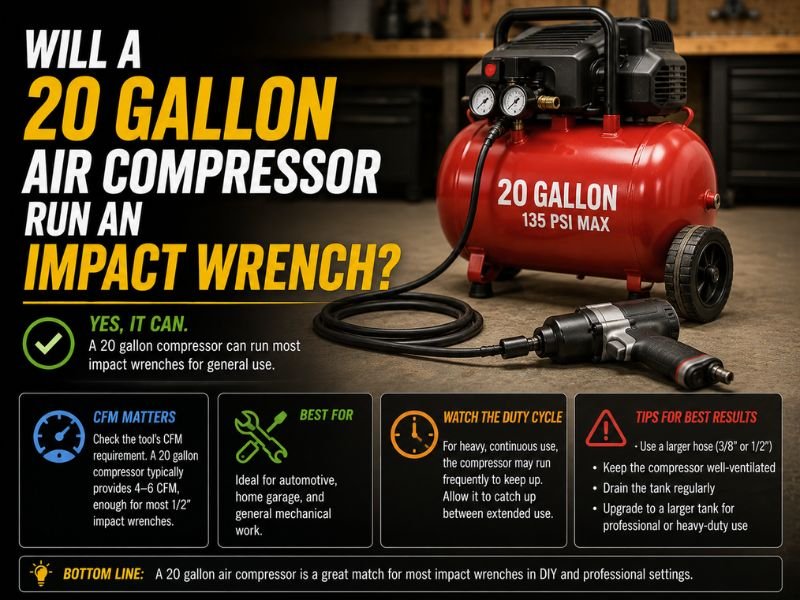
In many cases, yes.
A 20-gallon compressor is commonly suitable for:
- Occasional lug-nut removal
- Light automotive repair
- Short bursts with a 1/2-inch impact wrench
- Many 3/8-inch pneumatic impacts
- General home-garage use
The answer becomes less certain when you need:
- Continuous impact-wrench operation
- High-output 1/2-inch tools
- Large 3/4-inch impacts
- Heavy truck work
- Long periods of repeated fastener removal
The tank gives you stored air, but once the impact wrench starts consuming air faster than the pump can replace it, tank pressure begins to fall.
That is why a 20-gallon compressor can feel powerful at first and then gradually lose performance if the wrench is used continuously.
Why SCFM Matters More Than Tank Size
Tank size tells you how much compressed air is stored.
SCFM tells you how much air the compressor can continuously deliver.
Those are two different things.
Tank Size
A larger tank provides:
- Longer burst runtime
- More stored air
- Fewer immediate pressure drops
- More time before compressor recovery becomes noticeable
SCFM
SCFM determines:
- How quickly used air is replaced
- Whether the tool can run continuously
- How fast the tank recovers
- How well the compressor keeps up with repeated impact use
For impact-wrench compatibility, SCFM at the tool’s operating pressure is usually more important than gallons alone.
How Much Air Does an Impact Wrench Need?
There is no single air-consumption number for every impact wrench.
Requirements vary with:
- Drive size
- Tool design
- Impact mechanism
- Torque output
- Operating pressure
- How long the trigger is held
Many pneumatic impact wrenches are designed around approximately 90 PSI operating pressure.
Their average air consumption may fall in the range of several CFM, while actual consumption during continuous loaded operation can be much higher.
This distinction matters because impact wrenches are often used intermittently.
You may pull the trigger for two or three seconds, stop, move to another fastener, and then use the tool again.
A compressor can sometimes support this pattern even if its pump cannot match the wrench’s full loaded airflow continuously.
Average CFM vs. Air Consumption Under Load
Impact-wrench specifications can list more than one airflow number.
Average Air Consumption
This often assumes intermittent tool use.
It is useful when estimating typical garage operation.
Air Consumption at Load
This reflects how much air the wrench may consume while actually working hard.
That number can be much higher.
A 20-gallon compressor may handle average intermittent demand reasonably well while still falling behind during long, continuous impacting on a seized fastener.
This is why both the numbers and your actual work pattern matter.
Is a 20 Gallon Compressor Big Enough for a 1/2-Inch Impact Wrench?
Often, yes.
A 20-gallon compressor can be a practical match for many 1/2-inch pneumatic impact wrenches when used intermittently.
The setup works best when:
- Compressor output is close to or above the wrench’s average air demand
- Tank starts fully charged
- Regulated pressure is correct
- Hose is properly sized
- Fittings are not excessively restrictive
- Trigger use is relatively short
You may notice limitations if:
- Compressor has low SCFM
- Wrench is a high-air-consumption model
- Fasteners are severely rusted
- Tool is held at full load for long periods
- Many lug nuts are removed rapidly
The tank size is helpful, but the pump still needs enough airflow to recover efficiently.
Can a 20 Gallon Compressor Remove Lug Nuts?
Yes, a properly matched 20-gallon compressor and 1/2-inch impact wrench can be suitable for lug-nut removal.
However, the compressor is only one part of the system.
Whether the lug nut comes loose depends on:
- Wrench torque capability
- Compressor airflow
- Air pressure at the tool
- Hose diameter
- Coupler restriction
- Lug-nut condition
- Corrosion
- How tightly the nut was installed
A good impact wrench supplied with enough air may remove ordinary lug nuts quickly.
A seized or heavily overtightened lug nut may require longer impacting, which can drain the tank faster and expose an undersized compressor pump.
Is 4 CFM Enough for an Impact Wrench?
It can be enough for some impact wrenches in intermittent use.
If the wrench averages around 4 CFM, a compressor producing approximately that amount at the required pressure may be workable.
However, there is little performance margin.
During extended use, you may notice:
- Compressor running frequently
- Falling tank pressure
- Slower recovery
- Reduced wrench performance
For occasional home-garage work, that may be acceptable.
For repeated automotive work, more airflow is usually more convenient.
Is 6 CFM Enough for a 1/2-Inch Impact Wrench?
For many 1/2-inch pneumatic impact wrenches, around 6 CFM at 90 PSI is a much more comfortable range for intermittent use.
That does not mean every 1/2-inch wrench needs exactly 6 CFM.
Some require less, while others demand more.
But a compressor supplying airflow near or above the wrench’s average requirement is less dependent on tank reserve and can recover faster between fasteners.
The practical result is:
- Longer useful runtime
- Less waiting
- More consistent tool speed
- Better repeated-use performance
Why a 20 Gallon Tank Helps
Compared with a small pancake compressor, a 20-gallon tank provides much more stored air.
When you pull the trigger:
- The wrench draws air from the tank.
- Tank pressure starts falling.
- Compressor motor begins running when pressure reaches its cut-in point.
- Pump replaces the air being used.
- If the pump cannot match tool consumption, tank pressure continues falling.
A larger tank delays that pressure drop.
This gives you more time to complete short jobs before the compressor needs substantial recovery.
But the tank cannot compensate forever for inadequate pump output.
Does Higher Maximum PSI Mean Better Impact-Wrench Performance?
Not necessarily.
A compressor might advertise:
- 135 PSI
- 150 PSI
- 175 PSI
- 200 PSI
But the impact wrench may be designed to operate around 90 PSI.
The regulator controls the pressure delivered to the tool.
A higher tank-pressure rating can increase the amount of stored compressed air, but it does not automatically mean the compressor has more SCFM.
A 200-PSI compressor with low airflow may still perform worse in continuous impact use than a lower-pressure compressor with much stronger SCFM output.
Can You Run an Impact Wrench Continuously on a 20 Gallon Compressor?
That depends mainly on the pump.
A low-output 20-gallon compressor may:
- Run the wrench well initially
- Lose pressure during extended use
- Require regular pauses
- Run its motor almost constantly
A higher-output 20-gallon compressor may:
- Keep up much better
- Recover faster
- Maintain steadier pressure
- Reduce waiting between fasteners
Continuous compatibility should therefore be judged by airflow, not gallons.
Will a 20 Gallon Compressor Run a 3/8-Inch Impact Wrench?
Often, yes.
Many 3/8-inch impact wrenches have moderate airflow requirements, making them a natural match for a 20-gallon compressor.
However, do not assume drive size alone tells you air demand.
Some compact high-performance tools still consume substantial airflow.
Always check the exact wrench specification before deciding.
Will a 20 Gallon Compressor Run a 3/4-Inch Impact Wrench?
Possibly, but this is a much more demanding application.
A 3/4-inch pneumatic impact wrench is often intended for:
- Heavy automotive work
- Trucks
- Large suspension components
- Industrial fasteners
These tools can consume considerably more air than a typical 1/2-inch wrench.
A low-SCFM 20-gallon compressor may power one for a short burst but struggle during repeated use.
A higher-output 20-gallon unit has a better chance, but the exact compressor and wrench still need to be matched by airflow.
Does Air Hose Size Matter?
Yes.
A compressor can have adequate SCFM and still make the impact wrench feel weak if the hose is too restrictive.
Airflow can be affected by:
- Hose inside diameter
- Hose length
- Quick-connect fittings
- Regulator capacity
- Leaks
Many full-size pneumatic impact wrenches are commonly paired with a 3/8-inch hose or whatever minimum diameter the manufacturer specifies.
A long or undersized hose increases pressure drop.
That means the wrench may receive less usable air than the compressor itself is capable of producing.
Why Does My Impact Wrench Lose Power on a 20 Gallon Compressor?
Several problems can cause this.
Compressor SCFM Is Too Low
The pump cannot replace air as fast as the wrench consumes it.
Tank Pressure Is Falling
The wrench starts strong and weakens after several seconds.
Regulator Is Set Too Low
Tank pressure may be high while outlet pressure is insufficient.
Hose Is Too Small
Restrictive hose reduces airflow.
Hose Is Too Long
Longer lines increase pressure loss.
Fittings Are Restrictive
Small couplers can reduce usable air.
Air Leaks Are Present
Leaks waste compressor capacity.
Impact Wrench Needs Maintenance
Some pneumatic tools require lubrication and regular service.
Fastener Is Too Difficult
The wrench itself may not have enough torque.
Signs Your 20 Gallon Compressor Is Too Small
Watch for:
- Wrench starts strong then slows
- Compressor runs almost continuously
- Tank pressure drops rapidly
- You need long pauses between fasteners
- Tool becomes noticeably weaker during extended use
- Performance improves only after tank refills
These symptoms usually indicate that tool demand is exceeding available airflow.
How to Get Better Impact-Wrench Performance
Start With a Full Tank
Let the compressor reach normal cut-out pressure before starting.
Set Correct Working Pressure
Follow the impact-wrench manufacturer’s specification.
Use the Right Hose
Use the recommended inside diameter.
Avoid Excessively Long Hose Runs
Shorter runs generally reduce pressure loss.
Use Adequate-Flow Fittings
Restrictive couplers can become bottlenecks.
Fix Leaks
Even small leaks waste available air.
Maintain the Wrench
Follow lubrication and service instructions.
Use Short Bursts When Necessary
If compressor output is marginal, intermittent use gives the tank time to recover.
20 Gallon vs. 6 Gallon Compressor for an Impact Wrench
| Feature | 6-Gallon Compressor | 20-Gallon Compressor |
| Stored air | Limited | Much greater |
| Short impact bursts | Often possible | Better |
| Repeated lug work | Limited | More practical |
| Recovery interruptions | More frequent | Usually less frequent |
| Portability | Better | Lower |
| Continuous use | SCFM-dependent | Still SCFM-dependent |
The 20-gallon tank clearly provides more reserve.
But if both compressors use similarly low-output pumps, neither will necessarily support long continuous impact use very well.
What SCFM Should You Look For?
Start with the impact wrench, not the compressor.
Follow this process:
- Find the wrench’s required operating pressure.
- Find its average air consumption.
- Check the compressor’s SCFM at that pressure.
- Compare the numbers.
- Prefer some airflow margin for frequent use.
If your wrench averages about 5 CFM and the compressor produces significantly less, expect more reliance on tank storage and more recovery time.
If the compressor produces around 5 CFM or more, intermittent use should generally feel much more consistent for a tool with that average demand.
Common Mistakes
Choosing by Gallons Alone
A 20-gallon tank does not tell you pump output.
Looking Only at Maximum PSI
Pressure is only half of the requirement.
Ignoring SCFM at 90 PSI
This is the key continuous-airflow specification for many impact tools.
Assuming All 20-Gallon Compressors Are Equal
They can have very different pumps.
Increasing Pressure to Make Up for Low Airflow
Do not exceed the tool’s specified operating pressure.
Using an Undersized Hose
Restricted airflow can make the wrench feel weaker than it should.
Assuming a Bigger Tank Creates More CFM
Tank capacity increases stored air, not pump output.
Frequently Asked Questions
Will a 20 Gallon Air Compressor Run an Impact Wrench?
Yes, many 20-gallon compressors can run pneumatic impact wrenches, especially for intermittent automotive use. Check SCFM at the tool’s operating pressure.
Is a 20 Gallon Compressor Big Enough for a 1/2-Inch Impact?
Often, yes. Many 1/2-inch impacts work well intermittently when the compressor provides enough airflow.
Can a 20 Gallon Compressor Remove Lug Nuts?
Yes, if the impact wrench has enough torque and receives adequate air pressure and airflow.
How Many CFM Does a 1/2-Inch Impact Wrench Need?
It varies by model. Always check the exact wrench specification rather than assuming all 1/2-inch impacts use the same amount of air.
Is 4 CFM Enough for an Impact Wrench?
It can be workable for some intermittent applications, but higher-demand tools may require recovery pauses.
Is 6 CFM Enough for a 1/2-Inch Impact Wrench?
For many 1/2-inch impacts, around 6 CFM at 90 PSI can be a practical airflow level for intermittent work, depending on the exact tool.
Is 150 PSI Enough for an Impact Wrench?
Maximum tank pressure is not the main issue. The compressor also needs adequate SCFM at the wrench’s specified operating pressure.
Can a 20 Gallon Compressor Run an Impact Continuously?
Only if the compressor pump can supply enough airflow to match the wrench’s continuous demand.
Can a 20 Gallon Compressor Run a 3/4-Inch Impact?
Possibly, but large 3/4-inch impacts can require substantial airflow. Check the exact compressor and wrench specifications.
Does a Bigger Tank Make an Impact Wrench Stronger?
Not directly. A larger tank provides more reserve air, but wrench performance still depends on pressure and airflow.
What Hose Size Should I Use for an Impact Wrench?
Use the minimum hose diameter specified by the wrench manufacturer. Many full-size pneumatic impacts benefit from a 3/8-inch hose.
Why Does My Impact Wrench Lose Power?
Common causes include low compressor SCFM, falling tank pressure, low regulator setting, restrictive hose or fittings, leaks, and tool-maintenance problems.
Conclusion
If you’re asking “will a 20 gallon air compressor run an impact wrench,” the answer is yes for many pneumatic impact wrenches, especially for intermittent automotive work, but the compressor’s SCFM at the required operating pressure matters more than the 20-gallon tank size by itself.
The 20-gallon tank gives you a substantial reserve of compressed air compared with a small pancake compressor. That extra reserve helps with lug nuts, suspension bolts, and other short impact-wrench jobs because the tool can draw from stored air before pump output becomes the limiting factor.
However, different 20-gallon compressors can have very different airflow ratings. A low-output model may work well in bursts but require frequent recovery, while a higher-SCFM unit can keep a 1/2-inch impact wrench supplied much more consistently.
Pay attention to the entire air system:
- SCFM at working pressure
- Regulator setting
- Hose diameter
- Hose length
- Fittings
- Air leaks
- Impact-wrench demand
Tank gallons and maximum PSI alone do not tell you whether the setup is properly matched.
For most occasional 1/2-inch impact-wrench jobs, a properly matched 20-gallon compressor can be a practical choice. For continuous or high-demand pneumatic work, prioritize compressor SCFM and recovery performance rather than tank size alone.