Is a Stud Finder a Metal Detector? How Each Tool Actually Works
Is a stud finder a metal detector? Usually, no. A standard electronic stud finder is primarily designed to locate changes behind a wall that may indicate wood or metal framing, while a dedicated metal detector is specifically designed to sense metal. However, some advanced stud finders include a separate metal-scanning mode, so those models can function as limited wall-mounted metal detectors.
This distinction matters because a stud finder can sometimes react to metal without actually identifying the object as metal. For example, screws, pipes, metal studs, protective plates, and other dense materials can affect a normal stud scan. The tool may indicate that something is behind the drywall, but that does not necessarily mean it knows whether the object is wood, metal, or something else.
There are also simple magnetic stud finders that locate the screws or nails holding drywall to the framing. These rely directly on magnetic attraction to ferrous metal, making them different from both electronic stud finders and conventional metal detectors.
If your goal is simply to hang a shelf or picture, a normal stud finder is usually the more useful tool. If you specifically need to find metal pipes, rebar, metal studs, or concealed hardware, a multi-scanner with a dedicated metal mode or a proper metal detector is generally the better choice.
In this guide, I’ll explain exactly how stud finders and metal detectors work, why a stud finder sometimes detects metal, how to locate metal studs, what metal-scan modes can and cannot detect, how magnetic stud finders differ, and which tool you should use before drilling into a wall.
Is a Stud Finder a Metal Detector?

A regular stud finder and a metal detector are designed for different jobs.
A stud finder is designed primarily to locate framing or other hidden objects behind surfaces such as drywall. Many common electronic models do this by sensing changes in the electrical properties of the material beneath the scanner.
A metal detector, by contrast, is designed specifically to detect metal by producing and measuring electromagnetic effects.
This means a standard stud finder may respond when it passes over a metal object, but that does not automatically make it a true metal detector.
The easiest way to understand the difference is to consider what each tool is trying to answer.
A stud finder is generally answering:
“Where is the framing or a significant object behind this wall?”
A metal detector is answering:
“Is there metal here?”
Some multifunction wall scanners can answer both questions because they contain separate detection capabilities for wood framing, metal, and sometimes energized electrical wiring.
Standard Stud Finder vs Metal Detector
| Feature | Standard Stud Finder | Metal-Scan Stud Finder | Dedicated Metal Detector |
| Finds wood studs | Yes | Yes | Usually no |
| Finds metal studs | Often detects their location | Yes | Detects the metal |
| Identifies metal specifically | Usually no | Yes, within its designed range | Yes |
| Finds nails and screws | May react to them | Usually | Yes |
| Finds copper pipe | Unreliable in normal stud mode | Often possible | Usually |
| Finds rebar | Usually not its main purpose | Some models can | Appropriate detectors can |
| Designed for wall scanning | Yes | Yes | Depends on detector type |
| Finds buried outdoor metal | No | No | Some dedicated detectors do |
The important point is that the detection technology and intended application matter more than the name printed on the tool.
Key Takeaways:
- A standard stud finder is not the same thing as a dedicated metal detector.
- Some advanced stud finders include a separate metal-detection mode.
- A normal stud scan may react to metal without identifying the object as metal.
- Choose the tool according to what you actually need to locate.
How Does an Electronic Stud Finder Work?
Most electronic stud finders do not literally “see” the stud.
Instead, they measure changes in the wall that occur when framing or another dense object is located behind the surface.
Many electronic stud finders use capacitive sensing. The device creates a small electrical field and monitors how the wall affects that field.
Drywall over an empty cavity produces one type of reading.
When the scanner moves over a wood or metal stud, the material behind the drywall changes the electrical characteristics detected by the sensor.
The electronics then interpret that change and illuminate an indicator, display the stud edge, or identify the probable stud center.
Why Calibration Matters on Some Stud Finders
Many traditional electronic stud finders calibrate themselves against the section of wall where you first place them.
They establish a baseline and then look for changes as you move the tool sideways.
If you accidentally begin directly over a stud, dense material, or irregular wall section, some models may calibrate incorrectly and give confusing results.
Other designs use multiple sensors at the same time and may require less manual calibration.
The operating method therefore depends on the particular stud finder.
Can an Electronic Stud Finder Detect Both Wood and Metal Studs?
Often, yes—but there is an important distinction.
A normal stud-finding mode may detect a change in density or electrical properties caused by either a wood stud or metal stud.
The tool may therefore identify where the framing is without necessarily telling you what the framing is made from.
This is why a stud finder can sometimes locate a metal stud even though it is not operating like a dedicated metal detector.
A model with a separate metal mode gives you more information because you can rescan the location specifically for metal.
How Does a Metal Detector Work?
A dedicated metal detector generally uses electromagnetic principles.
The detector creates an electromagnetic field. When metal enters that field, it changes the signal received by the detector’s sensing circuitry.
The tool analyzes that change and indicates that metal is present.
The exact technology varies considerably between different types of metal detectors.
A detector intended for finding coins outdoors is very different from a wall scanner designed to locate rebar or copper pipe inside a building.
Wall Metal Detectors
Wall-scanning metal detectors are designed to find objects such as:
- Metal studs
- Nails
- Screws
- Steel pipe
- Copper pipe
- Rebar
- Metal conduit
- Protective nail plates
Their sensing range is designed for building materials rather than for searching several inches into soil.
Outdoor Metal Detectors
Traditional handheld metal detectors used for treasure hunting are optimized for searching soil, sand, and similar environments.
They can find items such as coins, jewelry, and other buried metal.
They are generally not the practical choice for identifying framing behind drywall.
The fact that both tools detect metal does not mean they are interchangeable.
Why Does My Stud Finder Detect Metal?
There are several reasons a stud finder may react when it passes over metal.
First, the metal may actually be part of the framing.
Many commercial buildings and some residential walls use metal studs rather than wood studs.
Second, the scanner may be reacting to drywall fasteners.
Drywall is typically attached to framing with screws or nails. Those fasteners form predictable vertical lines over the studs, which is why magnets can sometimes be used to locate framing.
Third, the object may not be a stud at all.
A wall can contain:
- Water pipes
- Electrical conduit
- Wiring
- Protective metal plates
- HVAC components
- Brackets
- Fasteners
- Other construction hardware
This is one reason you should not assume every stud-finder alert represents safe framing to drill into.
A Positive Reading Does Not Mean “Safe to Drill”
This is particularly important.
If a scanner detects something behind the drywall, you still need to determine what you found.
A water pipe and a stud can sometimes create readings in similar locations depending on the scanner and wall construction.
Electrical wiring can also cross a wall horizontally or vertically.
Before drilling or driving a long screw, confirm the stud location using more than one clue whenever concealed utilities could be present.
Stud Finders With Metal Scan Mode
Some multifunction stud finders include a dedicated Metal Scan mode.
In this mode, the tool is intentionally searching for metal rather than simply looking for stud-like changes behind the wall.
Depending on the model, metal mode may detect both:
Ferrous metal, which contains iron and is generally magnetic, and non-ferrous metal, such as copper.
This can help locate:
- Metal framing
- Steel fasteners
- Rebar
- Copper pipe
- Steel pipe
- Metal conduit
Detection depth depends on the scanner, object size, object orientation, and wall material.
A large metal pipe is generally easier to detect than a tiny screw at the same depth.
Metal Mode Can Help Confirm a Metal Stud
Suppose normal stud mode identifies a vertical framing member.
Switch to metal mode and scan the same area vertically.
If the detector indicates a continuous metal object running through much of the wall height, you may have located a metal stud.
If it finds only small isolated metal points at regular intervals, those points may simply be drywall screws or nails attached to a wood stud.
This is a useful way to distinguish between framing types.
Key Takeaways:
- Electronic stud finders usually identify changes behind the wall rather than directly identifying material type.
- A separate metal-scan mode is more useful when you specifically need to determine whether an object is metal.
- A continuous vertical metal signal may indicate a metal stud, while isolated points may be fasteners.
- Never assume a hidden-object indication means the location is automatically safe to drill.
Are Magnetic Stud Finders Metal Detectors?
In a very basic sense, magnetic stud finders locate metal, but they work differently from electronic metal detectors.
A magnetic stud finder contains one or more strong magnets.
As you move it across drywall, the magnet is attracted to steel screws or nails holding the drywall to the framing.
You are usually not detecting the wood stud directly.
You are finding the metal fasteners attached to the stud and using their location to infer where the stud is.
Why Magnetic Stud Finders Can Be Surprisingly Effective
Drywall screws are generally installed into framing.
If you find one screw and then locate another directly above or below it, the vertical line strongly suggests a framing member.
You can then verify the expected stud width and spacing.
Magnetic finders have several advantages.
They do not require batteries, calibration, or complicated controls.
They can also work well on walls that cause electronic stud finders to behave inconsistently.
Their biggest disadvantage is that they may require more patience because the target fasteners are small.
Can a Magnet Find Metal Studs?
Yes, because steel studs themselves are magnetic.
However, a simple magnet may not tell you clearly whether it is attracted to the metal stud body or to screws attached to framing.
You still need to interpret the pattern.
Can a Stud Finder Detect Metal Studs?
Yes, many electronic stud finders can locate metal studs.
In ordinary stud mode, the tool may detect the difference between an empty wall cavity and the area containing the metal framing.
However, it may display the result in the same way it displays a wood stud.
If knowing the framing material matters, use one of these additional methods:
Scan with a dedicated metal mode, use a strong magnet, examine visible framing elsewhere in the building, or check construction documents if available.
How to Find a Metal Stud With a Stud Finder
Start by scanning horizontally across the wall in normal stud mode.
Mark both edges of the detected framing area.
Then repeat the scan several inches higher and lower.
A genuine stud should normally continue vertically through the wall, except where framing changes around windows, doors, blocking, or other structural features.
If your scanner has metal mode, rescan vertically over the suspected stud.
A continuous metal response provides stronger evidence that the framing member itself is metal.
This is more reliable than making a decision from one quick horizontal scan.
Can a Stud Finder Detect Nails and Screws?
Yes, depending on the type of stud finder.
A magnetic stud finder specifically depends on finding steel nails or screws.
A stud finder with a metal mode can also detect many fasteners.
A conventional electronic stud finder may sometimes react to fasteners, particularly if they are close to the wall surface, but the result may not be displayed as a specific screw or nail.
Small fasteners can actually be useful because their layout helps confirm framing.
If you find several screws forming a straight vertical line, they are probably attached to the same framing member.
Can a Stud Finder Detect Metal Pipes?
Some can.
A stud finder equipped with metal detection may locate metal plumbing, including steel or copper components, depending on depth and scanner capability.
A conventional stud finder without metal mode is far less dependable for this purpose.
It may react to the pipe but cannot necessarily identify what caused the reading.
Copper Is Different From Steel
Copper is non-ferrous, meaning a simple magnet generally will not locate it.
A magnetic stud finder therefore cannot be relied on to find copper plumbing.
An electronic scanner specifically capable of detecting non-ferrous metal is more appropriate.
Steel pipe, on the other hand, may respond strongly to a magnet as well as to electronic metal detection.
Can a Stud Finder Detect Electrical Wiring?
Some stud finders include AC-wire detection, but it should be considered an additional warning feature rather than a guarantee that an area contains no wiring.
Wire detection can be affected by conditions such as:
- Wire depth
- Whether the conductor is energized
- Moisture
- Shielding
- Wall material
- Scanner orientation
- How the user holds the tool
Metal conduit may also influence readings differently from ordinary nonmetallic electrical cable.
Do Not Trust a “No Wire” Reading as Proof
This is one of the most important safety rules when using a wall scanner.
Failure to receive an electrical warning does not prove that there is no wire behind the wall.
Before drilling, use sensible construction knowledge and avoid locations where plumbing or wiring is likely to run.
Be particularly cautious above, below, and beside electrical outlets, switches, plumbing fixtures, and utility panels.
Where the risk is meaningful, disconnecting the relevant electrical circuit and using appropriate additional detection methods is safer than relying solely on a stud finder.
Metal Detector vs Stud Finder: Which One Should You Use?
The right tool depends on your goal.
Hanging Pictures, Shelves, or a TV
Use a stud finder.
The important information is normally where the framing sits behind the drywall.
A center-finding or multi-sensor stud finder can make this process faster.
Finding Metal Studs
Use a stud finder that includes metal mode, or combine an electronic stud finder with a strong magnet.
The stud scan helps locate framing, while metal detection helps identify the material.
Finding Pipes
Use a scanner designed to detect metal or multiple wall materials.
A simple stud finder is not enough if your actual goal is to locate plumbing.
Keep in mind that plastic PEX, PVC, and CPVC pipes may not be detectable using metal detection.
Finding Rebar
Use a wall or concrete scanner designed for metal detection at the required depth.
A basic stud finder intended for drywall is not the right tool.
Finding Buried Coins or Outdoor Metal
Use a dedicated outdoor metal detector.
A stud finder is not designed for searching soil.
Finding Drywall Screws
A magnetic stud finder is often the simplest and least expensive solution.
You can follow the fastener pattern to estimate the location of the stud.
Key Takeaways:
- Use a stud finder when your main goal is locating wall framing.
- Use dedicated metal mode when you specifically need to locate or identify metal.
- A magnetic stud finder is excellent for locating drywall fasteners but is not the same as a full electronic metal detector.
- Specialized jobs such as rebar scanning or buried-metal detection require specialized equipment.
How to Tell If You Found a Stud or a Metal Pipe
This is one of the biggest practical problems when scanning walls.
The best strategy is to look at the shape and continuity of the reading rather than relying on a single alert.
A wall stud typically runs vertically for most of the wall height.
After finding a possible stud, scan at several heights.
If the object remains at the same horizontal position as you move up and down the wall, framing becomes more likely.
A pipe may behave differently.
It might run vertically for some distance and then turn horizontally through an elbow. In that case, your reading may suddenly change direction or disappear.
Checking neighboring stud spacing also helps.
If several similar readings appear at roughly regular framing intervals, they are more likely to represent studs.
Still, no pattern is foolproof.
Plumbing risers and electrical conduit can also run vertically.
Can a Stud Finder Detect Protective Nail Plates?
Possibly, particularly if the tool has metal mode.
Protective steel plates are commonly installed over framing where wiring or pipes pass through areas that might otherwise be hit by screws or nails.
If you encounter a strong metal reading over a relatively small section of a stud, the object could be a protective plate.
That is an important warning.
Do not simply switch to a longer drill bit and try to force your way through the obstruction.
A protective plate is deliberately placed there to stop fasteners from reaching a concealed utility.
If your drill or screw encounters unexpected metal inside framing, stop and investigate rather than assuming the obstruction is harmless.
Why Stud Finders Sometimes Give False Readings
Stud finders are useful, but walls are rarely perfectly uniform.
Readings can be affected by:
- Uneven drywall thickness
- Multiple drywall layers
- Lath and plaster
- Foil-backed insulation
- Metal mesh
- Wallpaper
- Moisture
- Pipes
- Wiring
- Fasteners
- Blocking
- Cabinets or materials attached on the opposite side
Stucco and plaster walls can be especially challenging because metal lath may interfere with normal detection.
Start With a Clean Wall Area
When possible, begin the scan on an area that you reasonably expect to be an empty wall cavity.
Follow your stud finder’s calibration instructions exactly.
Move slowly and keep the scanner flat against the surface.
Repeat the scan from both directions.
If the edge locations agree, you have stronger evidence of the stud position.
Scan at Several Heights
A single horizontal scan can misidentify pipes, wires, and blocking.
Repeating the scan higher and lower gives you more information about the shape of the hidden object.
This simple step can substantially improve confidence.
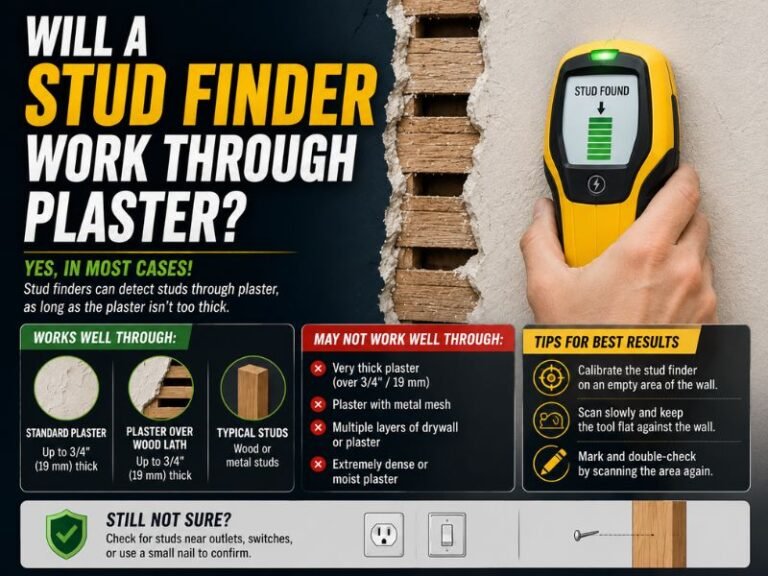
Can a Stud Finder Detect Through Plaster?
Sometimes.
Plaster walls are more difficult than standard drywall because they can have inconsistent thickness and may include wood or metal lath.
Some deeper-scanning stud finders can work through certain plaster assemblies, while others struggle.
If the wall includes metal lath, a metal detector may respond across a broad area, making it difficult to isolate individual framing members.
In that situation, other techniques can help, such as locating electrical boxes, using magnetic fastener detection where practical, or examining framing from an accessible opposite side.
Can a Stud Finder Detect Through Tile?
Results vary considerably.
Tile, mortar, backer board, waterproofing membranes, and other layers can make electronic readings difficult to interpret.
Some scanners are designed for deeper or multi-material detection, but a basic drywall stud finder may not work reliably through a tiled wall.
If the opposite side of the wall is accessible drywall, scanning from there can be easier.
You can then transfer the measurements to the tiled side.
Can a Metal Detector Replace a Stud Finder?
Usually not.
A metal detector can help you locate screws and nails attached to studs, but wood framing itself is not metal.
That means a metal detector may give you an indirect clue rather than directly identifying the full width of the wood stud.
A dedicated stud finder usually makes it easier to locate both stud edges and estimate the center.
This becomes especially important when installing:
- Heavy shelves
- Wall cabinets
- TV mounts
- Grab bars
- Structural hardware
For these jobs, I would use a stud finder as the primary framing tool and metal detection as a confirmation method when useful.
Can a Stud Finder Replace a Metal Detector?
Again, usually not.
A basic stud finder is optimized for detecting framing changes behind a relatively thin wall covering.
It is not designed to search broadly for arbitrary metal objects.
If you need to locate copper plumbing, rebar, steel pipe, conduit, or hidden metal hardware, use a tool specifically designed for metal detection.
A multifunction wall scanner can provide both capabilities without requiring two completely separate tools.
Are 3-in-1 and 4-in-1 Stud Finders Worth It?
They can be, particularly if you regularly drill into finished walls.
A multi-mode scanner may provide separate settings for:
- Standard stud scanning
- Deep stud scanning
- Metal detection
- AC-wire detection
This gives you more information than a basic stud finder.
For occasional picture hanging, however, a simple stud finder or magnetic finder may be all you need.
I would choose the more advanced scanner when the wall work regularly involves plumbing, metal framing, remodeling, cabinets, electrical installations, or deeper fasteners.
The additional detection modes can reduce guesswork, though none eliminates the need for sensible drilling precautions.
Magnetic vs Electronic Stud Finder
Neither design is universally better.
A magnetic finder is inexpensive, simple, and dependable at finding ferrous fasteners.
It has no battery and does not need calibration.
The tradeoff is that it finds fasteners rather than directly mapping changes across the whole stud.
An electronic stud finder can identify stud edges and centers much faster, especially on standard drywall.
However, readings depend on the wall construction and scanner quality.
For difficult walls, I often prefer using both approaches.
If the electronic scanner identifies a stud and a magnet also finds a vertical line of drywall screws in the same area, your confidence is much higher.
Important Safety Tips Before Drilling Into a Wall
Finding a stud is only part of the job.
Walls may also contain electrical wiring, plumbing, gas lines, ductwork, and other concealed systems.
Before drilling, consider what is located on both sides of the wall.
An electrical outlet or switch nearby suggests that wiring may travel through the framing.
A sink, shower, toilet, or appliance may indicate plumbing behind the wall.
If you detect an unexpected metal object, do not assume it is simply a drywall screw.
It could be a pipe or a protective plate installed specifically to stop you from drilling into a utility.
Important Tip: If you encounter a steel plate while drilling into a stud, stop. Do not drill through it simply because you want the screw deeper. The plate may be protecting electrical wiring or plumbing.
FAQs about Is a Stud Finder a Metal Detector
Is a stud finder basically a metal detector?
No. A standard electronic stud finder normally detects changes behind the wall that indicate framing or another object. A metal detector is specifically designed to sense metal.
Some stud finders include a separate metal-detection mode, which gives them both capabilities.
Can a stud finder detect metal?
Yes. Many stud finders can detect or react to metal studs and other dense objects.
A model with dedicated metal mode is better if you need to confirm that the object itself is metal.
Can a stud finder tell the difference between wood and metal?
A basic electronic stud finder may not.
It can often locate both types of framing but display them similarly.
A multi-scanner with metal mode can help determine whether the detected stud is metal.
Can a stud finder find metal studs?
Yes. Many electronic stud finders can locate metal framing.
Confirm the reading at several heights and use a metal mode or magnet if you need to distinguish metal studs from wood framing.
Can a stud finder find copper pipes?
Only some models.
A scanner with non-ferrous metal detection may locate copper pipe within its rated depth.
A magnetic stud finder will not reliably detect copper because copper is not ferromagnetic.
Can a stud finder detect steel pipes?
A stud finder with metal-detection capability may detect steel pipe.
A strong magnet may also respond to ferrous steel plumbing.
Do not confuse a pipe reading with a safe stud location.
Does a stud finder detect screws?
Many do.
Magnetic stud finders specifically locate steel screws or nails, while electronic models with metal mode may also detect them.
Why does my stud finder keep detecting metal everywhere?
The wall may contain metal studs, metal lath, foil-backed materials, conduit, many fasteners, or another metallic building component.
Try scanning at different heights and using the correct detection mode for your wall construction.
Can a stud finder detect rebar?
Some advanced wall scanners with metal mode can detect rebar.
A basic drywall stud finder is not the ideal tool for mapping steel reinforcement inside concrete.
Use a detector designed for metal or concrete scanning.
Is a magnetic stud finder better than an electronic stud finder?
It depends on the job.
Magnetic finders are simple and reliable for locating steel drywall fasteners. Electronic stud finders are generally faster for identifying stud edges and centers.
Using both can provide useful confirmation.
Can I use a metal detector to find wall studs?
A metal detector can locate screws or nails attached to wood studs, allowing you to infer the stud location.
It will not directly detect the wood itself.
For normal drywall work, a stud finder is generally easier to use.
Can a stud finder find electrical wires?
Some stud finders provide live-wire or AC detection.
However, the feature has limitations and should never be treated as proof that an area is safe to drill simply because no warning appears.
Can a stud finder detect plumbing?
A basic stud finder is not designed as a plumbing detector.
Metal-scan models may locate metal pipes, but plastic PEX, PVC, and CPVC can be much harder or impossible to detect using metal detection.
Does a stud finder detect nails instead of wood?
Magnetic stud finders do exactly that—they locate steel nails or screws and use them as clues to the framing location.
Electronic stud finders generally sense changes associated with the framing itself rather than depending entirely on the fasteners.
What is the best way to confirm a stud?
Scan from both directions, mark both edges, find the center, repeat the scan at several heights, and check whether neighboring studs follow a logical spacing pattern.
Using a magnet to confirm drywall fasteners can provide additional confidence.
Conclusion
So, is a stud finder a metal detector? A standard stud finder is generally not a true metal detector. Its primary purpose is to locate framing or changes behind a wall, and many electronic models do this using capacitive sensing rather than dedicated metal-detection technology.
That does not mean stud finders cannot locate metal. A conventional model may detect a metal stud because the framing changes the scanner’s reading, while a magnetic stud finder finds the steel screws or nails attached to framing. More advanced multi-scanners go further by including a separate metal mode that can intentionally search for ferrous and, depending on the model, non-ferrous metal.
For ordinary tasks such as hanging shelves, pictures, cabinets, or a TV, I recommend using a stud finder first. If you specifically need to identify metal studs, plumbing, conduit, rebar, or hidden hardware, use a scanner with dedicated metal detection or an appropriate specialized detector.
Most importantly, do not interpret any single scanner reading as permission to drill. Walls can contain studs, pipes, wiring, fasteners, and protective steel plates in the same area. Scan from multiple directions and heights, verify the framing pattern, and investigate unexpected metal before penetrating the wall.
The practical difference is simple: a stud finder tells you where framing or another significant hidden object may be, while a metal detector specifically tells you where metal is present. Some modern wall scanners combine both jobs, but knowing which mode you are using is essential for interpreting the result correctly.