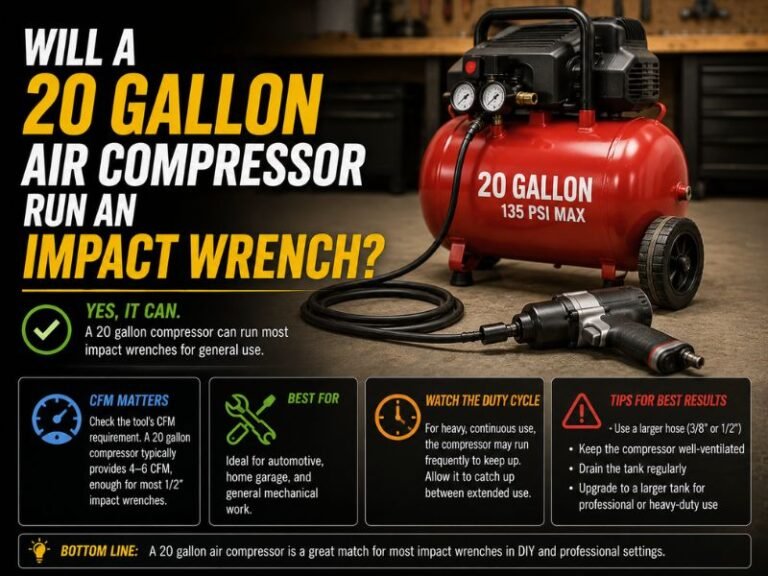
Will a 8 Gallon Air Compressor Run an Impact Wrench Key Facts
Yes, an 8-gallon air compressor can run an impact wrench, but usually for short bursts rather than continuous work. Whether it performs well depends more on the compressor’s delivered CFM at 90 PSI, the impact wrench’s air demand, and how often the tool is used than on the 8-gallon tank size alone.
The choice becomes less obvious when the goal is reliable torque instead of simply making the tool spin. A small compressor may loosen a few lug nuts, yet lose pressure before a stubborn fastener breaks free. That can lead to repeated waiting, reduced impact force, or the temptation to keep working while the compressor struggles to recover.
This guide explains the relationship between tank capacity, airflow, pressure, and impact-wrench size. You will learn how to compare the compressor and tool ratings, what an 8-gallon unit can realistically handle, when a larger compressor is the better choice, and how to test the setup safely before depending on it for a repair.
What determines whether the compressor will work
An impact wrench uses compressed air in rapid pulses, so the compressor must supply enough air to maintain useful pressure while the tool operates. The tank stores a limited reserve, but the pump’s airflow determines how quickly that reserve is replaced.
Three specifications matter most:
- Airflow at 90 PSI, usually listed as CFM or SCFM, shows how much usable air the compressor delivers while operating.
- Operating pressure tells you whether the compressor can reach the wrench’s required PSI.
- Tank capacity determines how long the tool can draw from stored air before pressure falls and the pump must catch up.
A compressor can have an 8-gallon tank and still be a poor match for an impact wrench if its pump produces limited airflow. Conversely, a strong pump paired with a relatively small tank may deliver acceptable short-term performance but cycle frequently.
Always compare the wrench’s required CFM with the compressor’s SCFM at 90 PSI, not just the advertised peak PSI. Maximum pressure is the highest pressure the tank can reach; it does not describe the volume of air available during tool use.
How an 8-gallon tank affects impact performance
An 8-gallon tank provides a temporary air reserve. When you pull the trigger, the wrench can use air from the tank immediately, even if the pump cannot supply the full demand by itself. This is why a small compressor may operate an impact wrench briefly despite having a modest CFM rating.
Once tank pressure drops, the pump starts rebuilding the supply. If the impact wrench consumes air faster than the pump produces it, pressure continues falling. The tool may slow down, strike with less force, or stop turning until the compressor restores pressure.
Tank size does not translate directly into operating time because the stored air is pressurized. An 8-gallon tank filled to a higher pressure contains more usable air than the same tank filled to a lower pressure, but the practical runtime also depends on the wrench’s trigger time and the minimum pressure at which the wrench remains effective.
For example, a user working one lug nut at a time may allow the compressor to recover between fasteners. Someone removing multiple rusted bolts without pauses will consume the reserve much faster. The same compressor can therefore feel adequate for occasional automotive work and frustrating for sustained mechanical work.
Matching the impact wrench to the compressor
Impact wrenches vary considerably in air consumption. A compact 3/8-inch model generally demands less air than a full-size 1/2-inch wrench, while a 3/4-inch or 1-inch tool can exceed what a portable 8-gallon compressor is designed to supply.
Check the tool label or manual for both average CFM and pressure requirements. Some manufacturers list air consumption at no load, while others provide an average use figure or a higher demand figure. No-load consumption can look reassuring but may not represent the airflow needed when the wrench is applying torque to a tight fastener.
A typical consumer 1/2-inch pneumatic impact wrench may list roughly 4 to 8 CFM at 90 PSI, although exact figures differ by model. Many 8-gallon compressors deliver less than that at 90 PSI, so they may run such a wrench only intermittently. A lower-air-demand wrench gives the compressor a better chance of maintaining pressure.
Do not assume that a higher-rated impact wrench will automatically perform better with a small compressor. The wrench may have greater maximum torque, but if it requires more airflow, the compressor can become the limiting component. A smaller wrench with a suitable air requirement may produce more consistent results.
Why delivered CFM is more important than peak horsepower
Horsepower can help describe the motor and pump, but it is not a direct substitute for airflow. Marketing labels may emphasize peak horsepower, tank size, or maximum PSI while giving less prominence to the compressor’s actual delivered CFM.
Look for the rating at 90 PSI, often called CFM at 90 PSI or SCFM at 90 PSI. If only displacement CFM or a rating at 40 PSI is shown, the figure may overstate the airflow available while an impact wrench is working against resistance.
When the tool’s stated demand is close to the compressor’s output, performance will be marginal. A useful practical margin is preferable because hose restrictions, fittings, temperature, voltage conditions, and normal rating differences can reduce the air reaching the tool.
What an 8-gallon compressor can realistically do
For occasional use, an 8-gallon compressor may be suitable for removing or installing a limited number of automotive fasteners. It can often handle a few lug nuts, light-duty suspension work, small engine repairs, and short bursts on bolts that are not heavily seized.
The compressor will work best when the tank is fully charged and the wrench is used in brief trigger pulls. Letting the pump recover between fasteners can preserve pressure and prevent the tool from becoming weak.
It is less suitable for continuous tire-service work, repeated wheel changes, production repair, or long periods of loosening rusted bolts. Those jobs require a steadier air supply than the tank alone can provide.
Tool size also changes the answer:
- 3/8-inch impact wrench: Often the easiest match for a small compressor, especially for light and medium-duty fasteners.
- 1/2-inch impact wrench: May work for short bursts, but performance depends heavily on the tool’s CFM requirement and the compressor’s output.
- 3/4-inch impact wrench: Usually a poor match for an 8-gallon portable compressor unless the tool has unusually low air demand and the work is very intermittent.
- 1-inch impact wrench: Generally requires a substantially larger air system and is not a practical choice for this tank size.
Battery-powered impact wrenches may be more convenient when the job involves several stubborn fasteners and no continuous air supply is available. A pneumatic tool is not automatically stronger in real use if the compressor cannot maintain its operating pressure.
Signs the compressor is too small
The clearest sign is a rapid pressure drop while the impact wrench is running. The tool may sound slower, produce weaker impacts, or fail to loosen a fastener that it should normally handle.
Other warning signs include:
- The pump runs nearly continuously during ordinary use.
- The pressure falls below the wrench’s minimum operating range.
- The tool works for one fastener but struggles on the next.
- Recovery takes so long that the job becomes inefficient.
- The motor trips an overload protector or becomes unusually hot.
- The compressor cannot reach its normal cut-out pressure after extended operation.
Do not compensate for weak airflow by raising the regulator beyond the tool’s rated pressure. Excess pressure can damage the wrench, increase wear, and create a safety hazard. If the tool needs more air, the correct solutions are a better-matched tool, a larger compressor, shorter restrictions, or a different power source.
How hose size and fittings affect the result
A compressor and impact wrench can have compatible ratings while the air line restricts performance. Long, narrow hoses, small quick-connect fittings, clogged filters, and restrictive couplers can create a pressure drop when the wrench is drawing air.
A short 3/8-inch inside-diameter hose is commonly more suitable for an impact wrench than a long 1/4-inch hose. The exact choice depends on the tool and manufacturer instructions, but the general principle is simple: high-demand tools need a path that can move enough air without excessive restriction.
Inspect the hose for kinks and check that the couplers are fully seated. Use fittings rated for the pressure and airflow, and avoid stacking unnecessary adapters. A dirty compressor filter or water-filled tank can also reduce effective performance and shorten equipment life.
Regulate pressure at the tool rather than relying only on the compressor’s tank gauge. The tank gauge may show stored pressure, while the regulator or inline gauge closer to the wrench gives a better indication of pressure under actual flow.
How to test an 8-gallon setup safely
Before starting a repair, read the compressor and impact-wrench specifications. Confirm that the compressor reaches the pressure required by the tool and note the delivered CFM at that pressure. If the compressor’s rating is substantially below the tool’s average demand, expect short cycles rather than continuous operation.
- Drain the compressor tank if necessary and inspect the hose, couplers, and fittings.
- Fill the tank to its normal cut-out pressure without connecting the impact wrench.
- Set the regulator to the wrench manufacturer’s recommended pressure, commonly around 90 PSI if specified.
- Install the correct impact-rated socket and test the wrench on a noncritical fastener.
- Use short trigger pulls while watching the pressure gauge and listening for changes in tool speed.
- Stop if the motor overheats, the pressure falls sharply, the hose leaks, or the wrench behaves abnormally.
For lug nuts, use the impact wrench mainly to remove fasteners or snug them lightly. Finish tightening with a calibrated torque wrench to the vehicle manufacturer’s specification. An impact wrench can over-tighten wheel hardware, damage studs, or leave uneven clamping force even when the compressor performs normally.
Never use an ordinary socket with an impact wrench. Select sockets and extensions designed for impact service, wear eye and hearing protection, and keep hands clear of rotating or shifting components. Disconnect power before servicing the compressor, and never bypass a pressure switch, safety valve, or overload protection.
When a larger compressor is the better choice
A larger compressor becomes worthwhile when the job requires repeated impacts, fast recovery, or dependable torque on difficult fasteners. More tank capacity provides a larger reserve, but the pump’s delivered CFM still matters. A large tank with insufficient pump output eventually faces the same pressure decline.
For regular automotive work, compare the tool’s demand with a compressor that provides a comfortable airflow margin at 90 PSI. A compressor designed for continuous pneumatic-tool use will generally be more practical than a small portable unit that must cycle constantly.
Consider a larger system if the wrench is your primary tool, the repair involves multiple wheels or suspension components, or waiting for recovery interrupts the work. A suitable electric or cordless impact wrench may be the more efficient alternative when upgrading the compressor would cost more than the tool solution.
Professional help is appropriate if the compressor repeatedly overheats, trips its breaker, leaks pressure rapidly, or cannot reach its normal cut-out pressure. Those symptoms may indicate an electrical problem, worn pump components, a faulty check valve, or another condition that should be diagnosed before continued use.
FAQ: 8-gallon compressors and impact wrenches
Will a 8 gallon air compressor run an impact wrench
Yes, it may run an impact wrench for lug nuts in short bursts. A fully charged 8-gallon tank can often remove or snug a limited number of lug nuts, especially with a low- or medium-air-demand wrench. If pressure drops quickly, pause between wheels or fasteners and finish tightening with a torque wrench.
Can an 8-gallon compressor run a 1/2-inch impact wrench?
It can, but only when the wrench’s air demand matches the compressor’s delivered CFM. Many 1/2-inch models require more airflow than a small compressor can continuously provide. Check the tool’s CFM at 90 PSI and expect intermittent use if the compressor output is lower.
How long will an 8-gallon compressor run an impact wrench?
There is no single runtime because air consumption varies by tool and trigger use. Short trigger pulls on loose fasteners may last through several operations, while a continuous pull on a seized bolt can drain the tank quickly. The pressure gauge and the tool’s changing speed provide the most useful real-time indication.
What PSI should an impact wrench receive from an 8-gallon
Set the pressure to the wrench manufacturer’s specified operating pressure. Many pneumatic impact wrenches are rated around 90 PSI, but the correct setting can differ. More PSI will not fix inadequate CFM and may damage the tool or fasteners.
Is tank size or CFM more important for an impact
CFM is more important for sustained impact-wrench performance, while tank size controls the short-term reserve. An 8-gallon tank can support brief bursts, but the pump must replace the consumed air. For repeated work, prioritize delivered CFM at 90 PSI and then choose enough tank capacity for practical recovery.
Why does the impact wrench lose power even when
The pressure may be dropping at the tool because the compressor cannot maintain airflow under load. The tank gauge can remain relatively high while a restrictive hose, coupler, regulator, or fitting causes pressure loss during flow. Check the pressure near the tool and inspect the entire air path.
Can a larger hose make an 8-gallon compressor stronger?
A larger, less restrictive hose can improve delivered airflow but cannot increase the compressor’s actual CFM. It may reduce pressure loss caused by a long or narrow line, allowing the wrench to use the available air more effectively. It will not turn an undersized compressor into a continuous-duty system.
Practical takeaway for an 8-gallon compressor
An 8-gallon air compressor can run a properly matched impact wrench for intermittent automotive work, particularly when the tank is full and the tool is used in short bursts. The main limitation is usually insufficient delivered CFM, not the ability to reach a high maximum PSI.
Compare the compressor’s CFM at 90 PSI with the impact wrench’s demand, use an adequately sized hose, watch pressure under load, and stop if the motor overheats or the tool loses power. For repeated heavy-duty work, choose a compressor with more airflow or use a suitable cordless impact wrench, then verify every critical fastener with a torque wrench.